
The worst advice around a Stripe Atlas alternative is that the cheapest filing wins. It doesn't. Founders usually pay for the work that happens after formation, not the click that created the entity, so the better comparison is about entity type, jurisdiction, banking, compliance, and recurring operating burden. Stripe Atlas still matters as a benchmark because it sits at $500 one-time and is built around a Delaware C-corp workflow, but the market has clearly moved into tiers, with options such as Clerky, Firstbase, doola, and Northwest Registered Agent serving different founder situations and cost structures, not just “better or worse” copies of Atlas (meow.com comparison).
That shift matters because incorporation isn't a one-time legal checkbox anymore. The formation market is fed by huge, recurring demand, with the World Bank treating new-business registration as a core entrepreneurship indicator and the U.S. Census Bureau tracking monthly business formation activity at high frequency; in practical terms, founders are choosing tools inside a market that keeps renewing itself (World Bank context, Census business formation statistics). Some platforms are also pushing into agent-first onboarding, where a company and bank account can be started in one conversation in roughly 15 minutes, which shows the category is moving from static filing forms to operational systems (StartGlobal market framing).
ScrollLaunch matters here only after incorporation. It's a discovery layer for indie makers and SaaS founders, not a formation substitute, so treat it as a post-launch channel for getting indexed, earning backlinks, and building visibility once the company exists.
Table of Contents
- 1. StartGlobal
- 2. Firstbase
- 3. Clerky
- 4. doola
- 5. LegalZoom
- 6. ZenBusiness
- 7. Bizee
- 8. Northwest Registered Agent
- 9. BetterLegal
- 10. Stripe Atlas
- 11. Swyft Filings
- Top 11 Stripe Atlas Alternatives Comparison
- Choose the Provider That Matches Your Next Filing, Not Your First Click
1. StartGlobal
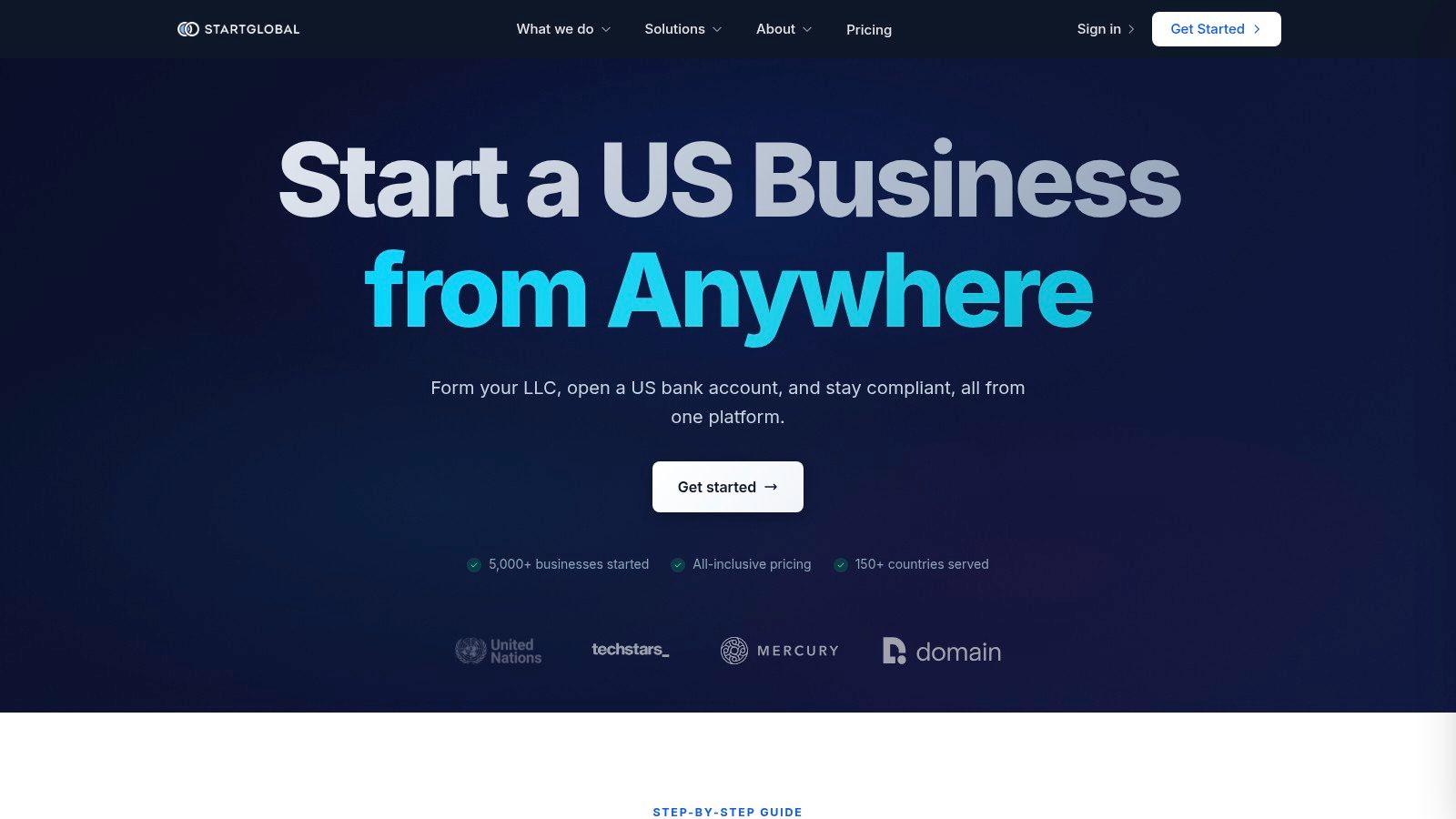
StartGlobal makes sense for founders whose real problem is the work that starts after incorporation. It positions itself as an all-inclusive U.S. formation service with a managed monthly plan and support for banking pathways, so the offer is broader than a one-time filing. Its comparison page is StartGlobal's Stripe Atlas alternative overview.
Formation, EINs, and banking without the usual handoffs
The practical advantage is bundling. StartGlobal handles LLC formation, EIN support, registered agent service, and remote banking help through partners such as Mercury and Relay, which reduces the number of vendors a founder has to coordinate after the state filing. For a founder outside the U.S., that matters because the entity is only one step, while banking, notices, compliance, and tax setup create most of the ongoing burden.
Practical rule: choose StartGlobal if you want fewer handoffs after filing and you accept a managed system instead of assembling a cheaper DIY stack.
Its managed plan also covers annual reports, bookkeeping, and tax filing, so the cost question should include operating work, not just formation. That makes StartGlobal different from low-cost entry providers that keep the first checkout light and add services later. The trade-off is straightforward. If you keep the managed layer over time, your long-term cost will be higher than a lean setup with a separate registered agent.
Who it fits best
StartGlobal fits founders who want one place for formation and operations, especially non-resident founders who need a cleaner path to banking. It also suits founders who care about clear upfront pricing. The platform's pitch is built around a quoted formation price that includes state and government fees, which reduces the usual surprise from add-ons and upsells. That matters more than the sticker on the first screen.
It is less useful if you already have a legal or finance stack in place and only need the cheapest entity filing. In that case, you would be paying for support you do not need. If your first question is whether the company can stay compliant after filing, StartGlobal is one of the few alternatives that treats that as the product.
For founders who care about what comes after formation, the next filter is not another filing page. It is where the company will get found, which is why a launch-and-discovery layer such as the best website for listing a startup belongs after the entity exists, not before.
Operating burden, not just incorporation
The deeper comparison is burden reduction. StartGlobal combines formation, address handling, bookkeeping, tax filing, and banking guidance in one workflow, so it fits founders who want fewer loose ends and less vendor coordination. It is also the better lens for comparing a provider like StartGlobal, an alternative to Stripe Atlas against cheaper filing-first options. The question is not only what it costs to form the company, but what it costs to keep the company usable afterward.
2. Firstbase
Firstbase lands in the middle of the market for a reason. It is not the cheapest filing option, and it is not a legal-document platform built for venture cleanup. It suits founders who want formation plus ongoing operations help, especially after the company exists and the operational work begins.
Back office first, filing second
The value is in the bundle. Firstbase handles LLC or Delaware C-corp formation, registered agent service, EIN support, and compliance reminders, then adds services such as tax filings and mailroom services. That fits founders who expect post-incorporation support and do not want to assemble a separate vendor stack for each task.
Its public plan structure is easier to review than many “call us for pricing” setups. That helps founders compare what is included against what becomes an extra charge later. For a company that wants a legal entity, a mailing layer, and basic compliance help under one roof, Firstbase is a practical operations choice.
Best fit and trade-offs
Firstbase works well when the founder is choosing between one bundled operator and a stack of disconnected vendors. That matters for non-lawyer founders who need the basics handled without tracking every state deadline themselves.
The trade-off is cost creep. If you keep adding bookkeeping, tax, mail, and compliance services, long-term spend will usually exceed a stripped-down setup. Firstbase is strongest when you want the bundle, not just the formation filing.
For founders comparing it with Atlas, the question is whether they want a back-office vendor or a venture-oriented formation flow. If the answer is still unclear, a broader comparison like Stripe Atlas alternatives can help separate filing price from the operating burden that follows.
3. Clerky
Clerky is the cleanest answer for founders who already know they're building a venture-ready company and want the paperwork to hold up later. It's not trying to be the broadest platform. It's trying to make the legal trail tidy from the start.
The legal-document-first choice
That focus matters because venture founders care about more than incorporation. They care about founder stock issuance, 83(b) support, fundraising documents, and downstream cleanup that doesn't make counsel rebuild the company's history later. Clerky is built around those workflows, which is why it's often the more appropriate Atlas alternative when the next milestone is a priced round, not a product launch.
The pricing model is also part of the decision. Recent comparison pages show Clerky at roughly $427 to $799 one-time, depending on the path chosen, which places it above some budget entry tools but still inside the category where founders are paying for more than a bare filing (meow comparison). That range matters because the lower upfront number doesn't automatically mean lower total cost if you need fundraising documents later.
When it beats Atlas
Clerky wins when legal cleanliness is more important than banking convenience. Stripe Atlas is still strong for fast incorporation plus Stripe and bank setup, but Clerky's strength is the company's legal spine. If you're planning SAFEs, option grants, or investor scrutiny, fewer shortcuts at formation often save time later.
Founders who expect due diligence should optimize for document quality first, then convenience second.
Clerky is not for everyone. It's focused on Delaware C-corps, so it's not the broad state-choice or LLC shop that a bootstrapping founder might want. But if your company is on a venture track, the narrowness is the point. You're paying for legal rigor, not for every possible operating layer.
4. doola
doola is best understood as a global-founder operations bundle rather than a pure formation product. It's designed for non-U.S. founders who need help turning a U.S. company into something they can run.
Bundled support for founders abroad
The platform handles LLC or C-corp formation, EIN, registered agent, and compliance support, and then pushes into bookkeeping and tax add-ons. That makes it attractive when the main pain point is cross-border setup, not whether you can click through a filing form alone.
The market context matters here. Independent comparison data shows doola starting from roughly $297 per year plus state fees, which places it in the lower-end subscription tier of the category, even before you decide which ongoing services you keep (meow comparison). That's useful if you want a lower upfront hurdle, but it also means you should watch the subscriptions, because the true cost depends on how much of the managed stack you retain.
Who should look at it
doola fits founders who want more hand-holding than a raw filing provider gives them, especially when they're outside the U.S. and need a practical path to bank access and tax setup. It's less compelling for founders who already know their state, their entity, and their compliance process, because then you're paying for guidance you don't need.
The key trade-off is simple. If you want a global-founder workflow, doola makes sense. If you want to minimize recurring software-like cost, the ongoing bundle can become expensive over time.
5. LegalZoom
LegalZoom sits at the broad end of this list. That helps founders who want formation and legal support from a name they already know, but it gives up the startup-specific workflow some leaner options provide.
Broad legal coverage, less startup depth
LegalZoom covers LLCs, C-corps, and nonprofits, plus formation support, EIN help, registered agent add-ons, compliance tools, and optional attorney consultations. For founders who expect legal needs after incorporation, a single vendor for documents and follow-up can reduce coordination.
It also has a $0 LLC formation entry point, though state fees still apply. That makes it easy to compare against lower-friction filing options, but the longer-term bill depends on which add-ons stay in the cart. For founders who want to avoid surprise recurring costs, that is the main trade-off to watch.
When it makes sense
LegalZoom fits founders who value brand familiarity, broad service coverage, and the option to add legal help later. It also works for businesses that are still deciding whether they need a venture-style formation stack or just a practical way to get started.
It is a weaker fit if you care most about startup-specific legal workflow, equity handling, or tighter control over recurring operating costs. In those cases, a broader menu can become extra noise rather than help. Before you migrate an existing company, verify the entity type, registered agent coverage, state compliance standing, and whether your current documents can move without creating gaps. If formation is only the first step and you want a place to launch and test what comes next, see where to launch a startup in 2026.
6. ZenBusiness
ZenBusiness is one of the clearer choices for first-time founders who want predictable tiers and decent budgeting cues. It doesn't try to be the most advanced formation platform. It tries to make the process easy to understand.
Tiered pricing and budgeting clarity
Its appeal starts with the Starter, Pro, and Premium plans, which make the entry path easier to compare than mystery-box bundles. ZenBusiness also provides state-by-state fee guidance, rush filing options, and compliance reminders, which helps founders budget with a bit more confidence before they file.
That kind of guidance is useful because the true cost of formation is not just the service fee. It includes state charges and ongoing maintenance, and ZenBusiness at least makes those moving parts visible. For founders who want a clean interface and a strong help library, that matters more than a flashy feature list.
Best fit and limits
ZenBusiness is a good fit for someone forming a company for the first time and wanting a smooth, guided path. It's less about venture rigor and more about reducing confusion.
The limit is the same one many tiered products face. Once you start upgrading plans and adding recurring services, the total cost can move away from the first price you noticed. So ZenBusiness is best when you want a straightforward filing experience and you're willing to keep an eye on plan renewal economics.
7. Bizee
Bizee, formerly Incfile, is the budget option that still looks like a serious company rather than a throwaway coupon site. For founders who want the lowest barrier to getting an entity on paper, it stays easy to understand.
Low barrier, familiar workflow
Bizee's main draw is its $0 plus state fee Basic package and the inclusion of one free year of registered agent service with formation. That combination lowers the initial hurdle for cost-sensitive founders who just need the entity and don't want a lot of friction.
It also offers clear package comparisons and compliance alerts, which helps a founder track what comes next after filing. That's important because the cheapest starting point is only valuable if the post-formation steps don't become a blind spot.
Where it fits
Bizee is most useful for bootstrap founders, solo operators, and people who want a no-frills legal entity. It is not trying to be the deepest legal product or the most integrated back-office platform.
The trade-off is the familiar one in this category. Many useful extras sit behind add-ons, so the cost profile changes if you need documents or ongoing support beyond the basic filing. If you're disciplined and only need core formation, Bizee is one of the clearest low-cost options. If you need a bigger operating system, the “cheap” checkout can become a false economy.
8. Northwest Registered Agent
Northwest Registered Agent is the best choice on this list when privacy and reliable registered-agent service matter more than headline price. It's the type of provider founders pick because they don't want their personal details floating around public records.
Privacy is the product
Northwest emphasizes privacy-forward filings, strong human support, and business identity extras like domain, email, phone, and address support. It also includes year-one registered agent service, which is meaningful because registered agent renewals are part of the ongoing operating cost of any entity.
That matters for founders who are planning multi-year ownership and want a cleaner long-term setup. It's less about “cheap today” and more about “less annoying later.” In a market where some services make you hunt for disclosures and add-ons, Northwest's flatter structure is refreshing.
If your home address showing up in formation records bothers you, privacy should beat a small headline discount.
Best fit and limits
Northwest fits privacy-conscious founders, consultants, operators, and small teams that want reliable state coverage and a well-supported filing process. It also works when the founder wants formation and registered-agent continuity without being pushed into a giant bundle of unrelated services.
The limitation is that it isn't always the lowest headline price. The point is not to win the cheapest-sticker contest. The point is to keep personal information protected and keep compliance service predictable over time.
9. BetterLegal
BetterLegal is built for founders who want quick filing and straightforward pricing without a lot of side quests. It's one of the cleanest options for people who don't want to decode a multi-page sales flow.
Fast filing with fewer surprises
Its structure is simple, a 2-business-day formation flow, core formation documents, EIN, operating agreement or bylaws, and banking resolution included up front. That makes it appealing if your main goal is to get the company done quickly and move on.
The platform also keeps optional services simple, including registered agent and state compliance support at published rates. That transparency reduces the chance of checkout surprises, which is exactly what many founders are trying to avoid when they compare Atlas alternatives.
When it's the right move
BetterLegal is a good match for founders who value speed and predictable one-time pricing over a bundled operating system. It's especially useful when the company's needs are straightforward and the founder wants to keep the setup clean.
The downside is that a lot of the broader operational support comes through partners. That can be fine if you already have a stack, but it means BetterLegal isn't trying to be your entire back office. It's a fast formation choice, not a broad operating platform.
10. Stripe Atlas
Stripe Atlas is still the benchmark because it packages incorporation with a fast path to banking and Stripe payments. It's not the only serious option anymore, but it's still the one many founders compare everything else against.
Where Atlas still wins
Atlas remains useful when the priority is speed and immediate operational readiness. Its $500 one-time fee and Delaware C-corp orientation make it a familiar default for founders who want a clean, VC-recognized starting point. That's also why it still shows up as the mental anchor in the category, even as alternatives split into more specialized tiers.
Atlas is no longer the only sensible answer. Independent comparison data shows alternatives now ranging from Clerky's roughly $427 to $799 one-time, to Firstbase at $399 one-time, to Northwest Registered Agent at $39 to $225 one-time, to doola from roughly $297 per year plus state fees, which proves the category is no longer a one-product market (meow comparison). That spread means the right choice depends on whether you want venture readiness, lower upfront cost, or ongoing help.
What Atlas is best for
Atlas is strong for founders who want incorporation, banking, and payments in one motion. It's less compelling if you already know your company's structure and just need stronger legal-document depth, lower recurring cost, or a more operations-heavy bundle.
The useful conclusion is not that Atlas is obsolete. It's that Atlas is now one option among several, and the “best” answer depends on whether you're buying formation convenience, legal rigor, or operational support.
11. Swyft Filings
Swyft Filings is the quick-turn option for founders who want a fast, simple checkout and don't need the provider to become their whole operating stack. It's built for speed and accessibility.
Fast filing, light hand-holding
The service supports LLC, C-corp, S-corp, and nonprofit filings and offers multiple tiers, including a low-cost Basic package. That flexibility makes it attractive for founders who want to file and then manage most of the business themselves.
It also provides EIN, registered agent, and compliance add-ons, plus state-specific filing guides and FAQs. That combination gives founders enough structure to move quickly without forcing them into a more expensive managed layer.
Where it fits in the decision tree
Swyft Filings is a good match for someone who wants a quick filing and is willing to handle operations after the entity exists. It's less ideal if you need a deep post-formation workflow or a strong back-office bundle.
The main caution is the familiar one. Many essential services are add-ons, so the cost can rise once you start building a real operating footprint. Use it when speed and entry cost matter most, but compare renewal pricing before assuming the first checkout tells the whole story.
Top 11 Stripe Atlas Alternatives Comparison
| Product | Core offering | Unique / Standout ✨🏆 | Pricing / Value 💰 | Target 👥 | Quality / UX ★ |
|---|---|---|---|---|---|
| StartGlobal | End‑to‑end US formation + EIN, remote bank pathways, managed ops | ✨ All‑inclusive quoted formation, remote banking support, Neo AI agent 🏆 | 💰 One‑time formation + optional managed monthly plan (transparent fees) | 👥 Non‑US founders needing full remote setup | ★★★★ |
| Firstbase | Guided formation (LLC/DE C‑Corp) + post‑incorp bundles | ✨ Partner banking & compliance bundles, clear plan pages | 💰 Tiered plans with à‑la‑carte upgrades | 👥 Non‑lawyer founders who want ongoing ops help | ★★★★ |
| Clerky | Venture‑grade Delaware C‑Corp incorporation + investor docs | ✨ Lawyer‑grade, YC‑backed workflows to minimize legal clean‑up 🏆 | 💰 Higher upfront, clear one‑time lifetime options | 👥 Startups preparing for priced rounds / investors | ★★★★★ |
| doola | Formation + ongoing back‑office (EIN, RA, bookkeeping) for globals | ✨ Workflows tailored for non‑resident founders, public pricing | 💰 Formation + subscriptions for ongoing services | 👥 Global/solo founders wanting managed operations | ★★★★ |
| LegalZoom | Broad legal services: formation, docs, attorney consults | ✨ Large national platform with extensive legal library | 💰 $0 entry options but add‑ons and higher tiers raise cost | 👥 Founders wanting one vendor for formation + legal needs | ★★★ |
| ZenBusiness | Streamlined formation (Starter/Pro/Premium) + compliance reminders | ✨ Clear tiering, rush filing options for fast turnaround | 💰 Annual plans (recurring); transparent state fee guides | 👥 First‑time founders needing simple, fast filing | ★★★★ |
| Bizee (Incfile) | Budget formation: $0 + state fee entry, free 1st‑year RA | ✨ Lowest‑barrier basic package for cheap entry 🏆 | 💰 $0 + state fee; many useful extras are paid add‑ons | 👥 Cost‑sensitive founders prioritizing price | ★★★ |
| Northwest Registered Agent | Formation + privacy‑focused registered agent services | ✨ Strong privacy stance, flat transparent pricing, human support | 💰 Mid‑range; better multi‑year RA value than $0 providers | 👥 Founders valuing privacy & dependable support | ★★★★ |
| BetterLegal | Fast, flat‑fee formation with EIN + core docs included | ✨ 2‑business‑day turnarounds and predictable one‑time pricing | 💰 One‑time flat fee; optional simple subscriptions for RA | 👥 Founders wanting quick, predictable formations | ★★★★ |
| Swyft Filings | Quick, budget‑friendly filings for multiple entity types | ✨ Low‑cost Basic tier and clear state guides for DIYers | 💰 Competitive entry; many add‑ons for extras | 👥 Founders who will self‑manage operations post‑formation | ★★★ |
Choose the Provider That Matches Your Next Filing, Not Your First Click
The cleanest way to choose is by founder situation, not by brand familiarity. Indie makers and solo founders usually do best with Bizee, ZenBusiness, or BetterLegal when they want a simple filing and can manage the rest themselves. Venture-oriented startups should look first at Clerky or Stripe Atlas, with Firstbase as a stronger operations-heavy alternative when they want more post-incorporation support. Non-U.S. founders are usually better served by StartGlobal or doola, because the issue is often banking access and ongoing operational support, not just the filing itself. Privacy-conscious founders should look hard at Northwest Registered Agent, and cost-conscious founders should compare Bizee and Swyft Filings before they pay for layers they won't use.
The two-year cost lens is where most comparison pages get lazy. Don't compare only the headline formation price, compare state fees, EIN handling, registered-agent renewals, compliance work, tax services, and add-ons over time. The reason is simple, a cheap front door can become a busy hallway of subscriptions once the company needs reminders, filings, mail handling, bookkeeping, or foreign qualification support. For a Delaware C-corp, recurring obligations matter even more, so founders should treat the first-year setup as only part of the budget.
If you're migrating an existing company, the first step is to confirm the required entity and state before changing anything. Then inventory the formation documents, ownership records, EIN paperwork, tax filings, and compliance history, because preserving the company's original trail matters if a bank, investor, or accountant asks for proof later. After that, verify the registered-agent change, update the mailing address wherever it appears, move the banking and payment accounts, review contracts for any foreign qualification or jurisdiction issues, and keep the old history intact rather than rebuilding the entity from scratch.
Before you cancel anything, check the renewal date, the cancellation terms, and whether any filing or document access disappears when the subscription ends.
A simple migration checklist keeps mistakes from compounding. Confirm the next renewal date, export every compliance record you can, save ownership and tax documents in one place, and make sure the new provider won't break your access to notices, filings, or entity history. If a provider offered a registered agent or compliance subscription, assume that service is part of your legal continuity until you've replaced it cleanly.
After formation, discovery becomes its own job. That's where ScrollLaunch fits, not as legal advice, not as incorporation support, but as a post-launch visibility layer for indie makers and SaaS founders who want permanent product pages, weekly leaderboards, SEO-ready metadata, and distribution tools that help a new company get found. If your entity is already set and you want a place to launch, index, and keep earning visibility, publish there next.