The Challenge of Maintaining Engineering Standards
In today’s fast-paced software development landscape, engineering teams face significant challenges when it comes to maintaining consistent coding standards. With the increasing adoption of AI coding agents, such as GitHub Copilot and Claude, the problem has become even more pronounced. These agents write a significant portion of code, yet they often lack access to the engineering standards that guide human developers. Standards that reside in wikis, review comments, and the minds of a few senior engineers often fail to reach these agents, leading to fragmented practices and potential security vulnerabilities. Groundrule aims to address these issues by centralizing and operationalizing engineering standards, making them accessible and enforceable across all coding agents.
The scattered nature of coding standards can lead to a variety of problems: inconsistent code quality, increased technical debt, and a slow-down in development cycles due to manual reviews. Engineering teams often find themselves in a cycle of fixing the same issues repeatedly, as coding agents produce code that doesn't adhere to established standards. This results in a lack of trust in AI-generated code and can ultimately hinder productivity. With Groundrule, teams can ensure that every coding agent adheres to the same set of rules, thus improving code quality and accelerating development timelines.
What is Groundrule?
Groundrule is an innovative platform that transforms your engineering standards into a single, coherent rulebook that every coding agent can read and follow. It centralizes the rules and checks them against every pull request (PR), ensuring that the standards are not only documented but also actively enforced. Groundrule allows teams to write a standard once, detailing its requirements, rationale, and possible fixes, while also assigning severities and stages for implementation.
The beauty of Groundrule lies in its ability to sync these standards across various coding agents. With a simple command, groundrule sync, all necessary files such as AGENTS.md, CLAUDE.md, Cursor rules, and Copilot instructions are automatically generated from the same source. Moreover, Groundrule includes a built-in mechanism for coding agents to validate their own work before finalizing any changes, thus promoting a culture of compliance and quality from the outset.
The Problem Groundrule Solves
The primary pain point that Groundrule addresses is the inconsistency and inaccessibility of engineering standards across teams using AI coding agents. Many organizations rely on disparate systems to manage their coding guidelines, resulting in the following challenges:
- Fragmented Standards: Engineering standards often live in multiple places—wikis, Git comments, and personal notes—making it difficult for coding agents to access and adhere to them.
- Human Error: With standards scattered, human reviewers are tasked with catching mistakes, leading to repeated errors and increased review times. This also creates a dependency on senior engineers, which can hinder team scalability.
- Compliance Gaps: Without a centralized rulebook, it becomes challenging to enforce compliance across all coding agents, leading to potential security vulnerabilities and technical debt.
Groundrule consolidates these standards into one accessible rulebook, enabling every coding agent to adhere to the same guidelines, thereby reducing errors and enhancing code quality. Teams can now trust that their AI coding agents will produce code that meets their established engineering standards, ultimately streamlining the development process.
How Groundrule Works
Groundrule operates through a series of straightforward steps that allow teams to define, import, review, teach, and enforce their coding standards efficiently. Here’s a typical workflow:
- Define Your Standards: Write a standard once, clearly outlining its requirements, rationale, severity, and how to address violations.
- Import Existing Guidelines: Utilize Groundrule’s scanning feature (
groundrule scan) to read existing coding practices and standards from your repositories and documentation. This feature identifies rules like layer boundaries and package conventions, making it easy to incorporate what you already have. - Create a Rulebook: Use curated packs to begin with common standards for security, languages, and infrastructure. Groundrule offers 179 maintained standards in 14 packs, covering various programming languages and frameworks.
- Sync with Coding Agents: Execute the
groundrule synccommand, which writes all the necessary instructions to coding agent files. This ensures that every agent reads from the same set of standards. - Self-Check Mechanism: With the MCP server, coding agents can validate their compliance before finalizing changes. This step promotes accountability and reduces reliance on manual reviews.
- CI Integration: Groundrule runs deterministic checks during Continuous Integration (CI) on every pull request and commit, identifying any deviations from the established standards. Each failure includes evidence of what went wrong and how to fix it.
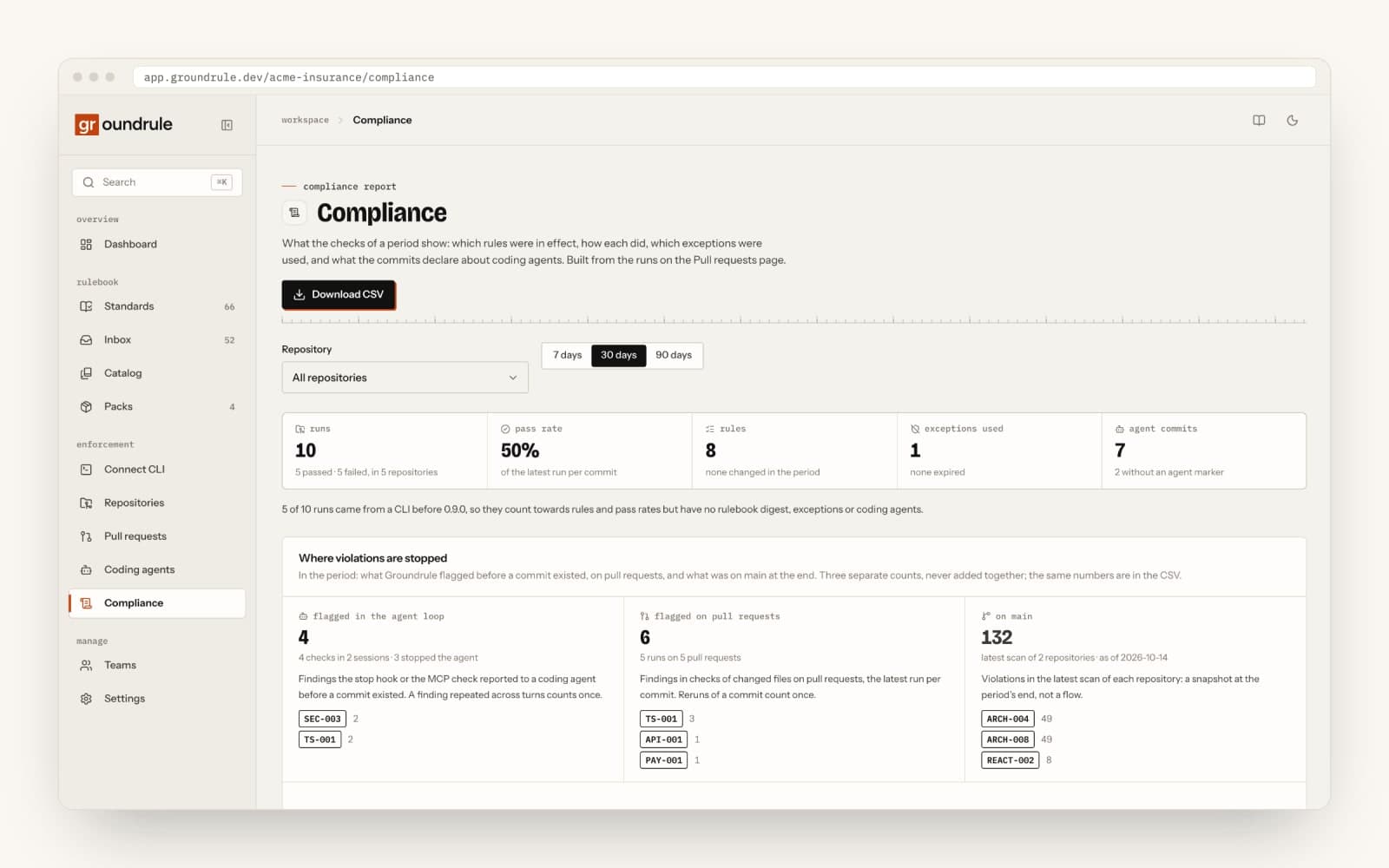
- Rollout and Reporting: As rules are enforced, teams can track their effectiveness through compliance reports, which provide insights into pass rates, exceptions, and rule adherence across repositories.
By following these steps, Groundrule effectively integrates your engineering standards into your development workflow, ensuring that every coding agent aligns with your organization’s best practices. For more details on how Groundrule functions, visit Groundrule.
Key Features of Groundrule
Groundrule is packed with features designed to enhance code quality and streamline engineering processes. Below is a summary of its key features:
- Centralized Rulebook: Consolidates all engineering standards in one accessible location, ensuring uniformity across coding agents.
- Automated Sync: The
groundrule synccommand automatically updates coding agent instruction files, eliminating manual updates and reducing errors. - Self-Checking Agents: Coding agents can validate their compliance against established rules before submitting code changes.
- Deterministic Checks in CI: Groundrule performs checks on every pull request and commit, providing detailed reports on compliance and violations.
- Compliance Reporting: Offers insights into adherence rates, exceptions, and overall rule effectiveness, allowing teams to make informed decisions.
- Open Source Core: The core functionality is open-source under Apache-2.0, enabling teams to customize and extend it without the need for an account.
These features are designed to not only improve adherence to coding standards but also to foster a culture of quality within engineering teams. They reduce the burden on human reviewers and ensure that coding agents can work independently while still adhering to established best practices.
Who Groundrule is For
Groundrule is primarily designed for engineering teams that are integrating AI coding agents into their development processes. The target users include:
- Platform Engineers: Professionals responsible for the architecture and infrastructure of the platform, ensuring that coding standards align with technical requirements.
- Staff Engineers: Senior engineers who oversee code quality and mentor junior developers, ensuring that everyone adheres to established standards.
- Tech Leads: Individuals who lead engineering teams and are responsible for maintaining coding quality, architecture, and security standards.
- Engineering Managers: Managers who oversee development teams and need a reliable way to enforce standards across multiple projects and repositories.
These personas benefit from Groundrule by having a centralized, accessible rulebook that enhances collaboration and ensures consistency across teams. With Groundrule, they can easily onboard new coding agents, monitor compliance, and maintain high code quality without being bogged down by manual processes.
Groundrule vs Alternatives
When comparing Groundrule to its alternatives, it’s essential to consider its unique offerings and trade-offs. Groundrule competes with various tools and practices, including:
- Handwritten AGENTS.md and CLAUDE.md Files: While these allow for custom rules, they are prone to inconsistencies and require constant manual updates. Groundrule automates this process, ensuring all coding agents are synchronized with the latest standards.
- Cursor Rules and GitHub Copilot Custom Instructions: These tools provide some level of customization for coding agents but lack the comprehensive compliance checking and reporting features that Groundrule offers. Groundrule’s deterministic checks and self-validation for agents set it apart.
- ESLint + Custom Rules: ESLint is a popular tool for enforcing JavaScript coding standards. However, it is limited to JavaScript and doesn’t provide the same level of integration across multiple languages or agents as Groundrule does.
- SonarQube and Semgrep: These tools focus on static code analysis but do not offer the same centralized rule management and enforcement capabilities as Groundrule.
In summary, while there are several tools available for managing coding standards, Groundrule stands out due to its centralized rulebook, automatic syncing, and comprehensive compliance reporting. It effectively combines the best features of traditional linting and code analysis tools with modern AI capabilities, making it a valuable addition to any engineering team.
Real-World Use Cases
Groundrule can be applied in various scenarios to improve coding standards and compliance. Here are a few specific use cases:
- Onboarding New Coding Agents: When a new coding agent is introduced into a project, Groundrule can quickly sync the relevant standards, ensuring that the agent adheres to established guidelines from day one.
- Architecture Rule Enforcement: In projects with strict architectural guidelines, Groundrule can enforce layer boundaries and package dependencies, preventing architectural drift during development.
- PR Compliance Checks: Engineers can utilize Groundrule to automatically check pull requests against the defined standards, reducing the need for manual reviews and allowing for faster code merges.
- Security Baseline Enforcement: Groundrule can help teams implement security best practices by automatically enforcing security standards, thus reducing the risk of vulnerabilities in the codebase.
- Agent File Drift Detection: Over time, AGENTS.md and other agent files can drift from the original standards. Groundrule detects these discrepancies and ensures that all coding agents are aligned with the latest guidelines.
These use cases illustrate how Groundrule is not just a tool for managing coding standards but a comprehensive solution for fostering a culture of quality and compliance within engineering teams.
Getting Started with Groundrule
To experience the benefits of Groundrule firsthand, getting started is easy. Visit Groundrule to explore the platform and access a free workspace that never expires. You can quickly set up Groundrule in your development environment by following these steps:
- Go to Groundrule and sign up for a free account.
- Follow the documentation to install the Groundrule CLI using Node.js.
- Run the command
npx @groundrule/cli initto create a configuration file for your workspace. - Use
npx @groundrule/cli syncto generate the necessary agent files based on your defined standards. - Start using Groundrule to check compliance and enforce your engineering standards across your coding agents.
By following these steps, you’ll be well on your way to enhancing code quality and compliance within your engineering team.
FAQ
What is Groundrule?
Groundrule turns engineering standards into one rulebook, writes it into every coding agent's instruction files (AGENTS.md, CLAUDE.md, Cursor rules, Copilot instructions), and checks every pull request against it with findings that name the standard, the evidence, and the fix.
Which coding agents does Groundrule support?
Groundrule supports any agent that reads AGENTS.md, as well as Claude Code (CLAUDE.md), Cursor (.cursor/rules), and GitHub Copilot (copilot-instructions.md). The groundrule sync command writes all of them from the same source, and an MCP server lets agents look up and check their work.
Do I have to write all the rules myself?
No, you can start from curated packs that include security baseline, TypeScript/Node, Python, Go, Java/Spring, React, architecture, Docker, Kubernetes, Terraform, GitHub Actions, and testing. Alternatively, you can run groundrule scan, which reads existing rules from your repositories and documentation, proposing them with evidence.
How are rules checked?
Rules are checked deterministically by default. Groundrule performs checks on imports, layout, metrics, files, regex, and dependencies without relying on an LLM. Each finding states what failed, which standard it pertains to, the file and line, and how to fix it. AI-answered checks are clearly labeled.
Can I use Groundrule for open-source projects?
Yes, the core functionality of Groundrule is open-source under the Apache-2.0 license and works without an account. Open-source projects can use Groundrule for free.
Bottom Line
In a world where coding agents are becoming increasingly integral to software development, having a comprehensive, accessible set of engineering standards is crucial. Groundrule provides the tools necessary to unify and enforce coding standards across all coding agents, ensuring consistency, quality, and compliance in every pull request. By turning scattered standards into a single, manageable rulebook, Groundrule not only enhances the capabilities of coding agents but also fosters a culture of accountability and excellence within engineering teams.
For more information and to get started with Groundrule, visit Groundrule today.