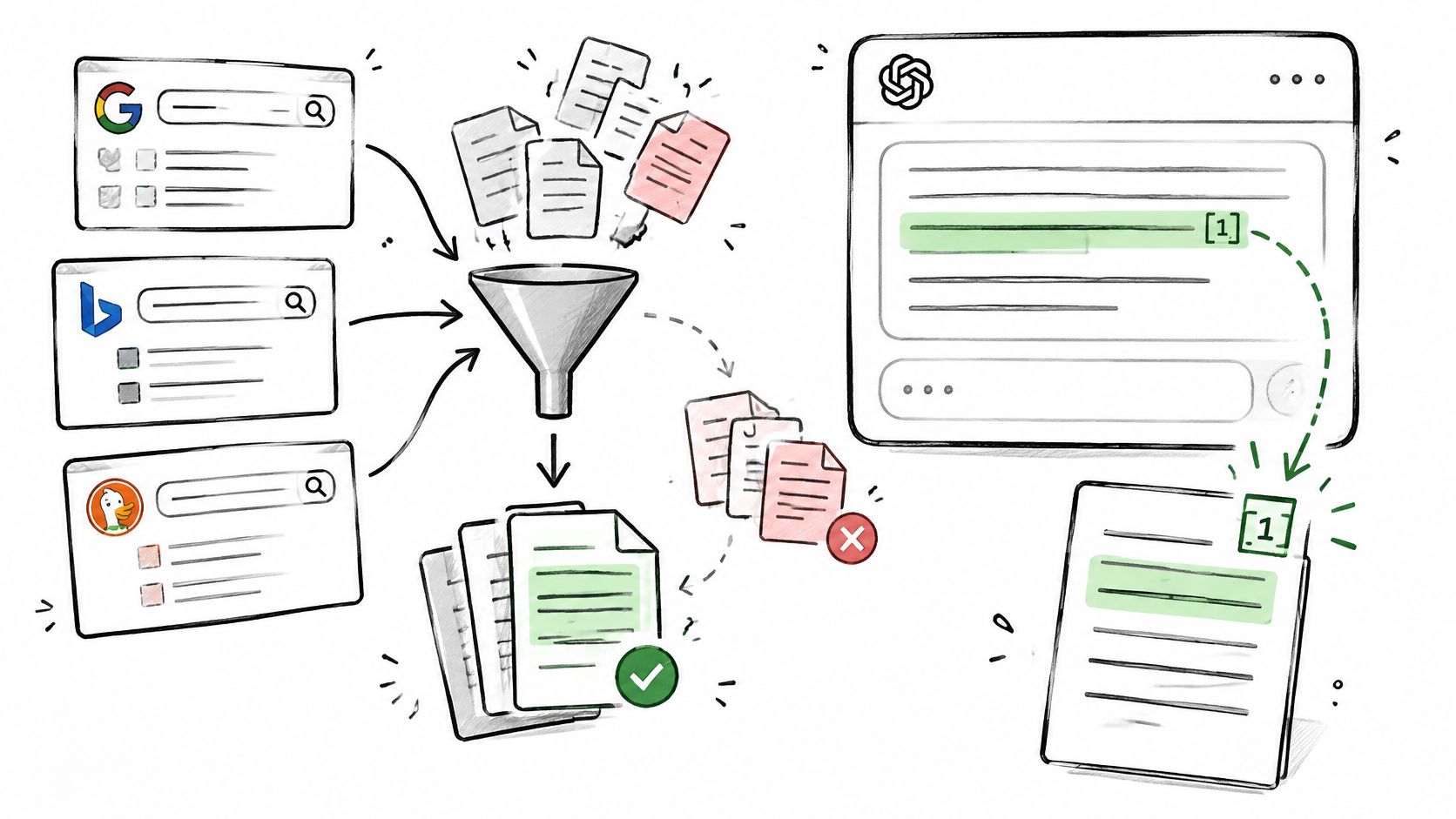
You ask an AI assistant for the best tool in your category. It names a competitor, adds a neat numbered link after the sentence, and says nothing about your product. Your page ranks on Google, your pricing is public, and your launch post got shared. So why did the assistant choose someone else, and how would you even tell whether that link proves anything?
That question is the useful starting point for AI citations. A citation isn't a trophy you collect once. It's a claim you can inspect, sentence by sentence, to see whether the assistant found your page, attached it to the right statement, and represented that statement accurately.
Table of Contents
- What AI Citations Are and Why They Matter
- How Citation Behavior Differs Across AI Search Tools
- Why Ranking Does Not Guarantee an AI Citation
- Drafting Pages Built to Be Cited With Outrank
- Misconceptions About AI Citations to Drop
- How to Test Whether an AI Tool Cites You Correctly
- Making Your Pages Easy to Find and Cite
- Set Up a Recurring AI Citation Review
What AI Citations Are and Why They Matter
An AI citation is a source link or reference that an AI answer attaches to a specific claim. It works like a footnote in a research paper. The footnote points the reader to evidence for that sentence, rather than vaguely supporting the whole page.
A mention works differently. It's a name dropped in conversation, with no evidence attached. If an answer says "Tool X is popular for small teams" and gives no link, Tool X was recognized, but no page was put forward as proof. The reader has nowhere specific to verify the statement or click through.
Four Terms People Often Blur Together
A mention means the brand or product appears in the answer text. A citation means a linked or numbered source is attached to a claim. A search ranking means a page holds a position in a results list for a query. Those three describe visibility in different systems, and none of them proves the answer is right.
That's why claim support needs to sit alongside them. Claim support asks whether the cited page says what the answer claims it says. If the answer states a price, the cited page should state that price, for that plan, with the same conditions and date. If it doesn't, you have a citation without reliable attribution.
The ALCE benchmark makes that distinction measurable by separating citation recall, whether an answer is fully supported by its cited passages, from citation precision, whether the cited passages are relevant rather than extraneous. In benchmark evaluation, ALCE reported 85.1% accuracy for citation recall and 77.6% for citation precision. In plain terms, an answer can include a supporting source and still attach extra citations that add little.
A citation shows the assistant attached a source. It doesn't, by itself, show the source backs the sentence.
Why This Matters for Buyers and Founders
Cited sources can send referral clicks, but the bigger effect happens before any click. The cited set shapes which products a buyer considers, which prices they treat as normal, and which features they think a category requires. If a competitor is cited for a capability you also offer, the buyer may never reach your page to compare.
The reverse problem matters too. If you're cited for an outdated price or a feature you've retired, the citation creates work instead of trust. A prospect arrives expecting one thing, finds another, and discounts the rest of your page. Counting citations without checking them hides that risk.
Treat citation as a claim-level outcome instead. For each important answer, ask three questions. Were you mentioned? Were you linked? Does the linked page support the exact statement made about you? That sequence turns a vague visibility goal into something you can test and improve.
| Term | What It Is | What It Proves | Example |
|---|---|---|---|
| AI mention | Brand or product named in the answer text | Recognition only | 'Tool X is popular for small teams' with no link |
| AI citation | Linked or numbered source attached to a claim | The source was retrieved and attached | A numbered link after a pricing sentence |
| Search ranking | Position in a search results list | The page is crawled and judged relevant | Position 4 for a category query |
| Claim support | The cited source actually backs the statement | The attribution is accurate | The cited page states the same price and date |
How Citation Behavior Differs Across AI Search Tools
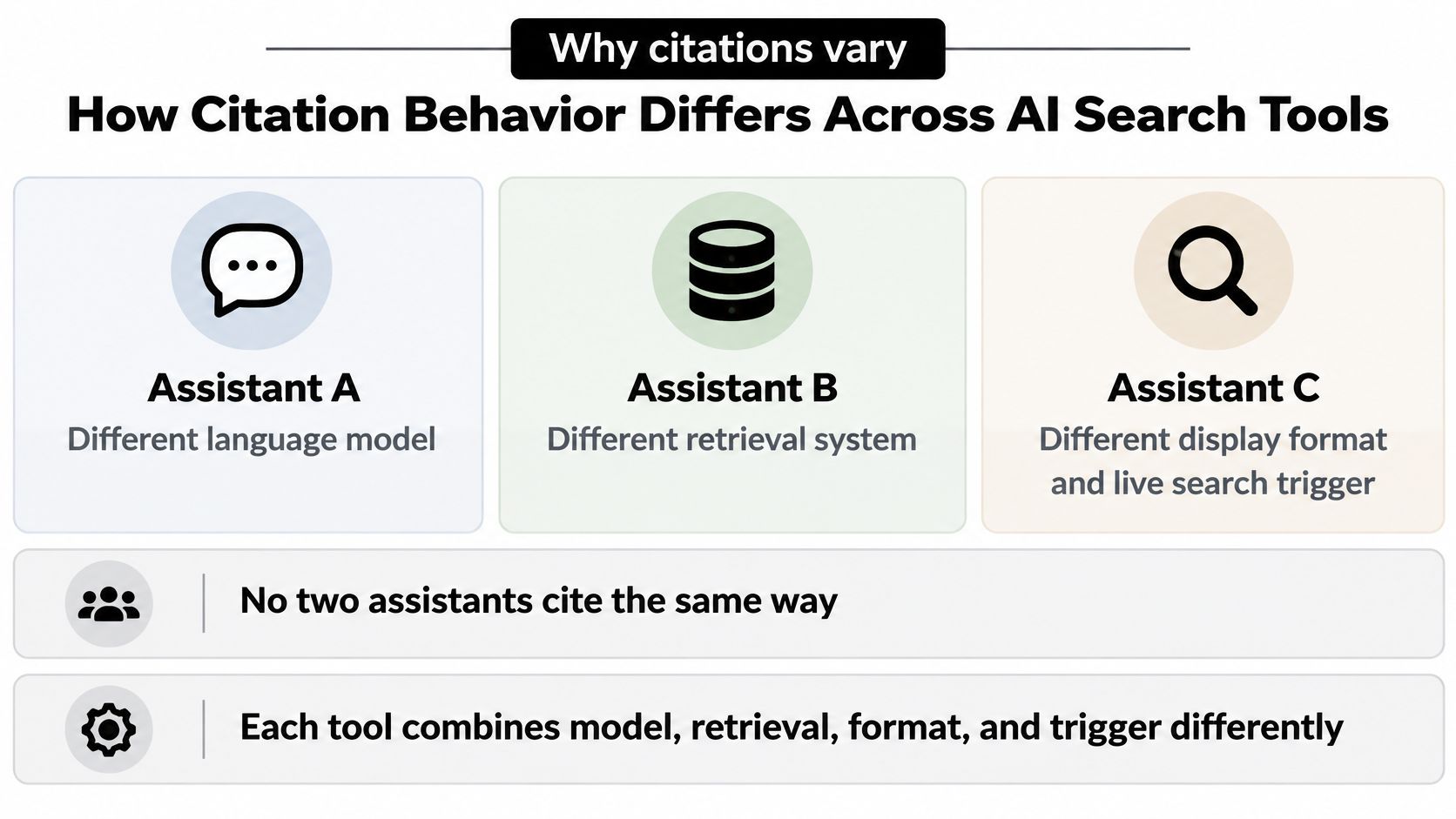
No two assistants cite the same way. Each one pairs a language model with its own retrieval system, its own display format, and its own trigger for running live search. Change any of those parts and you can get a different source set for the same question.
That difference is also why a single screenshot proves very little. A result from one tool, in one mode, on one day tells you about that combination. It doesn't describe your visibility everywhere else.
ChatGPT and Claude Depend on Search Mode
ChatGPT shows inline source links and a source panel when web search runs. Search tends to run for recent or niche queries, but the mode and the question affect whether it happens at all. Run the same prompt with search on and off and you'll often be comparing two different systems, one retrieving pages and one relying on what the model already knows.
Claude shows citations alongside the answer when web search is enabled. That makes the on or off state essential context for any result you record. If you don't note it, a later change in sources may look like a visibility shift when it's really a settings change. Background on where model knowledge comes from helps here, so our guide to AI training data is worth reading before you interpret a no-search answer as a retrieval failure.
Gemini and Google AI Overviews Sit Closer to Google Search
Gemini grounds answers in Google Search results for queries that need current information. Its citations often track Google visibility more closely than the other assistants, so compare its source list against your Google rankings for the same wording. Close doesn't mean identical, though. Gemini still selects sources for a generated answer rather than reproducing a results page.
Google AI Overviews show source cards beneath a summary, and they appear on only a subset of queries. Start by checking whether an overview appears at all for your prompt, then whether your page ranks in the top 10. If there's no overview, you haven't lost a citation. The surface wasn't there for that query.
Perplexity Is the Clearest First Test
Perplexity runs search on nearly every query and shows numbered sources on most answers. That makes it the easiest place to see whether your page is being pulled into the retrieved set at all. Count how often your domain appears as a numbered source across your core prompts, then open the claims attached to those numbers.
Start where your audience asks questions. If buyers tell you they use ChatGPT, begin there and record the mode. If you don't know, begin with Perplexity for visibility, then verify the important prompts in the other tools separately. Never generalize one tool's results to another.
| Tool | How Citations Appear | When Sources Are Pulled | What to Check |
|---|---|---|---|
| ChatGPT | Inline source links and a source panel | When web search runs, often for recent or niche queries | Test with search on and off |
| Claude | Citations shown alongside the answer | When web search is enabled | Confirm search is on before recording results |
| Gemini | Source links drawn from Google Search grounding | For queries that need current information | Compare with your Google rankings |
| Perplexity | Numbered source links on most answers | Search runs on nearly every query | Count how often your domain appears as a numbered source |
| Google AI Overviews | Source cards beneath the summary | On a subset of queries only | Check whether the page ranks in the top 10 |
Why Ranking Does Not Guarantee an AI Citation
A shop on a busy high street is easy to find. A guidebook writer still has to choose which shop to recommend for a specific need, and they may pick a different one even when both are listed on the same street. Ranking puts you on the street. Citation means the guide chose you as evidence.
The robot with a city guide below captures that separation between being listed and being recommended.
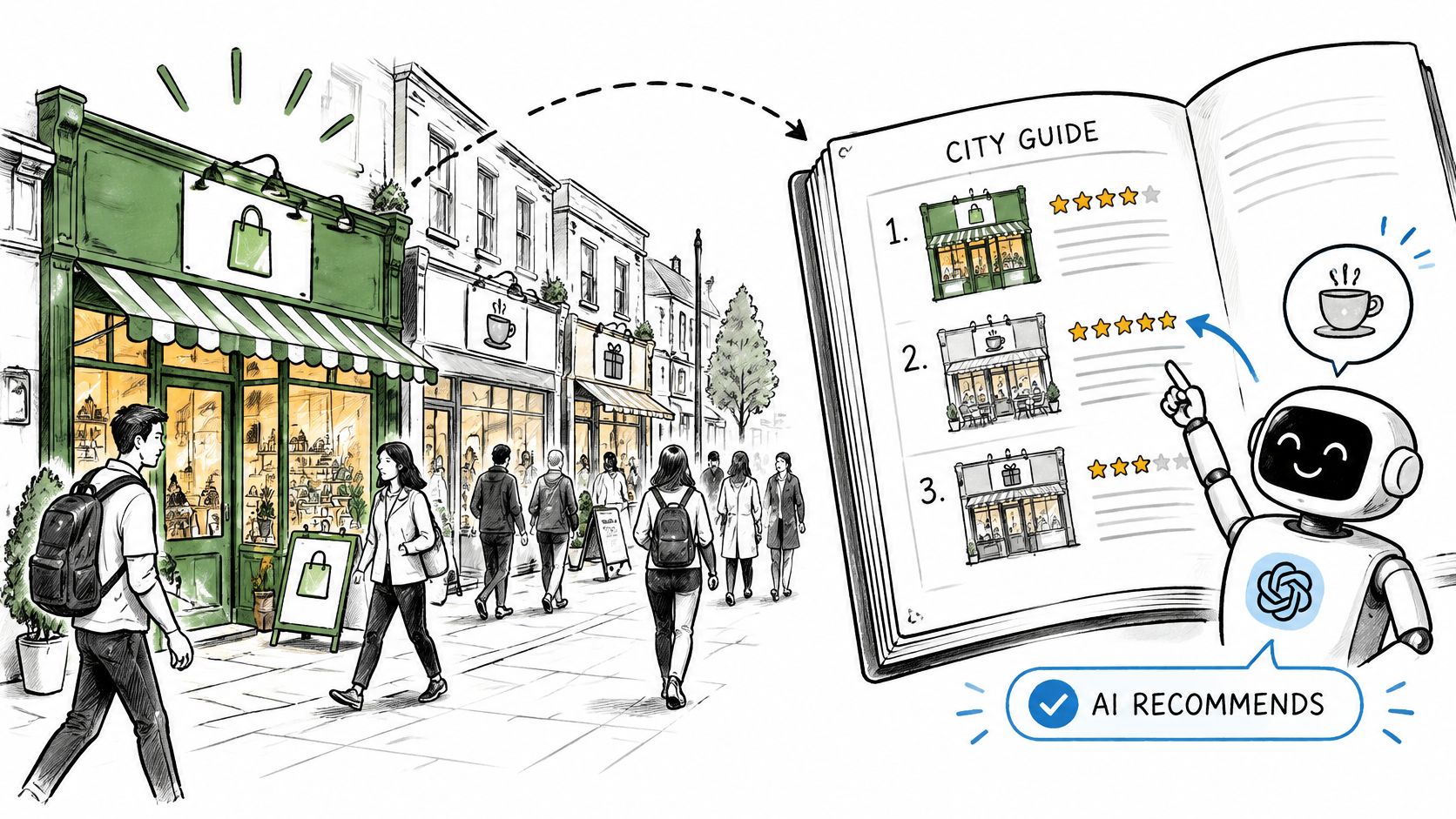
AI systems generally retrieve candidate pages first, then select the few that best support an answer. Discoverable and selected are different steps. Research in Information Systems Frontiers on generative search indicates citations remain partly connected to ranked visibility while reallocating exposure toward a narrower set of sources rather than reproducing the top results.
Structured data doesn't settle that selection either. Schema helps machines read fields on your page, which is useful, but being machine-readable isn't the same as being the best evidence for a particular sentence. Treat schema as a clarity step, not a citation switch.
Four Reasons a Ranked Page Gets Skipped
- Prompt wording points elsewhere: The buyer asks for alternatives, pricing, or a use case your page doesn't address in those terms.
- Source type does not match: The answer needs independent evidence, documentation, or research, and your page is a sales page.
- Content is stale: Prices, features, or dates look old, so a fresher source gives the assistant a safer passage to use.
- Answer is buried: Your first lines set context instead of answering the question, so the retrieved passage doesn't match the claim.
Scale makes the source mix worth noticing. The Muck Rack Generative Pulse report covered by Yahoo Finance found nearly 99% of links cited in AI-generated responses came from non-paid sources, while more than 84% came from earned or third-party sources such as journalism, government and nonprofit websites, academic research, encyclopedic resources, and third-party corporate pages. Your presence in independent references can therefore shape your citation odds as much as your own ranking does.
The short video below walks through how answer engines narrow a broad retrieved set down to a handful of cited sources.
A diversified footprint holds up better than any single tactic. Keep a clear first-party page for your own facts, and earn credible independent references that describe the same product in consistent terms. If one surface changes, you still have evidence elsewhere.
Drafting Pages Built to Be Cited With Outrank
A citable page reads like a lab notebook: each claim has a date, a source, and a place where the evidence sits. AI drafting tools can produce long drafts and integrate with common publishing platforms, which helps with speed. The part they cannot do is decide whether a claim about your product is true. Verify every claim before publishing.
When Outrank or a similar tool gives you a draft, treat it as a stack of unverified assertions. Break each paragraph into single claims: price, feature, limit, comparison, launch date. Keep a claim only if the page itself can show the proof near the sentence, because an assistant may lift that passage without the surrounding context.
Then score the outcome three ways. Mentioned means your name appears. Linked means the answer points to your URL. Supported means the cited page contains the statement the assistant made. A page can win the first two and fail the third, which is the failure that teaches a model to distrust you.
A practical test is to paste a draft into a blank document and underline every checkable sentence. If a line needs a sales call, a private dashboard, or a guess to confirm it, rewrite it or cut it. For a drafting-stage workflow built around AI citations, Outrank is a useful reference, but the editorial sign-off stays with you.
Misconceptions About AI Citations to Drop
Four beliefs cause most of the wasted effort in this area. Each holds a grain of truth, which is why it survives, and each pushes you toward measuring the wrong thing. One distinction helps before the list: a citation can mean your brand was mentioned, your URL was linked, or your page genuinely supports the sentence it sits beside. Those are three different outcomes, and only the third is evidence.
More citations mean more trust. A large-scale citation evaluation framework reported that leading language models maintained link-validity rates above 94% and topical-relevance rates above 80%, yet factual accuracy of the cited claims ranged from only 39% to 77%. Working links on the right topic can still sit beside inaccurate statements. Your action is to score each citation's claim as supported, partly supported, or unsupported, and track that score next to your citation count.
Schema markup guarantees citations. Structured data helps a machine parse your pricing, category, and FAQ fields, but the assistant still has to select your page as evidence for a specific answer. Keep the markup for readability, then fix the claims themselves so each one is exact, dated, and placed beside its supporting text. Readability gets you understood. Evidence gets you chosen.
Practical rule: Never report a citation count without a claim-support score beside it. Volume alone can rise while accuracy stays weak.
One tool's results predict the others. The model, retrieval layer, display format, and search trigger differ across ChatGPT, Claude, Gemini, Perplexity, and Google AI Overviews, so a numbered source in Perplexity may be absent from Gemini for identical wording. Your action is to run each tool separately and record the mode used, especially whether web search was on.
AI citations work like backlinks. A backlink persists in a link graph and carries search equity over time, while a citation is a per-answer event. It can disappear when the model changes, the retrieved set changes, or a fresher page replaces yours. Your action is to schedule a recheck instead of treating one appearance as a permanent asset.
Dropping these four beliefs changes your to-do list. You stop chasing a bigger number and start checking whether each citation is a mention, a link, or genuine support, then build pages whose claims survive inspection across tools and across time.
How to Test Whether an AI Tool Cites You Correctly
A citation can look convincing and still mislead. The Delft University of Technology study "Correctness is not Faithfulness in Retrieval Augmented Generation" reported that up to 57% of citations in the tested systems lacked faithfulness. Faithfulness means the cited source supports the claim, rather than being topically related or added after the answer was effectively written.
That finding reframes the job. You need two measures, not one. Was the source cited, and does the source support the associated statement? The procedure below gives you both with nothing more than a spreadsheet and an hour.
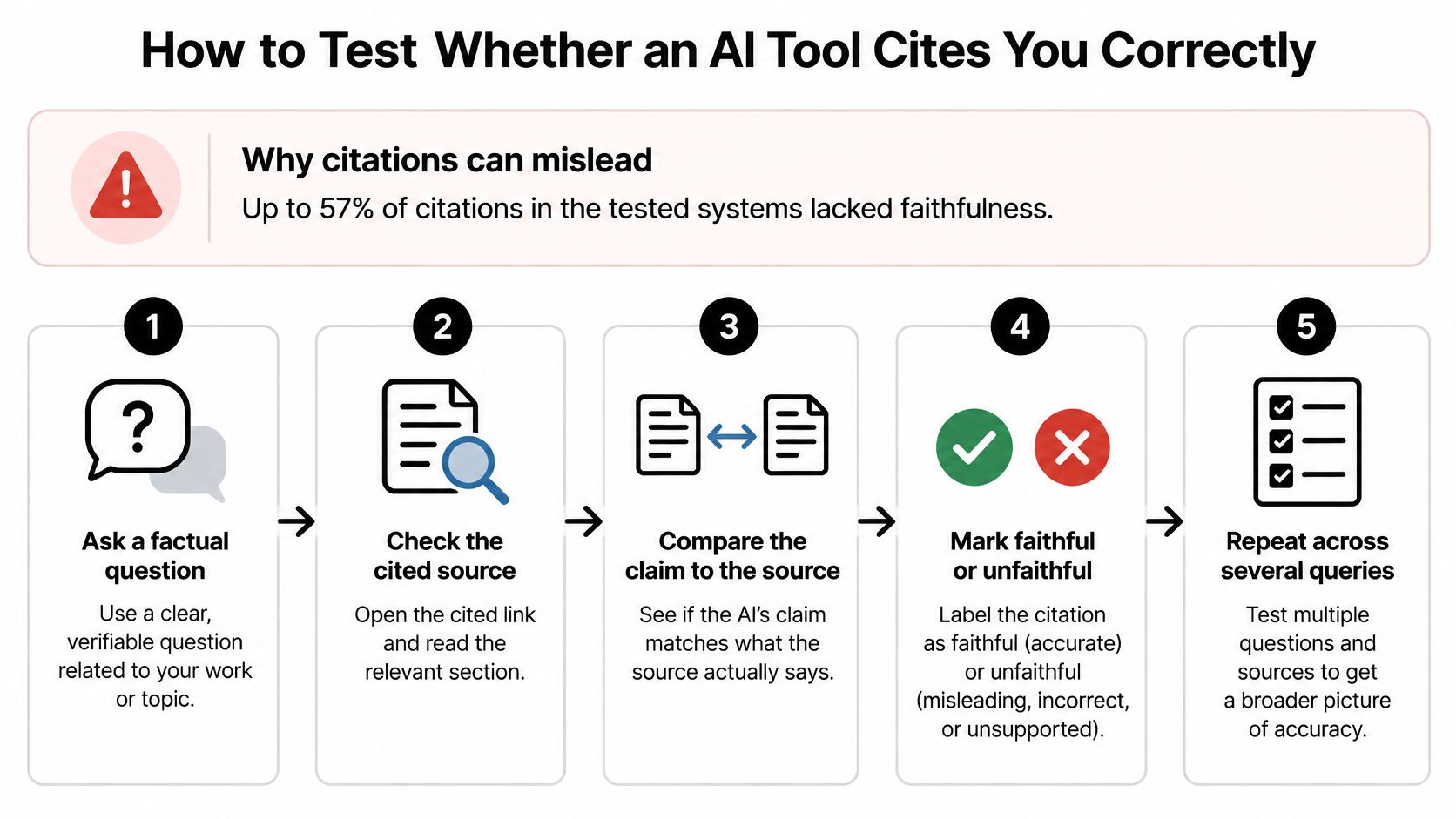
A Six-Step Claim-Level Test
- Build your prompt list: Write 10 prompts a real buyer would type, mixing category questions ("best invoicing tool for freelancers"), comparison questions ("Tool X vs Tool Y pricing"), and problem questions ("how do I track expenses across clients").
- Run every tool separately: Ask each prompt in ChatGPT, Claude, Gemini, and Perplexity. Record whether search was enabled for each run, because mode changes the source set.
- Record your status: For each answer, note whether your domain is cited, mentioned without a link, or absent. Copy the exact sentence about your product.
- Open each cited source: Find the precise sentence on the cited page that matches the AI claim. Don't accept a page that's merely about the same topic.
- Score the claim: Mark it supported, partly supported, or unsupported. Check qualifiers, dates, and numbers word by word, since "starts at" and "costs" make different promises.
- Repeat monthly: Run the same prompts with the same wording and log what changed, including new sources, lost citations, and altered claims.
Say an answer cites your pricing page and states a monthly figure. Open the page and search for that figure. If the page shows it as an annual-billing rate and the answer drops the condition, score it partly supported. The number exists, but the qualifier that makes it true is missing. That's a page wording problem you can fix.
If you can't find the sentence that proves the claim, score it unsupported. Close enough on topic isn't support.
Record outcomes in a sheet from the first run, not after you've fixed things. The table below turns each result into a next move, and it only works if your baseline reflects what buyers currently see.
| Result | What It Means | Next Move |
|---|---|---|
| Cited and claim supported | Attribution is working | Keep the claim current and dated |
| Cited but claim unsupported | Page wording is vague, outdated or overgeneral | Rewrite the claim with exact figures and dates |
| Mentioned without a link | Recognized but not sourced | Publish a clear, linkable reference page |
| Absent from answers | Not retrieved or not selected | Check indexing first, then broaden source diversity |
Making Your Pages Easy to Find and Cite
Citable pages make each important claim easy to verify. Retrieval systems pull passages, not whole pages, so the assistant needs a passage where the fact and its evidence sit together. If your best evidence is three paragraphs away from your claim, the retrieved chunk may contain one without the other.
One tested signal shows how much wording can matter. A 2024 study by Princeton University, Georgia Tech, and IIT Delhi found that adding direct quotations to web content produced a 41% lift in the amount of content used by AI answer engines compared with an unoptimized baseline. Treat that as something to replicate and measure on your own pages, not a guaranteed result for every site.
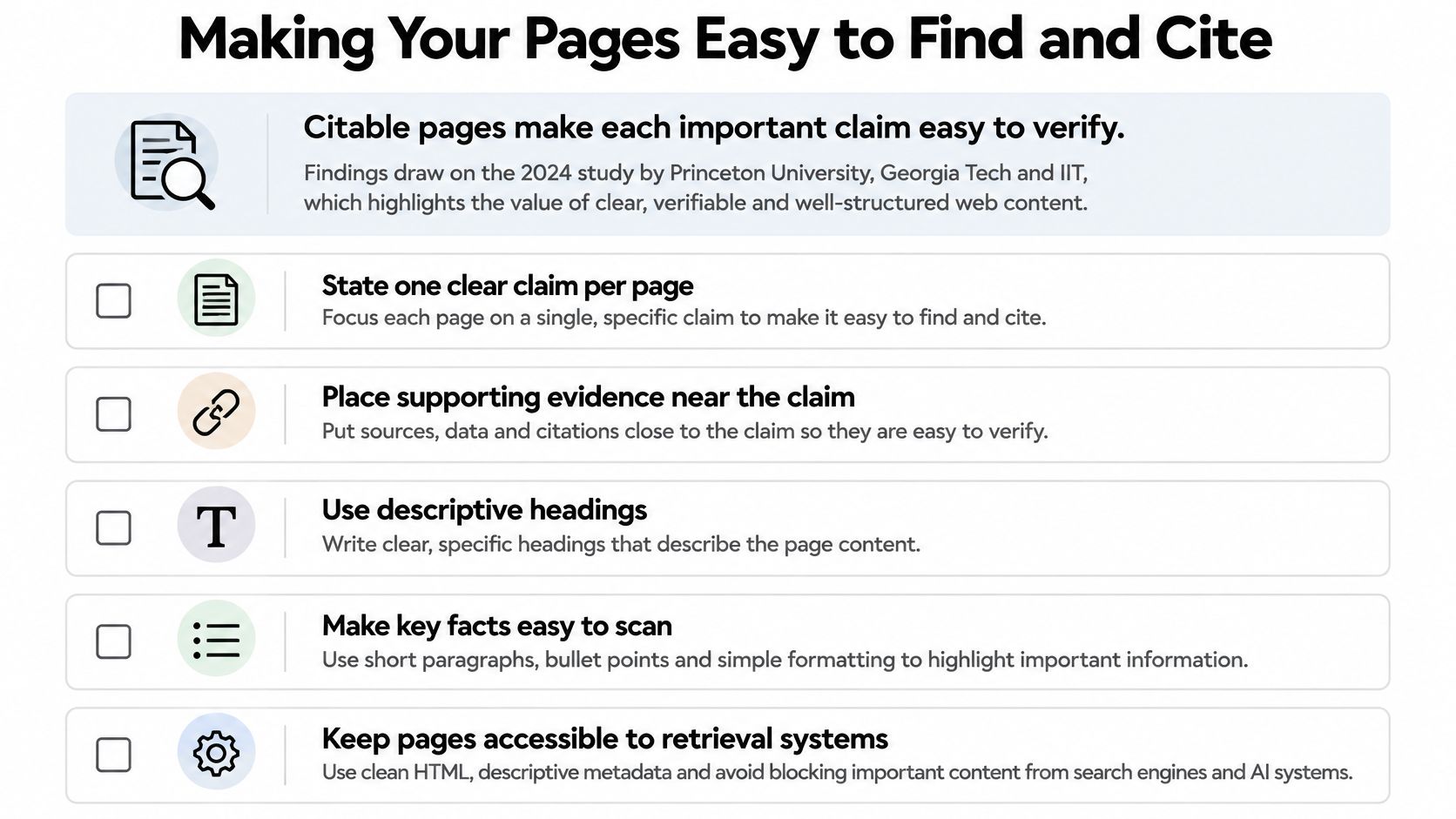
Page-Level Practices That Help Retrieval
- One claim per sentence: State each key claim with its number, unit, and date, because a vague sentence gives the assistant nothing exact to attribute.
- Evidence sits beside the fact: Place each fact next to the text that supports it, so both land in the same retrieved chunk.
- Separate your claims from independent evidence: Mark first-party statements clearly and link to third-party sources such as journalism, government, or research pages where they exist.
- Date anything that changes: Put a visible date on pricing and feature information, then update the date when the facts change.
- Answer first: Address the buyer question directly in the first lines of each section, before context or background.
- Add a short FAQ: Use precise answers to the exact questions buyers ask, with the same figures used in the body text.
Say your product page says "affordable pricing for growing teams." There's nothing to cite. Rewrite it as a dated sentence naming the plan, the price, the billing period, and who it's for. The claim becomes verifiable, and your monthly test can score it cleanly.
Breadth of testing matters as much as any single tactic. The 2024 KDD study on Generative Engine Optimization evaluated 10,000 queries across nine datasets and 25 domains to measure which content strategies affected AI-generated answers. That design supports testing several strategies against each other rather than adopting one blindly because it worked on someone else's site.
Indexing comes before all of this, since an unindexed page can't be retrieved. If your test shows absence everywhere, work through our SpeedyIndex guide to fast Google indexing to confirm the page is discoverable, then retest. On our own platform, every listing gets an SEO-ready page with structured data and an AI-readable markdown version, so search engines and AI assistants can find and cite it. The same principle applies to your site: give machines a clean, readable version of the facts.
Start with one page this week. Pick its most important claim, rewrite it with an exact figure and date, move the supporting evidence beside it, and add one FAQ answer using the same wording. Then rerun your prompts and compare the claim score, not just the citation count.
Set Up a Recurring AI Citation Review
A single test is only a snapshot. Models update, retrieved sources rotate, competitors publish, and search features expand or contract by query. A citation you earn this month can vanish next month without anything changing on your site.
You don't need a team or a dashboard to keep up. You need a fixed prompt set, a shared sheet, and a cadence one person can maintain. Consistency matters more than volume here, because the value comes from comparing like with like over time.
A Cadence One Person Can Run
Weekly, run your 10-prompt set in one tool, rotating tools if you like, and log whether your domain is cited, mentioned, or absent. Keep it light. You're watching for sudden disappearances, not producing a report.
Monthly, run the full set across ChatGPT, Claude, Gemini, and Perplexity. Score claim support on every cited answer and compare the result with last month's log. Note any tool whose mode changed, since a default search setting can shift results overnight. If you want tooling beyond a sheet, our RankControl guide to AI search traffic shows how structured monitoring builds on the same fields.
Quarterly, step back and review the source mix. Check which competitor domains gain citations for your prompts, which source types keep winning, and which of your pages scored unsupported. Rewrite the weakest pages first, starting with unsupported claims, because those are live trust problems rather than missed opportunities.
| Cadence | Task | What to Record |
|---|---|---|
| Weekly | Run the 10-prompt set in one tool | Date, prompt, cited or absent |
| Monthly | Run the full set across four tools and score claim support | Tool, mode, outcome and claim score |
| Quarterly | Review source mix, competitor citations and weakest pages | Pages rewritten and citation trend |
Fields Every Log Entry Needs
- Date: The day you ran the prompt, so changes can be tied to edits or model updates.
- Tool and mode: Which assistant, and whether search was on or off.
- Prompt wording: The exact text, copied rather than paraphrased.
- Outcome: Cited, mentioned, or absent.
- Claim score: Supported, partly supported, or unsupported, with the quoted sentence.
Keep the log in one shared sheet so trends stay visible across quarters. Machine-readable files deserve the same periodic check. On our side, a llms-full.txt file provides a full-content mirror of live products and blog posts, and an ai.txt file sets permissions and restrictions. Whatever equivalents you maintain, confirm during the quarterly review that they still match your live pages.
Build the sheet today with your 10 prompts and record the first run before you change anything on your site. Without a baseline, later edits can't be measured.
Resist rewriting pages between the baseline and the first monthly comparison. Change one weak claim at a time, note the edit date in the sheet, and let the next run tell you whether the assistant picked up the clearer wording. Slow, logged changes beat a full site rewrite you can't evaluate.
Start your first citation review this week. Write down the 10 prompts your buyers ask, run them in ChatGPT, Claude, Gemini, and Perplexity, and score every claim about your product as supported, partly supported, or unsupported. Then list your product on ScrollLaunch so it gets an SEO-ready page and an AI-readable markdown version that assistants can find, retrieve, and cite accurately.