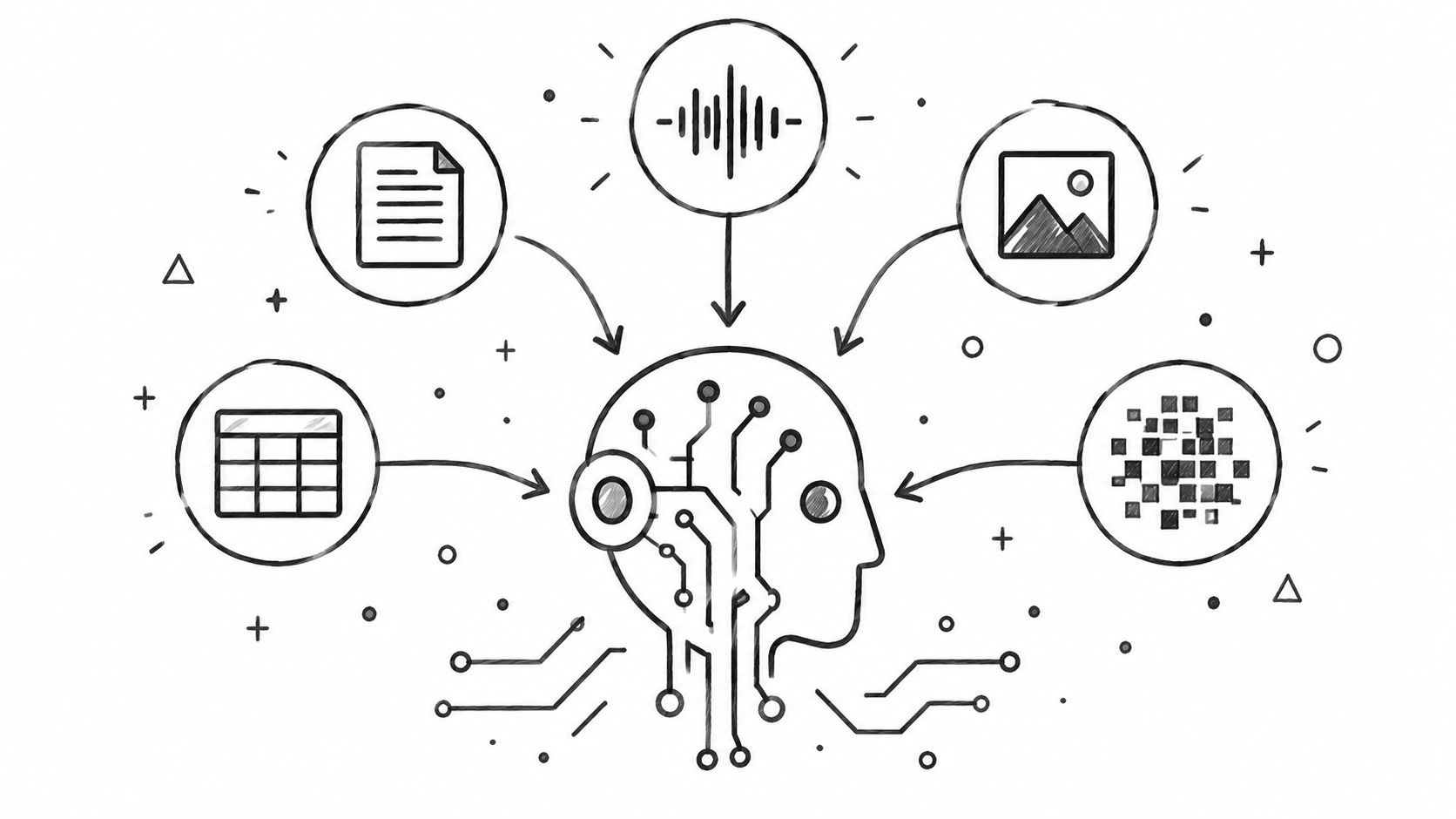
You've probably got the same problem a lot of small teams face right now. The product works in demos, the model answers feel promising, and the next obvious move is to grab a pile of text, scrape some pages, and fine-tune over the weekend. That can work, but only if you know what you're feeding the model, where it came from, and what kind of mess you're gradually building into the system.
AI training data is the material a model learns from, the same way a chef learns by cooking with ingredients again and again. The model doesn't memorize the world in a literal sense, but it does absorb patterns from examples, labels, and feedback. If the ingredients are noisy, biased, duplicated, or misused, the result can still look polished while carrying serious problems underneath.
For a quick glossary-style reference, this AI training data glossary is a useful companion when you run into unfamiliar terms.
Table of Contents
- What AI Training Data Actually Is
- The Main Types of AI Training Data
- How Training Data Is Collected and Sourced
- Annotation and Labeling Without Sinking the Project
- How SourceX Can Help
- Quality, Bias, and Privacy in One Picture
- Dataset Examples and Sources Worth Knowing
- Tooling, Pipelines, and the Boring Bits That Save You
- Practical Checklist for Indie and Early-Stage Teams
What AI Training Data Actually Is
If you're about to fine-tune on a folder of scraped pages from last weekend, start with a simpler mental model. AI training data is the collection of examples a model studies so it can learn patterns, relationships, and outputs. For a text model, the examples might be paragraphs and responses. For an image model, they might be pictures and labels. For a support bot, they might be past conversations, tags, and outcomes.
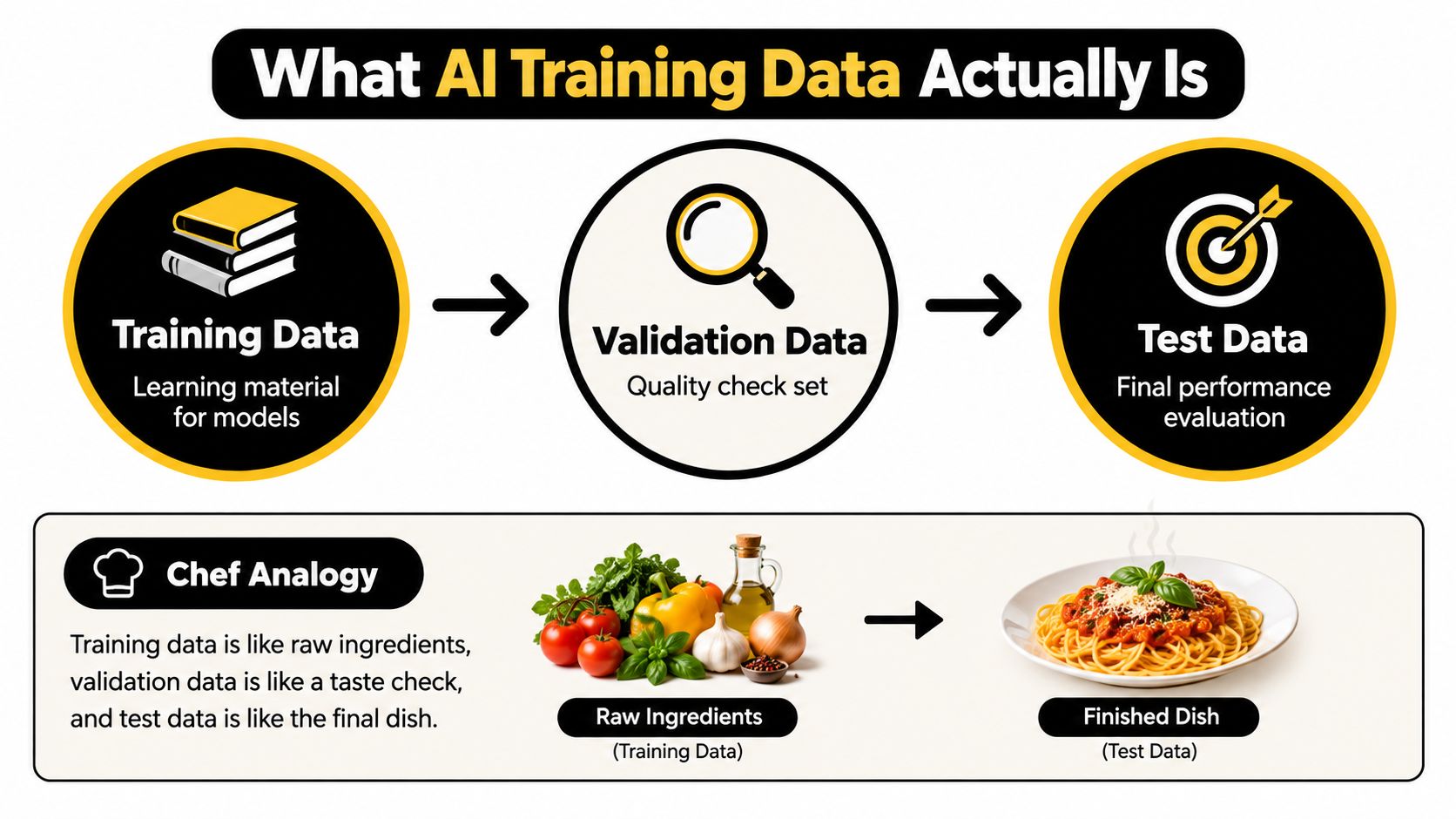
A cooking-school analogy helps because it keeps the parts straight. The training data is the ingredient pantry and the practice dishes, the validation data is the tasting panel, and the test data is the final exam dish that nobody was allowed to adjust for. The chef learns by repeating recipes, correcting mistakes, and getting judged on what wasn't used during practice. A model follows the same logic.
Training, validation, and test sets are not the same thing
People often mix these up because all three are just data. They serve different jobs, though, and if you blur them together you lose the ability to tell whether the model learned anything useful. Training data teaches the model. Validation data helps tune choices during development. Test data stays untouched until the end, so you can measure performance truthfully.
That separation matters more than most early teams expect. If you evaluate on examples the model already saw during training, your score can look better than reality. In practice, that means the number on the dashboard may be flattering, but the product still fails when real users ask something slightly different.
Practical rule: If a dataset influences decisions during training, it should not also be your final proof that the model works.
Think of the model as a compressed summary of the examples it has seen. It doesn't store every row like a spreadsheet, but it does internalize patterns from those rows. That's why garbage in, garbage out isn't a slogan here. It's a literal warning about what the system can learn, repeat, and amplify.
For builders, the important question isn't “Do we have data?” It's “What kind of examples do we have, what are they supposed to teach, and what did we keep separate so we can still trust the result?” That's the working mental model worth carrying forward: examples, labels, and splits. Once those are clear, everything else, scraping, labeling, tuning, and evaluation, becomes much easier to reason about.
The Main Types of AI Training Data
Not all data pulls the same weight, and different kinds of models fail in different ways. A text classifier, a vision system, and a voice agent may all be “AI,” but the data they need, and the risks they inherit, are very different. The type you choose shapes cost, licensing exposure, annotation work, and the kinds of bias that slip through.
Five common buckets
Text data is the most familiar bucket. Product reviews for a sentiment classifier are the cleanest example. You can also use support tickets, articles, chats, code, or policies, depending on the task. Text is flexible, but it's also where scraping temptation shows up fast because there's so much of it on the open web.
Image data powers tasks like object detection, medical imaging, and visual search. Bounding boxes around a car, a tree, or a defective part turn raw pixels into training examples. The annotation burden is usually higher than people expect because an image often needs precise labels, not just a single category.
Audio data is what voice agents, transcription systems, and call analytics rely on. Think recorded speech paired with transcripts, speaker tags, or timestamps. Teams often forget that audio is not just sound, it's timing, noise, accents, and room quality, all of which can affect performance and fairness.
Structured data includes tables, events, logs, transactions, and feature stores. It underpins recommendation engines, fraud rules, risk systems, and a lot of enterprise ML that never gets much attention. The upside is consistency. The downside is that structured systems often mirror business processes so closely that old policy mistakes become machine behavior.
Synthetic data is generated rather than collected directly from the world. It can help with rare cases, privacy-sensitive examples, or rapid prototyping. It's not a free lunch, though. If the generator is weak or biased, the synthetic set can reproduce that weakness at scale.
| AI training data types at a glance | ||||
|---|---|---|---|---|
| Data type | Typical use case | Licensing risk | Annotation effort | Bias to watch |
| Text | Sentiment, retrieval, chat | Medium to high | Low to medium | Representation gaps in language and topic coverage |
| Image | Detection, classification, vision search | Medium to high | High | Skewed lighting, scenes, demographics |
| Audio | Speech, transcription, voice agents | Medium to high | High | Accent, background noise, channel quality |
| Structured | Forecasting, fraud, ranking | Medium | Low to medium | Process and policy bias in historical records |
| Synthetic | Prototyping, edge cases, privacy relief | Low to medium | Low to medium | Generator drift and amplified artifacts |
The best data type is the one that matches the task without importing more legal or labeling pain than your team can absorb.
For a founder, that table should lead to one practical conclusion. If the use case is narrow and business-specific, structured or first-party text data usually beats a giant generic crawl. If the problem depends on visual or audio judgment, there's no shortcut around careful labeling. And if you're reaching for synthetic data first, ask whether you're using it to cover a gap or to avoid doing the hard part.
How Training Data Is Collected and Sourced
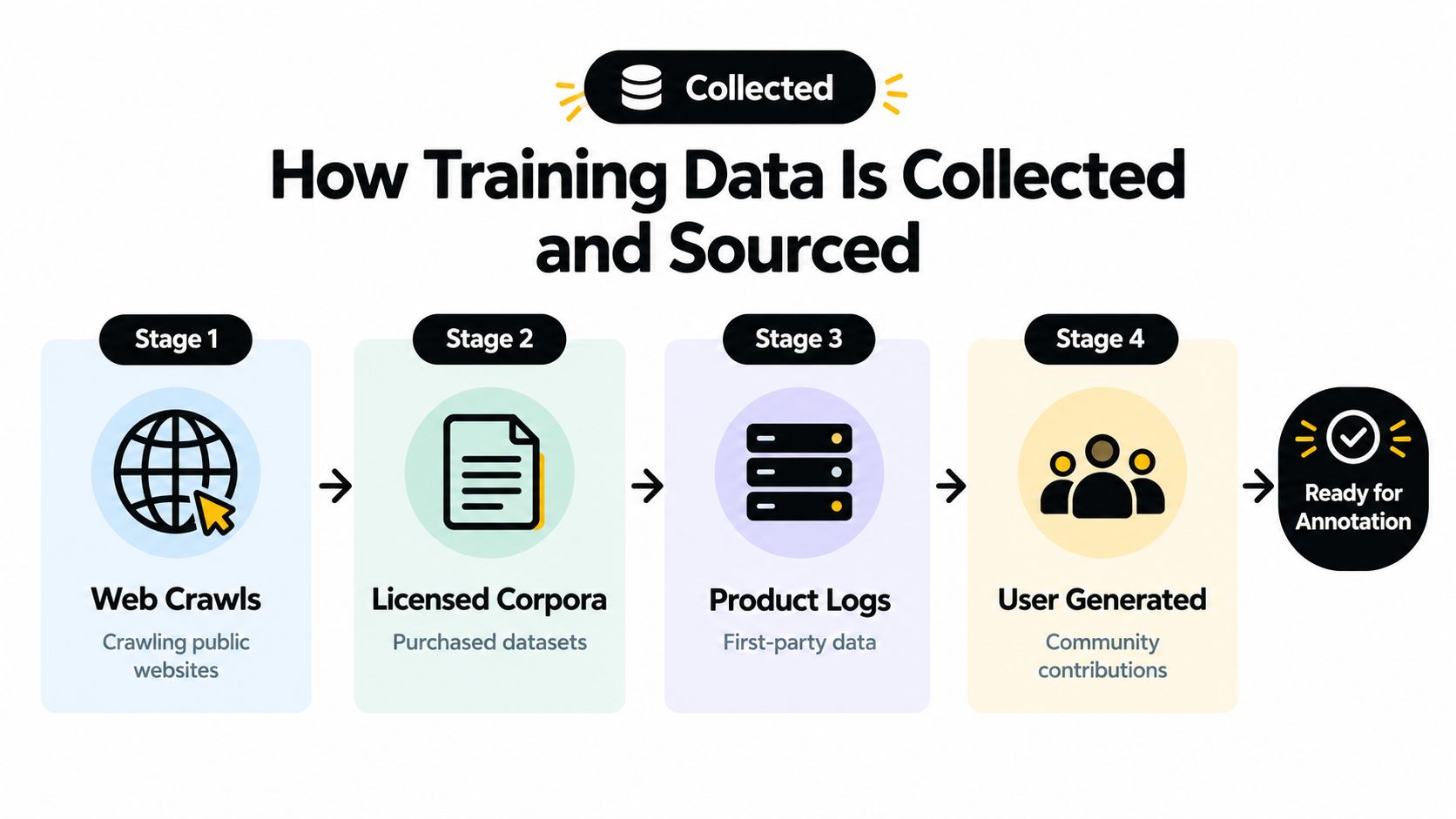
Data collection is less like downloading a file and more like assembling a supply chain. You usually start with one of four sources. Public web crawls, licensed corpora, first-party product logs, and user-generated contributions each come with their own trade-offs, and synthetic examples can be layered in when the actual world is too sparse or too sensitive.
Picking the source without fooling yourself
Web crawls are tempting because they feel abundant. That abundance hides a lot of cleanup work, and it also hides rights questions. Licensed corpora solve some of that by giving you a clearer legal path, but they can be expensive, restrictive, or too generic for your domain. Product logs are often the highest-signal source for a business because they reflect real users and real outcomes. User-generated contributions can be valuable too, as long as people understand what they're contributing and how it will be used.
A concrete example shows why raw size is a bad proxy for usable size. A documented version of Google's C4 dataset contained about 305 gigabytes of filtered text and 156 billion tokens after the source material was collected and aggressively cleaned, which is a reminder that a huge crawl becomes much smaller once it's fit for training. The actual work is not getting data. It's turning messy material into something the model can safely learn from. The C4 dataset description makes that contrast obvious.
A simple decision rule helps when you're stuck. License when the data is commercially important, clearly owned by someone else, or tied to legal risk you don't want to inherit. Scrape only when the content is public, the use is defensible, and you've checked whether the site's terms or robots policy make the plan fragile. Generate from scratch when the task needs synthetic coverage, privacy protection, or edge cases you can't safely collect from the actual world.
This operational data licensing workflow is a useful reference if you're deciding what kinds of internal business records can be packaged, prepared, and moved into a model pipeline.
Treat collection as procurement, not just engineering
The biggest mistake small teams make is treating sourcing like a technical afterthought. It's really a procurement and ethics problem with engineering attached. You're not just collecting rows, you're deciding what you're allowed to learn from, what will age well, and what might get you in trouble later.
If you can't explain where each dataset came from and why you had the right to use it, you're already carrying avoidable risk.
That's why teams benefit from a short checklist before any collection starts. Ask who owns the source, what consent exists, whether redistribution is allowed, whether the content contains personal data, and whether you can still prove provenance six months later. If those answers are fuzzy, the dataset probably isn't ready.
Annotation and Labeling Without Sinking the Project
Good labeling work looks boring from the outside, and that's usually a sign it's being done well. The moment a team treats annotation like cheap labor instead of quality control, the dataset starts drifting. One uncertain label can be tolerable. A whole process with no checks can poison training for weeks.

Build the label system before you hire the labelers
Start with a gold set, a small set of examples with answers you trust. Use it to calibrate raters before they touch the full workload. If people disagree on the gold set, the guideline is unclear, not the workers. That's the signal to rewrite instructions, add examples, or narrow the scope.
Different tasks need different label shapes. Classification is the simplest. Spans and bounding boxes take more precision. Preference pairs show up when you're ranking model answers. Free-form rationales can help review, but they also add room for inconsistency if you're not strict about format. The right choice depends on what the model needs to learn, not on what's easiest for the annotation platform.
In-house labeling works when the domain is specialized, privacy-sensitive, or high-stakes. Vendor labeling helps when you need throughput and a managed process. Crowd labeling can be useful for broad, low-risk tasks, but only if the instructions are tight and the QA loop is real. The mistake is assuming one approach is universally best. Each one creates different failure modes.
Watch for disagreement before it becomes drift
A healthy labeling process includes overlap between raters, regular calibration meetings, and an audit trail for disagreements. If two people repeatedly interpret the same example differently, that's not noise to ignore. It's a clue that the policy is underdefined or the task is too ambiguous.
Watch for four warning signs. No gold checks, no overlap between raters, no calibration meetings, and no review of disagreements. Any one of those can introduce drift. All four together are a recipe for a dataset that looks complete but teaches the model the wrong lesson.
A useful habit is to treat disagreement as product feedback. If annotators can't tell what the label means, users won't magically find the system intuitive later. The annotation layer often reveals the ambiguity that product specs hide.
How SourceX Can Help
SourceX is useful when the training-data problem is not “find some text” but “turn real enterprise records into something a buyer can safely evaluate.” It acts as an enterprise data transaction layer for licensing operational datasets to AI labs and other buyers, with supplier approval built into the workflow. That matters when the data is spread across systems, the rights story is messy, and the team needs a controlled path from inventory to delivery. Request AI training data is the most direct place to start if you're exploring that route.
The strongest reason to look at a service like this is not convenience, it's risk reduction. If you're holding support logs, CRM records, engineering tickets, or document archives, the hard part is usually not finding value, it's proving what you own, what you can share, and what needs to be removed first. SourceX focuses on fit assessment, private inventory creation, rights review, privacy preparation, and buyer negotiation, which makes it relevant when the dataset itself is the product.
That also makes it a fit for teams that don't want to improvise licensing. If your concern is legal exposure from scraped or permissionless data, or if you need a documented provenance trail before any buyer sees the material, a transaction layer can be the difference between a promising asset and an unusable one. The right choice is usually a controlled workflow when the data is valuable, operational, and sensitive enough that one bad decision would be expensive.
Quality, Bias, and Privacy in One Picture
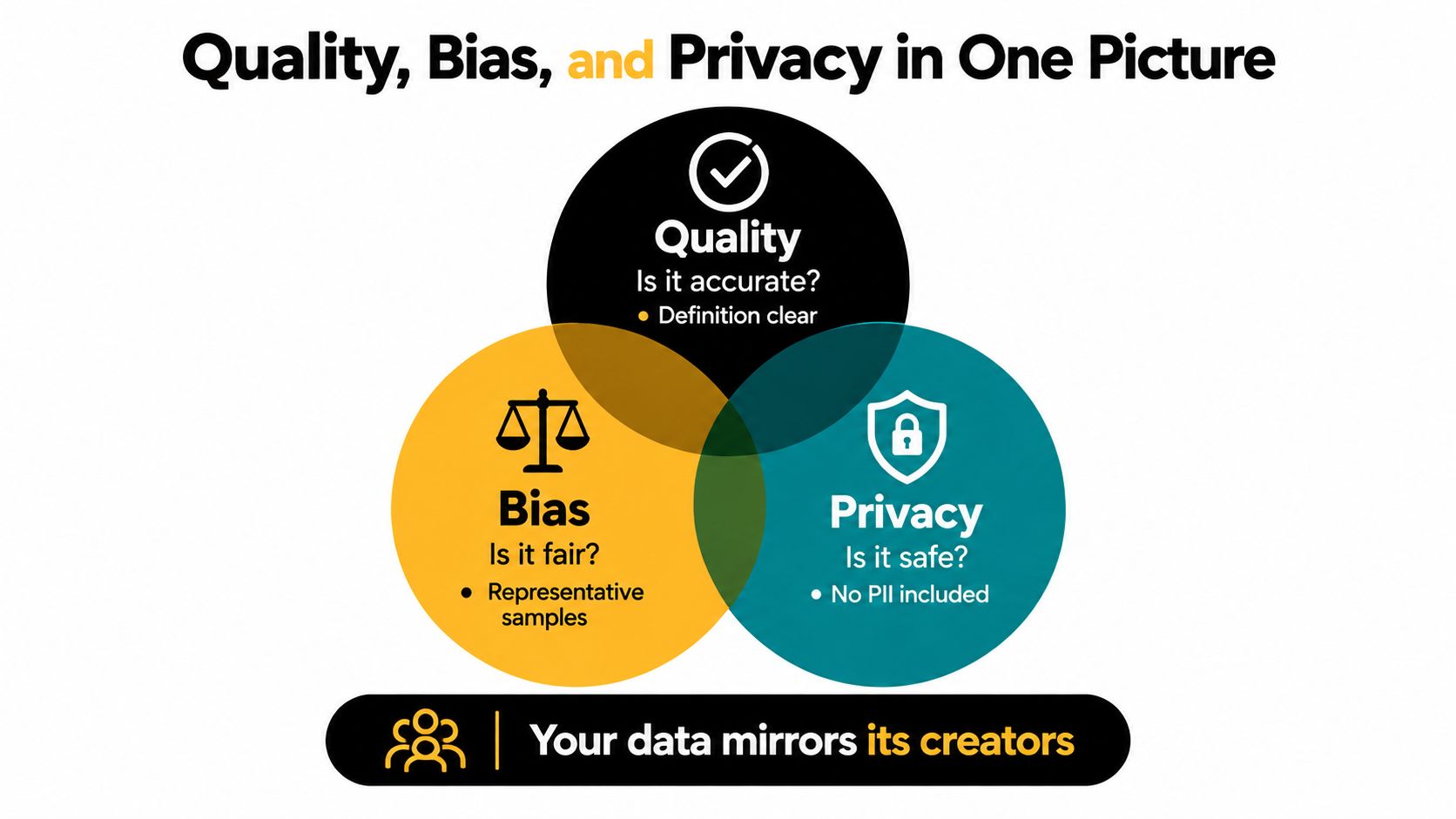
The same dataset can be accurate, biased, and unsafe at the same time. That's why these topics belong together instead of in separate mental buckets. Data quality asks whether the examples are correct. Bias asks whose reality the data reflects. Privacy asks whether the material contains information you should not have captured or reused.
One leak can damage all three at once
Approximate duplication is a good example of the overlap. In one analysis, the C4 corpus contained near-duplicates for 3.04% of analyzed examples, while RealNews had 13.63%. The same analysis found overlap between training and validation data of 4.6% for C4 and 14.4% for RealNews, which creates a leakage path that can inflate benchmark scores rather than show real generalization. The underlying analysis is a sharp reminder that a model can look stronger than it is when evaluation examples have already been seen in training.
That's not just a measurement problem. It's a product problem. If benchmark contamination makes a model look better than it is, a team may ship too early, overtrust a weak system, or miss the places where generalization still fails. The fix is boring but necessary. Freeze evaluation sets, scan them against every training snapshot, and keep deduplication active after normalization, not just before upload.
Use the same checklist for every dataset
A practical review loop can stay short:
- Provenance: Can you trace where the data came from and who collected it?
- Consent: Did the source allow the use you want?
- Duplicates: Have you checked for exact and near-duplicate overlap?
- Representation: Who is missing, and whose edge cases got filtered out?
- Privacy: Does the data include personal details, secrets, or anything you shouldn't keep?
The point isn't to make every dataset perfect. The point is to avoid the quiet failures that are hardest to diagnose later. If the data is contaminated, the model may look smart while learning the wrong lesson. If the data underrepresents certain users, the model may work beautifully for the majority and fail at the edges that matter most.
Dataset Examples and Sources Worth Knowing
The easiest way to get lost in datasets is to think you need the perfect one before you start. You usually don't. A better strategy is to begin with a published baseline, then add domain-specific examples on top of it. That saves time, keeps the pipeline understandable, and gives you a known reference point when things break.
Open web archives are still the default starting point for broad pretraining because they offer scale and variety. Curated instruction sets are better when you're fine-tuning behavior, following prompts, or teaching a model to respond in a certain style. Evaluation suites are separate from both. They're there to tell you whether the model is improving or just memorizing. Domain collections for legal, medical, code, or support use cases are where general models start becoming products.
A founder's decision often comes down to maintenance. Community datasets are cheaper to start with, but they can cost you later in cleanup and governance. Maintained commercial datasets can save weekends because someone else has already done part of the curation and packaging. The trade-off is that you're buying process as much as content.
Start with the smallest dataset that can still answer the product question honestly.
That rule keeps teams from overbuilding. If your use case is narrow, a modest but carefully labeled dataset often beats a giant general corpus. If the use case is broader, use the baseline as a scaffold instead of reinventing the wheel. The most common mistake is collecting from scratch before proving that a simpler, already published set would have worked.
Tooling, Pipelines, and the Boring Bits That Save You
Most painful AI failures don't come from the model architecture. They come from the pipeline around it. Ingestion, format conversion, deduplication, filtering, splitting, versioning, and evaluation gating are the parts that keep a training run reproducible. When those steps are manual, teams end up re-cleaning the same data months later because nobody can prove what changed.
Selection quality matters more than raw volume. Research on data pruning found that removing low-value examples in a ranked way can improve how model error scales with dataset size, which is one reason the best dataset is often the one you've trimmed carefully rather than the one you've stuffed full of everything. The pruning research supports that intuition directly.
A minimal pipeline that a solo founder can actually run
A workable setup doesn't need to be elaborate.
- One source of truth: Store raw data in one place and never edit it in place.
- One frozen eval set: Keep a test slice untouched and locked.
- One automated check: Add a dedup or schema check that runs every time.
- One version log: Record source, timestamp, filters, and label rules.
- One rollback path: Be able to recreate the last good run without guesswork.
This llms.txt validator is handy if your workflow includes publishing or checking machine-readable content, because it forces you to think about structured outputs and consistency.
The payoff is not speed, it's trust. When a model regresses, you want to know whether the data changed, the labels drifted, or the split leaked. Without that record, every failure turns into a forensic project. With it, debugging becomes a normal engineering task instead of archaeology.
Practical Checklist for Indie and Early-Stage Teams
Before you collect a single example, put five decisions on paper. First, define what the model is for in one sentence. Second, define what success looks like in a way you can test. Third, write down exactly where the data will come from. Fourth, note how consent, licensing, and retention are handled. Fifth, decide how you'll know the data is good enough to train on.
Three mistakes show up in postmortems again and again. Teams train on production data without clear retention limits. They evaluate on examples the model has already seen. They treat synthetic data like a license-free substitute for real examples instead of a supplement. Each one is avoidable if the decision is explicit before the first upload.
Print the list, mark it up with your team, and revisit it before every new data source. That habit costs almost nothing and prevents the kind of mistakes that are expensive to unwind later.
If you're building a model this quarter, start with the checklist above, then map your current data sources against consent, ownership, and evaluation risk. If you need a structured way to think about what to collect, what to license, and how to package it for AI use, explore ScrollLaunch's resources and use them as a practical launchpad for the next dataset decision.