Popular advice says you need a new agency for a new kind of search. That is mostly branding. AI SEO is mostly classic SEO rebranded, and every agency below knows it. The honest ones say so, then show you what changes: which sources answer engines cite, how they measure visibility apart from rankings, and what they'll do beyond your own website. The dishonest ones sell you a prompt dashboard and call a mention a win.
That's why this list of the Best AI SEO Agencies doesn't rank by reputation. I treat every agency's AI-visibility claims as a hypothesis to verify. Each entry covers services, strengths, suitable business types, and published pricing where it exists, then ends with the exact questions I'd ask before signing anything.
Three tests run through every entry. Does the agency work on off-site sources that AI systems draw on, or only on your pages? Is AI visibility reporting separated from organic metrics? Is pricing or scope disclosed up front? The urgency is real, at least. The Search Engine Land report on Semrush's keyword tracking found AI Overviews appeared for 88% of 400 U.S. desktop commercial keywords in August 2026, compared with 45.75% in September 2025. Urgency is not a reason to skip verification. It's a reason to do it faster.
Table of Contents
- 1. Seopaslaugos.io
- 2. First Page Sage
- 3. Siege Media
- 4. Omniscient Digital
- 5. WebFX
- 6. SEO Inc.
- 7. Amsive
- 8. Think Catalyst
- Best AI SEO agencies at a glance
- Choose Slowly, Verify Everything, and Build Free AI Visibility First
1. Seopaslaugos.io
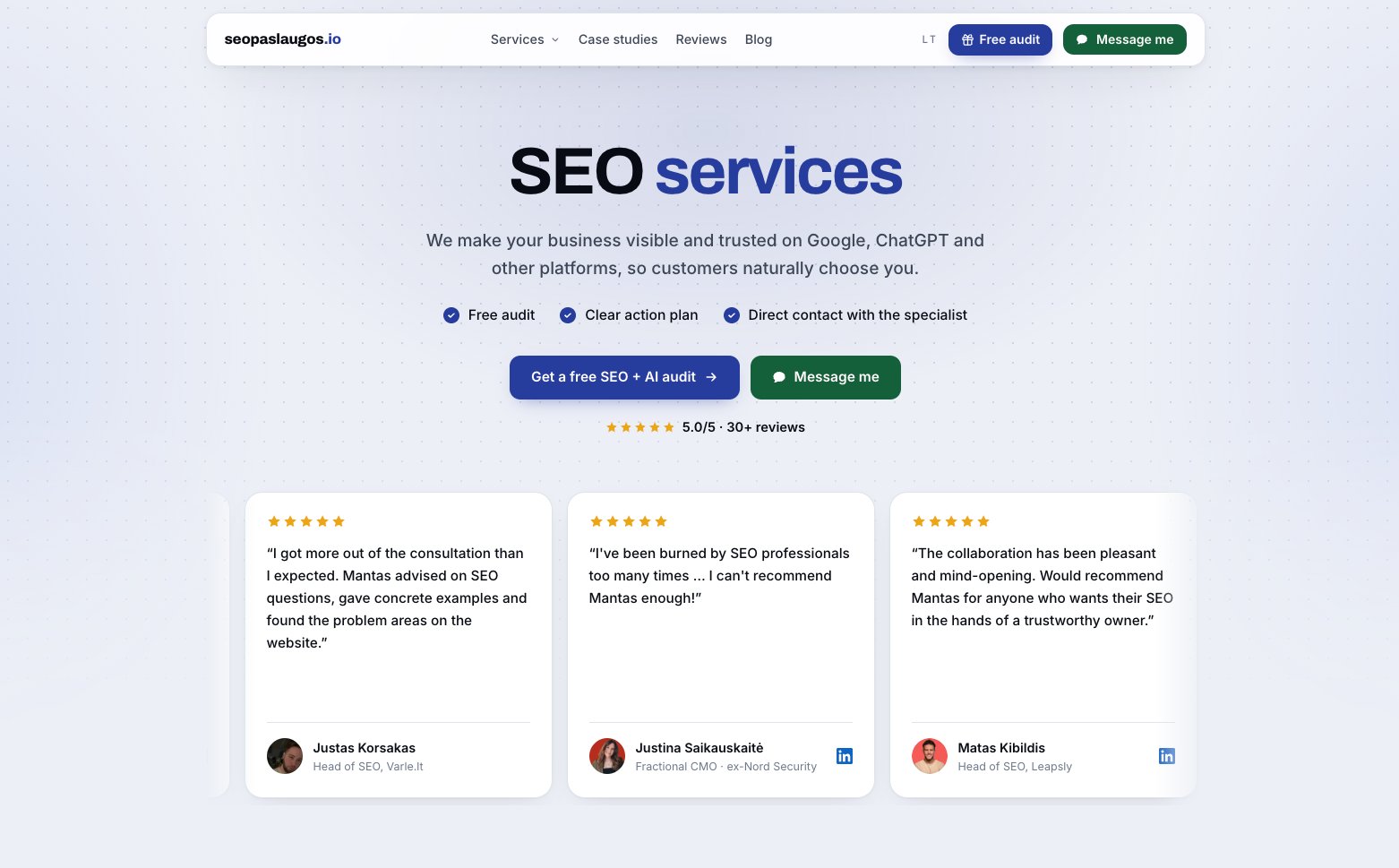
A service business can rank well and still miss its sales targets. Seopaslaugos.io, run by Mantas Tamošaitis, a technical SEO consultant from Lithuania, frames its work around calls, inquiries, and sales, treating rankings and traffic as indicators rather than outcomes. Its services span organic search, local map visibility, and AI-powered results, a mix that may suit service companies and online stores.
What the Engagement Actually Covers
The work combines technical SEO, commercial content, and link acquisition. Technical SEO addresses speed, indexing, site architecture, and internal barriers. On-page work targets purchase-intent searches with service pages, city pages, and product categories. Off-page work focuses on backlinks and brand mentions, while local SEO includes Google Business Profiles and city-specific pages.
Its ai seo services also cover structuring content, facts, and data for citation in ChatGPT and Google AI, with measurement of AI visibility. Ecommerce work includes catalog indexing, filter management, duplicate-content prevention, and optimization of category, brand, and manufacturer pages. Call and form tracking, alongside ecommerce conversion reporting, connects organic activity to business outcomes.
Practical rule: Ask to see how the agency connects an AI citation or organic visit to a tracked call, form submission, or sale. Without that link, visibility reports do not establish commercial impact.
The Trade-Offs Worth Probing
seopaslaugos.io describes two collaboration models. One works with your existing website. The other is a no-retainer partnership for service businesses: seopaslaugos.io builds and ranks websites in the business’s niche at its own cost, and payment is an agreed share only of deals confirmed at a monthly review, so the provider shares the risk. You work directly with Tamošaitis rather than an account manager, and 5+ marketing agencies in Lithuania and abroad resell its SEO to their own clients.
Direct access can make coordination faster when one specialist leads technical changes, content, links, localization, and conversion tracking. The team prepares content and links, but the trade-off is capacity: a specialist-led setup may be a weaker fit than a larger agency when you need high-volume content or PR across several languages. The partnership model also depends on a clear definition of a closed deal and a business case that makes shared risk workable.
Ask before signing: Which purchase-intent pages would you prioritize, and what supports that choice? How will you report AI visibility separately from organic calls and sales? Under the order-based model, what counts as an agreed order, and who owns the work if the engagement ends?
2. First Page Sage
First Page Sage bets on a simple idea: buyers ask AI systems high-intent questions, and the provider whose content answers those questions gets recommended. It combines traditional SEO and thought-leadership content with generative and answer engine optimization, aimed squarely at vendor shortlists. If your sales cycle starts with a buyer comparing providers, that focus is relevant.
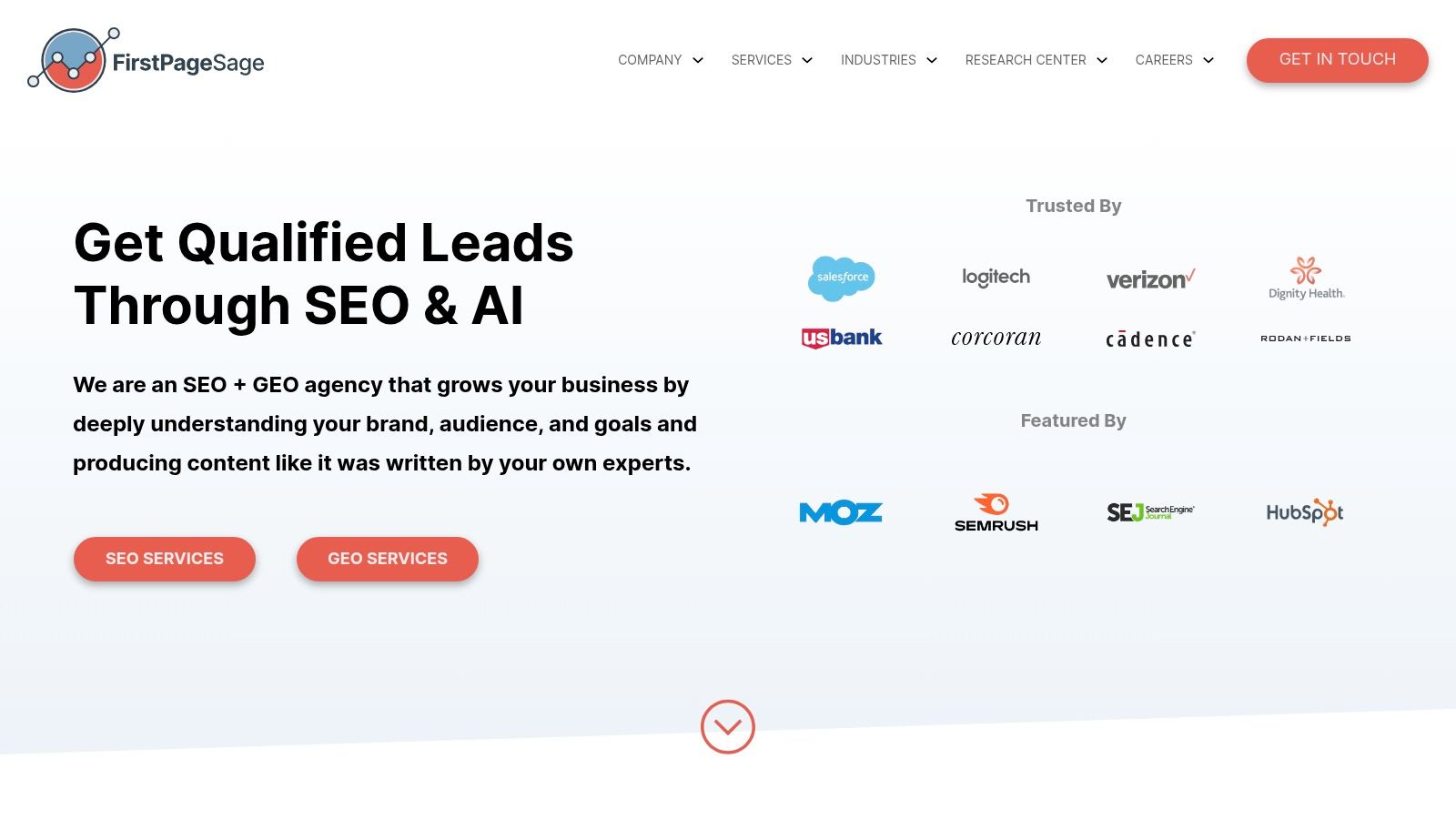
The agency publishes research on GEO and public case material, which makes it easier to evaluate than firms that hide behind a contact form. That openness has a catch, though. Agency-produced research is still agency-produced, so you should ask for examples from your own market rather than accepting benchmarks built on someone else's clients.
The measurement question is where I'd push hardest. The BrightEdge survey reported by GlobeNewswire found 68% of organizations were actively changing strategy for AI search in a June 2025 survey of more than 750 professionals. Plenty of firms claim multi-platform coverage now. Few will show you the exact prompts, locations, devices, and model versions behind their numbers.
- Best fit: B2B and established brands where authoritative long-form content influences who makes the shortlist.
- Watch out for: A content-led program that leaves technical implementation and digital PR to somebody else.
- Pricing reality: Pricing isn't consistently published, so you need a scoped proposal before comparing it with anyone.
Understanding how citations form helps you judge the pitch, and a primer on how AI citations work is worth reading before the sales call.
Ask before signing: Show me a buyer question where your content changed an AI recommendation, not just a ranking. How do you separate a cited page from a recommended brand? Who handles technical fixes and off-site coverage if your team doesn't?
3. Siege Media
Siege Media is the broadest operation here. It pairs GEO with content strategy, digital PR, technical SEO, affiliate, and community work, and it pays explicit attention to sources beyond your own website. That's the right instinct. AI systems cite third-party coverage heavily, and an agency that only polishes your blog is fighting with one hand tied.
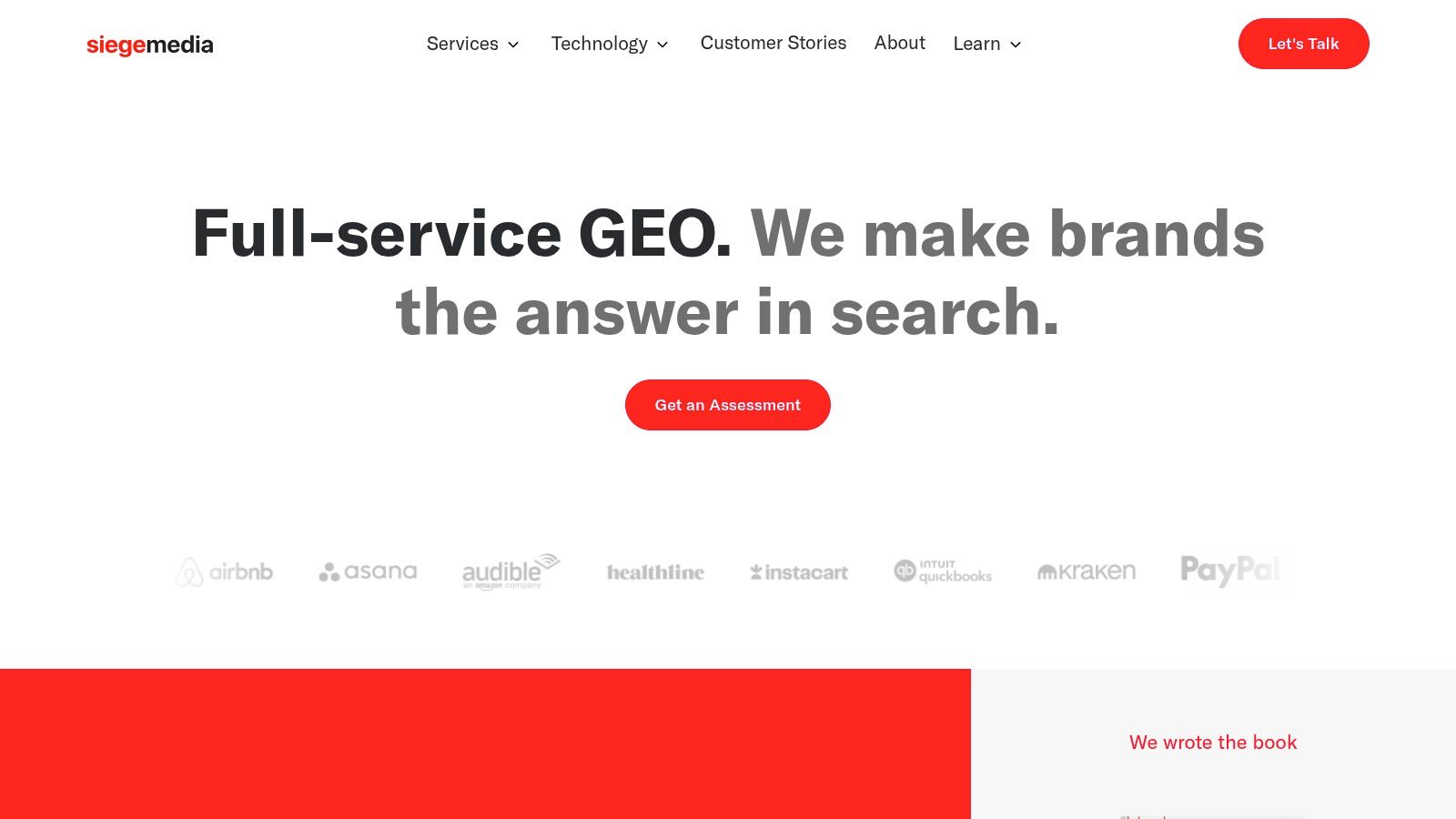
Its reporting is also better specified than most. Monthly reporting includes AI share of voice, citations, and AI referral traffic alongside conventional organic metrics, which at least keeps the two scoreboards from being blended into one flattering number. Public examples span SaaS, health, and consumer brands, so there's a portfolio to interrogate.
But referral traffic is exactly where reporting can mislead you. The National Law Review report on AI traffic analysis describes AI-referred visits at about 1.25 visits for every 100 Google organic visits across more than 16,000 sites. Referrals are a floor, not the full effect, because many people who see your brand in an answer later search for you directly.
A citation count tells you an answer mentioned you. It says nothing about whether anyone bought anything afterward.
Breadth is also the cost concern. A full-service program built for sustained campaigns can exceed what a bootstrapped founder needs, and pricing isn't published on the service page. You're committing to a retainer conversation before you know the ballpark.
Ask before signing: For this reported result, what was the baseline, timeframe, and attribution method? How do you track assisted conversions after an AI mention, not just last-click referrals? What's the smallest engagement that still gets digital PR, not just content?
4. Omniscient Digital
Say you're a B2B software company with a complex product and a sales cycle measured in months. Buyers ask dozens of questions before anyone talks to sales. Omniscient Digital is built for that situation, with content-led organic growth mapped to the buyer journey rather than a keyword list.
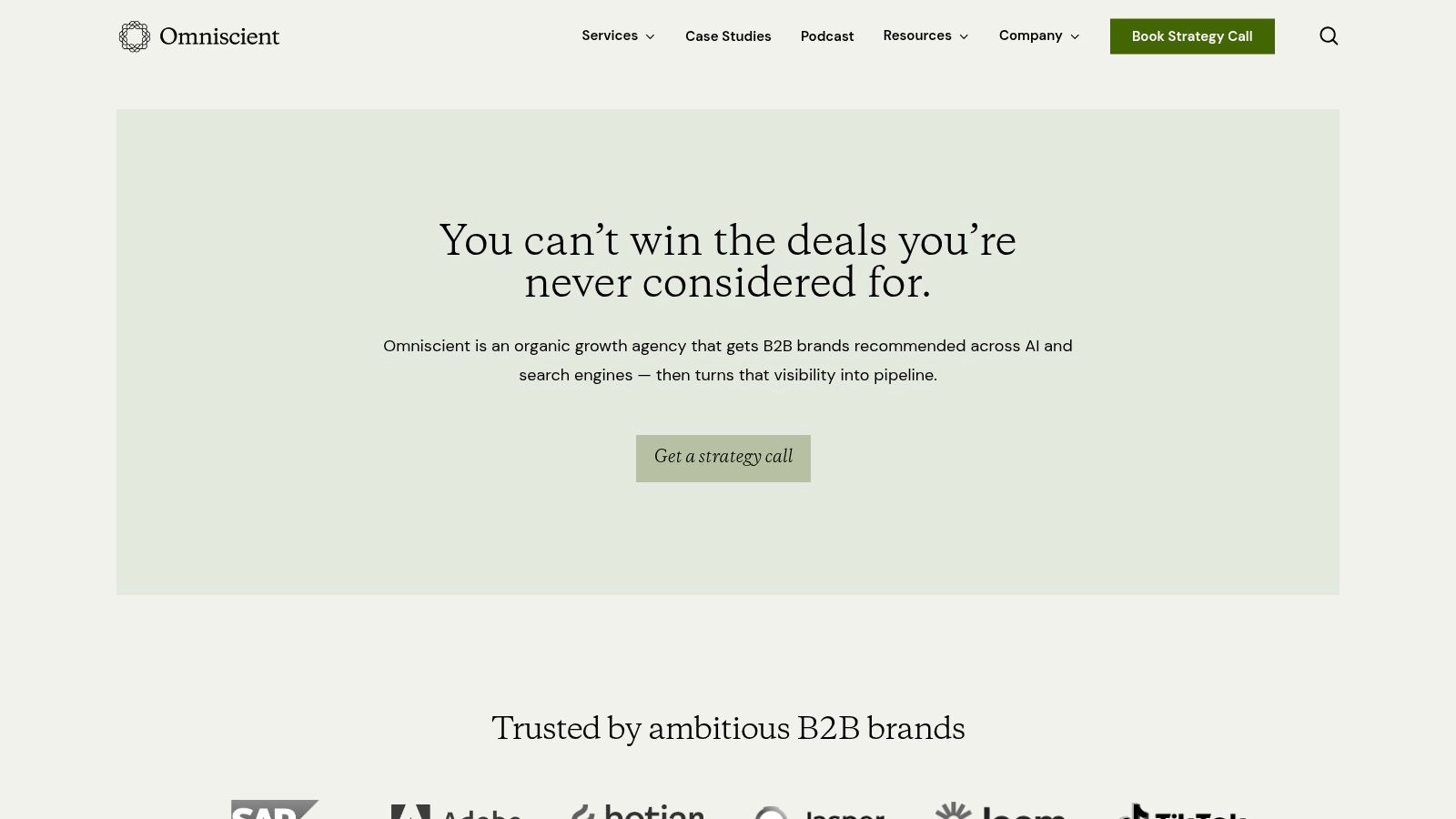
Its GEO approach extends traditional SEO instead of replacing it. The team maps content to buyer questions across the funnel, refreshes important pages, publishes new ones, and builds a broader presence around your category so both search engines and AI systems find consistent material to work with. For SaaS, that specialization is the appeal. Generic agencies routinely misjudge how technical buyers evaluate software.
Where the Model Strains
Content programs like this need your people. Subject-matter experts must review drafts, correct product claims, and supply the specifics that make a page citable. If your team can't give that time, output slows and quality drops, no matter how good the strategy is. Budget is the other filter, since pricing isn't published and the scope may not suit an early-stage startup still finding its message.
Site quality underneath the content matters too. If your marketing site itself is the bottleneck, comparing it against what a specialist Webflow development agency delivers can clarify whether you need content, a rebuild, or both.
Ask before signing: How do you measure AI citations, referral traffic, and pipeline as three separate things? How much of my team's time does the review process need each week? Show me a content refresh where AI visibility moved and pipeline followed.
5. WebFX
WebFX is the large, established option: AI search optimization inside a broader SEO and digital marketing operation, covering ChatGPT, Perplexity, Gemini, and Google AI Overviews, with tracking software and strategist support included in engagements. One vendor coordinating several channels is convenient. Convenience is not evidence that the AI work is a separate program.
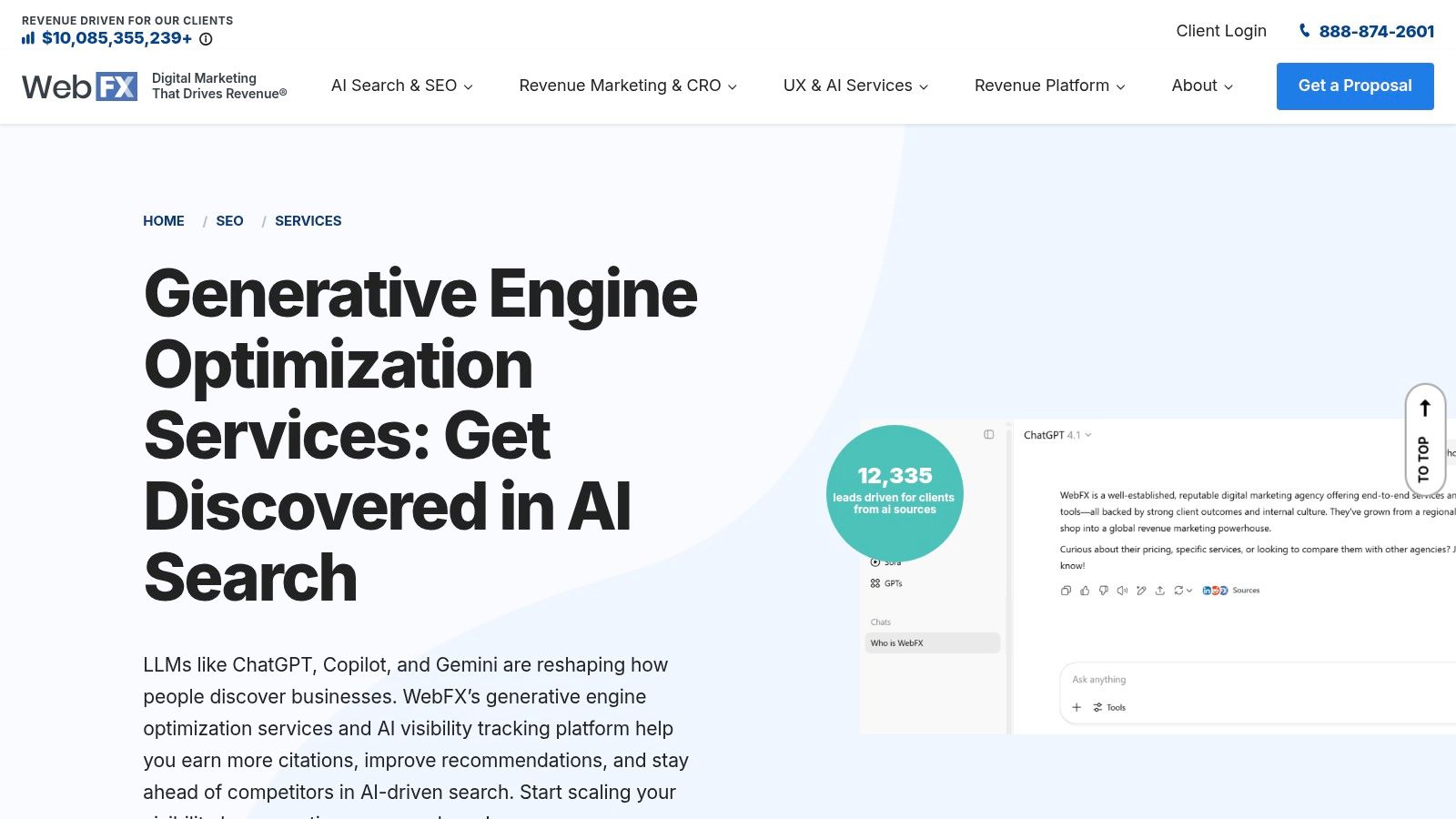
Platform coverage matters because these systems do not pull from the same places. The Cincinnati.com report on the 2026 Victorious study found Google AI Overviews cited pages ranking in Google's conventional organic top 10 for 37% of cited sources, while the comparable rate for ChatGPT, Perplexity, and Microsoft Copilot ranged from 13% to 18%. Strong Google rankings help. They will not carry a brand on every assistant.
Treat the AI offer as a hypothesis until WebFX shows a source plan for each platform. A retainer that only adds a new report can still be useful. I would not approve extra spend unless the work itself changes by engine.
Companies that want an ongoing team, proprietary tracking, and AI work run alongside wider marketing are the clearest fit. A published starting price can already be a heavy commitment for an indie founder, so price the engagement against what you can pause if results stall. Ask WebFX directly what the minimum term is and how exit terms work. Get that answer in the contract, not from a marketing page.
Ask before signing: What work is included at the starting price, platform by platform? How does your ChatGPT strategy differ from your AI Overviews strategy? What is the minimum term, what reporting do I keep if I leave, and which deliverables stop when the contract ends?
6. SEO Inc.
SEO Inc. leads with the technical end of the work. It combines AI SEO and GEO with technical SEO, content improvements, entity work, structured data, and authority building, starting from audits across AI search platforms. If your problem is a messy site that machines can't parse, that ordering makes sense.
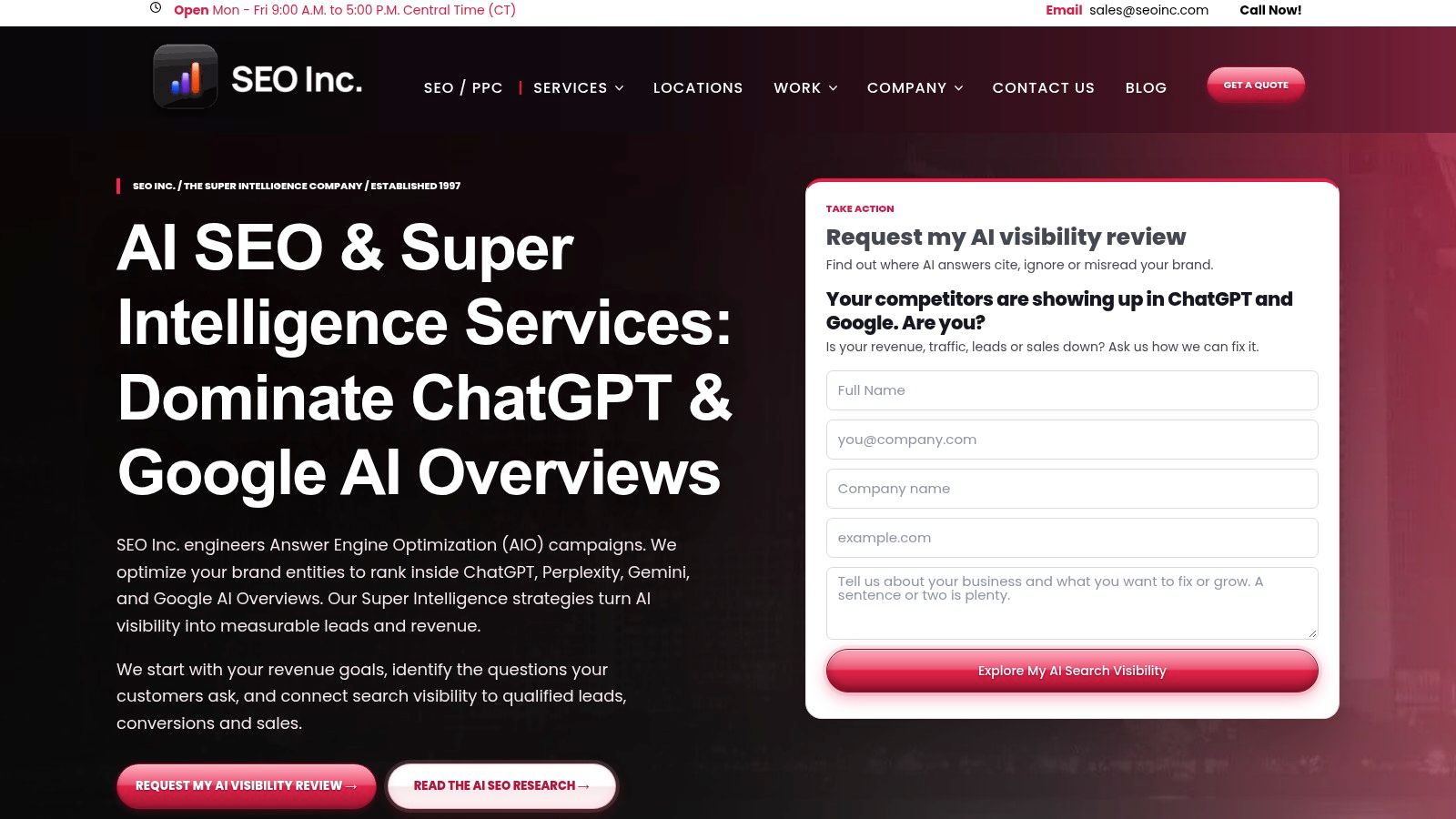
The audit structure is worth copying even if you hire someone else. It covers branded, service, and comparison prompts separately, then moves into entity mapping, crawlability, and structured data fixes. That separation matters because these query types behave differently and shouldn't be averaged into one visibility score.
Volatility is the other reason to keep intent separate. The Semrush AI Overviews study covering more than 10 million keywords in 2025 found AI Overviews appearing for 6.49% of tracked queries in January, peaking at 24.61% in July, and declining to 15.69% in November. A one-time technical fix can't hold steady against movement like that. You need ongoing monitoring, and any agency promising guaranteed citations in that environment is selling certainty it doesn't own.
One offering needs scrutiny. SEO Inc. can build an MCP server where it suits a client's stack and security needs. For a large, data-rich site, that may be useful. For a small product site, it's likely engineering you don't need yet, billed at agency rates.
Ask before signing: Show me AI-specific results, not general SEO tenure. Which technical fixes come first and what evidence says they'll change citations? Why would my site need an MCP server now rather than later?
7. Amsive
Amsive treats answer engine optimization as an extension of established SEO within a broader performance-marketing practice. That approach suits organizations seeking continuity across search and marketing, though it may be more scope than a smaller company needs.
Amsive's work targets visibility and accuracy across AI-powered search, including ChatGPT, Gemini, Perplexity, and Copilot. Accuracy matters: a mention that gets your pricing, features, or positioning wrong can do more harm than a missed citation, particularly for brands with complex offerings.
A partnership with Profound, an AI visibility platform, supports the monitoring side. Ask how those measurements lead to changes on your site. A platform partnership can support strategy and reporting, while implementation may still fall to your team.
Fit Check
A company seeking SEO, AEO, and performance marketing under one provider may value the coordination. A solo founder may not need that breadth. Amsive does not publish pricing in its service information, so request a scoped proposal that separates strategy, reporting, and hands-on implementation. Broad service models can make it difficult to compare costs against a narrowly defined need.
Ask before signing: Does AEO include hands-on implementation, or mainly strategy and reporting? What does the Profound data change in your monthly work? How do you correct inaccurate AI descriptions of a brand? For context on how specialist marketing firms present their services, compare Amsive's scope with these cybersecurity marketing agencies.
8. Think Catalyst
Think Catalyst is the transparency outlier here. It publishes monthly service tiers and onboarding fees, which almost nobody else on this list does. Published prices won't be your final scope, since deliverables and onboarding are confirmed in a written agreement, but they give you a real comparison point before a sales call.
The offer combines GEO with technical SEO, AEO, content strategy, and AI-search analytics. It runs a phased process, discover, design, deliver, and improve, and offers a free AI SEO analysis as an entry point. That free analysis is useful as a test. Send the same site to two agencies, compare what each finds, and you'll learn more than any credentials deck will tell you.
Verification habit: An agency's free audit shows you its real diagnostic process. Vague findings in the audit mean vague work in the retainer.
The entry tier sits lower than many full-service programs, which suits founder-led products testing whether agency help beats doing it themselves. The risk runs the other direction. A lower tier can mean templated deliverables, thin reporting, or limited experience in your specific SaaS niche. Tier names tell you nothing about who touches your account.
Transparency about price also isn't transparency about results. Sample reports and client references matter more than the pricing page, and both should be easy for a confident agency to produce.
Ask before signing: Which deliverables in my tier could change in the written agreement? Can I see a real monthly report with prompt-level data? Which client in a business like mine can I speak with?
Best AI SEO agencies at a glance
| Agency | Core AI SEO Focus | Best For | Published Pricing | Standout Strength |
|---|---|---|---|---|
| seopaslaugos.io | AI visibility, local SEO, and commercial search optimization | Businesses and online stores focused on calls, leads, and sales | Alternative performance-based model available; standard pricing not specified | Tracks business outcomes and AI visibility |
| First Page Sage | Content-led SEO and GEO/AEO for buyer questions | B2B companies seeking visibility in vendor research | Not published | Thought-leadership content targeting commercial-intent questions |
| Siege Media | GEO combined with content, digital PR, and technical SEO | Brands seeking sustained content and authority building | Not published | Reports AI citations, share of voice, and referral traffic |
| Omniscient Digital | B2B SaaS content strategy and AI discovery | SaaS companies with complex products and longer sales cycles | Not published | Buyer-journey-focused content planning |
| WebFX | AI search optimization alongside SEO and digital marketing | Businesses seeking an ongoing team and broader marketing support | Starting price published; amount not specified here | Coverage across multiple AI search platforms |
| SEO Inc. | AI visibility audits, technical SEO, entities, and structured data | Sites with technical or information-architecture challenges | Not published | Combines AI search work with technical SEO and authority building |
| Amsive | AEO/GEO integrated with SEO and performance marketing | Established businesses seeking broader marketing support | Not published | AI visibility monitoring partnership with Profound |
| Think Catalyst | GEO, technical SEO, content, and AI-search analytics | Teams seeking scoped services and pricing transparency | Monthly tiers published; exact prices not specified here | Phased process and free AI SEO analysis |
Choose Slowly, Verify Everything, and Build Free AI Visibility First
Don't hire anyone until you've built your own baseline. Pick ten prompts that matter, your brand name, your category, your top competitors, and a few comparison and alternative-to questions. Run them on ChatGPT, Perplexity, and Google AI Overviews, in the same locations your buyers use, for two weeks, and save dated screenshots with full answers and cited sources.
That folder is your negotiating position. When an agency presents its own baseline, compare it with yours. When it reports progress in month three, check whether your prompts moved, whether you're merely cited or recommended, and whether the description of your product is accurate. Then cross-check against branded search demand and direct traffic, because referral data alone will understate whatever influence exists.
Ask every finalist the same three questions and write down the answers. How do you measure AI citations separately from organic traffic? Will you give me the exact prompts, model versions, locations, and dates behind every number, so I can reproduce it myself? What will you do on third-party sites, not just mine? An agency that welcomes those questions probably measures properly. An agency that deflects them is telling you something.
Hold one line firmly. No honest provider guarantees indexing, rankings, or citations, because nobody controls those systems. We state this openly ourselves. ScrollLaunch does not guarantee any specific Domain Rating, crawl frequency, indexing outcome, referral traffic, or SEO effect. What you get instead is verifiable infrastructure: an SEO-ready page with structured data and an AI-readable markdown version, a permanent product-page backlink, and free GEO and DR audit tools you can run yourself anytime.
While your budget is small, stack those free surfaces before you stack retainers. Claim crawlable launch pages and directory listings so answer engines have consistent, structured facts about your product to draw on. Our archive of 1,018+ DR-ranked directories is a practical starting point, and it costs you time rather than a monthly fee. Do this alongside an agency engagement, not instead of thinking, and the agency inherits better raw material.
The best AI SEO agency isn't the one with the boldest claims or the longest client logo wall. It's the one whose claims you can independently verify, with your own prompts, your own analytics, and reporting you'd be able to audit after the contract ends.
Start with the baseline you control. Launch your product on ScrollLaunch for free, get your SEO-ready page and AI-readable markdown twin live this week, and run our free GEO checker before and after so you can see the change in your own data. Then take that evidence into every agency conversation and hire whoever survives your questions.