
The worst advice in cybersecurity marketing is to hire a generic B2B agency and hope they “learn the category.” They won't learn it fast enough, and your buyers won't wait. Security buyers shortlist early, contact vendors before the final decision, and pull information from peers, analysts, events, trade media, and LLMs, so the agency you hire has to win attention before sales ever gets a chance to pitch the buyer-behavior research.
That changes the job. A strong cybersecurity marketing agency is not just there to make content look polished. It has to build credibility assets, shape pre-sales influence, and support a committee-driven decision process where proof matters more than polish. If it can't do that, it's the wrong partner.
Table of Contents
- Why Cybersecurity Marketing Plays by Different Rules
- The Vetting Checklist for Any Cybersecurity Marketing Agency
- Budget Ranges and Engagement Models That Work
- How HackerContent Can Help
- Writing the Brief and Onboarding Your Agency
- KPI Templates That Match How Security Buyers Decide
- When to Skip the Agency and Go DIY Instead
- Decision Triggers and Final Recommendations
Why Cybersecurity Marketing Plays by Different Rules
Security buying does not behave like a normal SaaS funnel. It runs through technical, economic, and executive committees, and weak messaging gets exposed fast. In the global survey of 500 cybersecurity decision-makers across the US, UK, France, and Germany, the average purchase journey was about 7 months, 55% of purchases finished in under 6 months, 65% of buyers engaged vendors before shortlisting, and only 9% waited until the final decision to make contact buyer journey survey.
That changes the job for any cybersecurity marketing agency. The agency is not there to dress up content and call it strategy. It has to build credibility assets, shape pre-sales influence, and support a committee-driven decision process where proof beats polish. If it cannot do that, it is the wrong partner.
The funnel starts before sales contact
Security buyers do their own research early and aggressively. One industry summary says 90% of B2B buyers research security solutions online before contacting sales, and a separate buyer study says 94% of buying groups rank a shortlist before vendor contact while 79% of buyers initiate first contact themselves paid acquisition report, buyer preference summary. That is the category, not an edge case.
If an agency keeps talking about “awareness” without showing how it changes shortlist position, it does not understand cybersecurity demand.
After you map that behavior, the privacy angle matters too. Buyers expect serious answers on data handling, risk, and trust, which is why a useful agency brief should connect demand work with privacy concerns early, not after the fact. See the related privacy resource if you want to frame that part of the story better.
The market itself raises the stakes. Independent reporting in 2026 put global cybersecurity spending around $314 billion, with other estimates for 2024 to 2025 in the roughly $210 billion to $245 billion range and projections to roughly $375 billion to $563 billion by 2030 to 2032, depending on methodology market overview. More vendors are chasing the same deals, so paid media, SEO, ABM, and content strategy are easier to waste and harder to fake.
A real cybersecurity marketing agency has to work upstream. That means analyst-ready positioning, proof-heavy case studies, comparison pages, integration storytelling, and thought leadership that sounds like it came from someone who has sat in a security review, not a generalist copywriter.
The Vetting Checklist for Any Cybersecurity Marketing Agency
Do not let an agency slide a polished pitch deck across the table and call that qualification. In cybersecurity, the failures show up fast once you ask the right questions. The three weak spots are technical depth, ROI evidence, and integration storytelling, because those are the exact credibility gaps buyers keep calling out in vendor messaging influence study.
Ask questions that expose substance
Start with case studies. Ask which security products they've marketed, who reviewed the technical accuracy, and what changed in pipeline or engagement. A good answer names specific work, the review process, and the buyer stage affected. A weak answer stays at “we increased visibility” and never gets into evidence.
Then ask how they handle evidence density. Buyers in this space said marketing often lacks technical depth, ROI justification, and enough operational detail or tradeoff disclosure. If the agency's own content is packed with vague adjectives, broad claims, and soft positioning, expect the same output for your brand.
Red flag: An agency that makes everything “simple” often strips out the detail security buyers need to trust the work.
Score the first call, not the first proposal
Use a one-call scoring sheet. Give points for clear technical authorship, named security reviewers, proof of ROI measurement, understanding of integrations, and a real process for comparison content. Take points away if the answers sound built for generic SaaS, especially if they dodge what the product displaces or where it compromises.
Read the agency's own content like a skeptical buyer would. Is there enough detail to answer a technical objection, or just enough polish to look presentable? Security buyers punish shallow content because they can tell when the writer does not understand the stack.
Use this infographic as a literal screen during the first call.
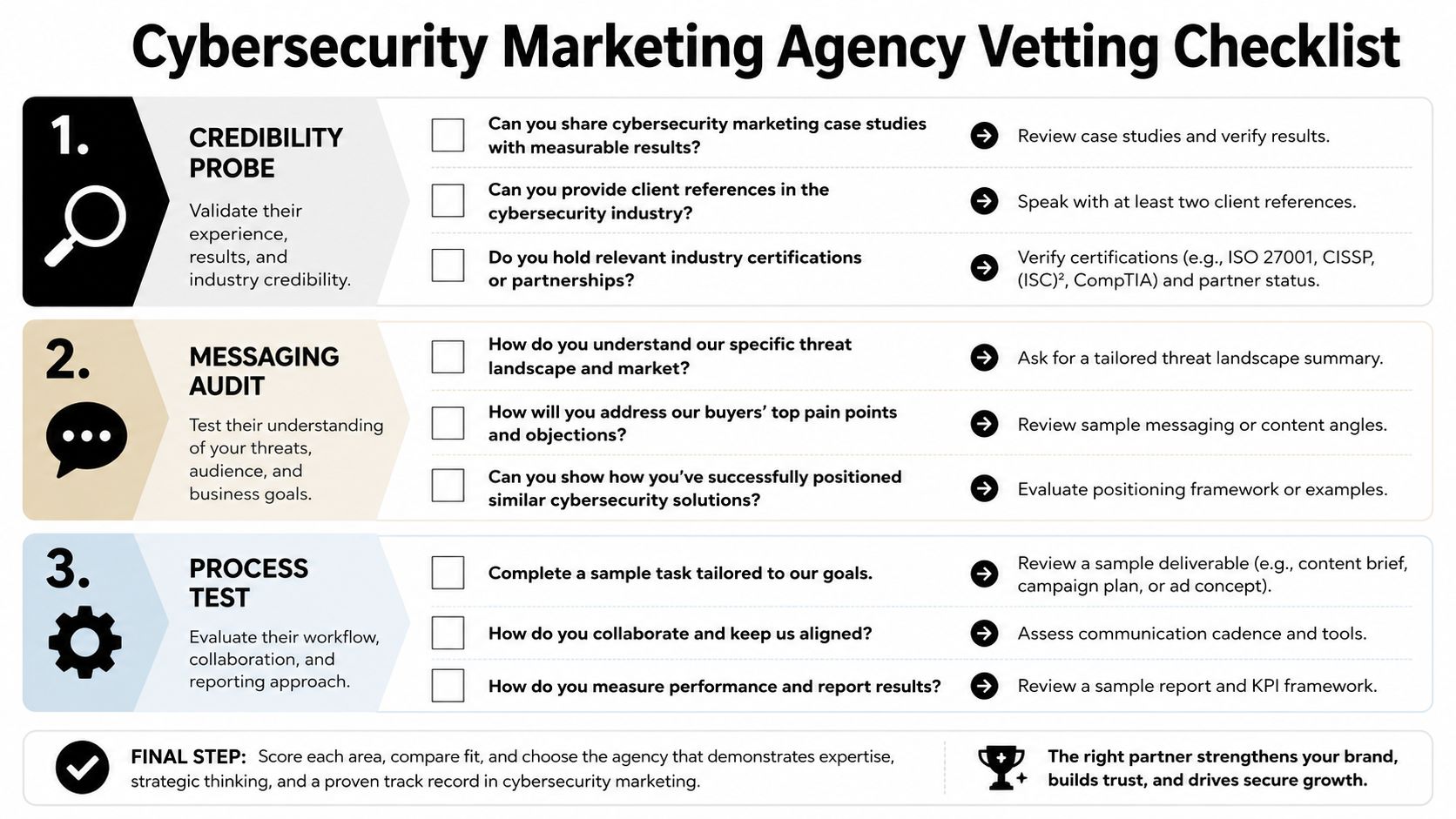
If you want a cleaner filter, ask one question. “Show me how you would explain this product to a CISO, an engineer, and a finance buyer without dumbing it down.” A specialist can do that. A generalist will collapse all three into the same bland paragraph.
Budget Ranges and Engagement Models That Work
Cybersecurity costs more to market because the economics are unforgiving. Keyword CPCs in this space can sit in the $15 to $40 range, and broader industry reporting puts customer acquisition cost around $1,200 to $2,500 while rising about 15% year over year channel economics summary. Cheap retainers usually fail for one reason. They cannot fund the depth security buyers expect.
Buy the structure, not the fantasy
A lean engagement should cover strategy, technical content, search intent mapping, and proof assets. A mid-market engagement should add ABM support, comparison pages, landing pages, and reporting that tracks pipeline influence. An enterprise engagement should include multi-channel coordination, content systems, analyst support, and deeper campaign management.
Security companies also tend to set aside about 10% of annual revenue to marketing, according to the same source set behind the broader market figures market overview. That is not a target for every startup. It is a reminder that you are buying access to a hard-to-reach committee, not a casual inbound click.
Budget rule: If an agency quote looks too cheap for cybersecurity, you are probably buying slideware, not pipeline work.
Match the model to the work
Retainers work when you need ongoing content, SEO, and campaign support. Projects work when you need a defined deliverable, such as a messaging sprint, comparison-page rebuild, or launch kit. Performance-based models sound appealing, but they only make sense when attribution is clean and the agency controls enough of the funnel to matter.
| Agency Budget Tiers and What Each Realistically Buys | ||
|---|---|---|
| Monthly budget tier | Typical scope | Realistic expectations |
| Lean retainer | Technical blog posts, a few SEO pages, light reporting | Slow but credible content production, limited channel breadth |
| Mid-market program | Content, SEO, ABM support, landing pages, comparison assets | Better committee coverage and tighter pipeline alignment |
| Enterprise engagement | Multi-channel strategy, analyst support, large content system, campaign ops | Stronger coordination across teams, but it requires internal commitment |
Before you sign, require exit clauses, ownership of tools and accounts, and reporting access. If the agency controls the assets, you do not own the growth system. Ask them to show where the economics work, not just where the clicks look cheap.
For a practical example of how a campaign structure should look, see the cybersecurity marketing campaign use cases.
How HackerContent Can Help
HackerContent is a focused option if you need a specialist rather than a full-service generalist. It covers technical cybersecurity content, social media, SEO, marketing strategy, and video for security vendors and communities, with work available as monthly retainers or bespoke projects priced in USD. If you're comparing specialist agencies, the public overview at HackerContent, a cybersecurity marketing agency is worth scanning because it makes the service mix and positioning easy to assess.
The main reason a security founder would pick a specialist like this is simple. Generic agencies often flatten the technical story, while security buyers punish weak detail. HackerContent's strongest use case is when your team needs technically correct content, credible social output, and a single partner that can handle several channels without losing the security context.
Its fit is best when you already know the category, need consistent publishing, and don't want to stitch together separate freelancers for SEO, writing, and video. That matters when your internal team is thin and every asset has to do real work in the buyer journey.
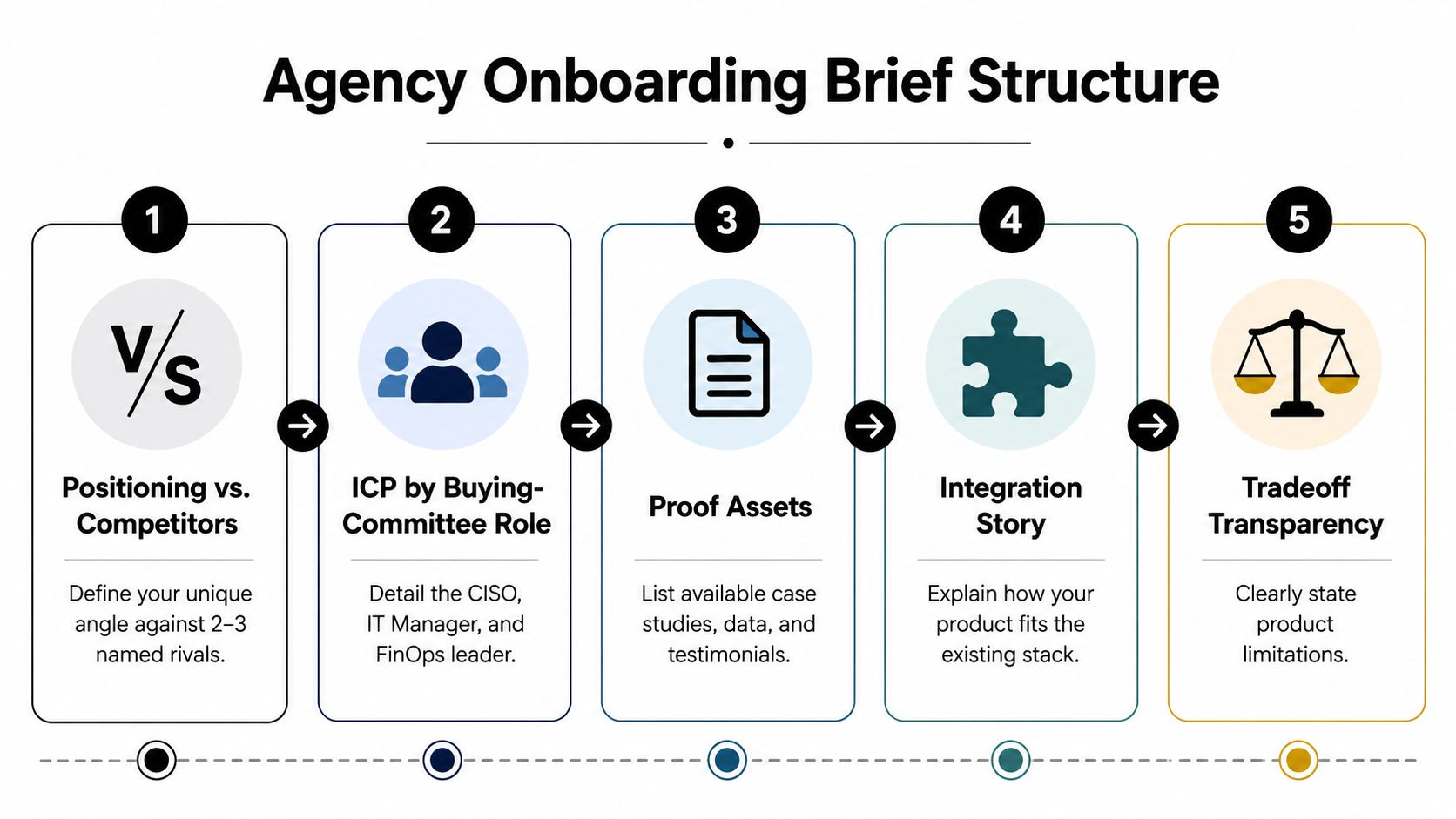
If you're just trying to get the first credible layer of content in place, use a brief like this, then judge the output hard. Ask for a positioning statement against named competitors, the buyer roles you care about, the proof assets you already have, the integration story, and the tradeoffs your product makes. That will tell you whether the agency understands the market or just the marketing vocabulary.
Writing the Brief and Onboarding Your Agency
A strong brief beats a “brand tone” document every time. Security buyers care about what your product displaces, where it fits in the stack, and what it costs them operationally to adopt it. If you leave those details out, the agency will fill the gap with generic positioning, and the content will feel safe but useless.
Put the product into a real buying context
Your brief should name the competitors you lose to, not just the ones you'd like to beat. It should spell out the buyer roles in the committee, especially the technical evaluator, the economic buyer, and the executive sponsor. It should also list proof assets you can already provide, because a weak agency cannot create evidence you don't have.
Use the same internal language your sales team uses when they talk to prospects. Spell out the integration story in plain English. Then write down the tradeoffs, including what the product does not do as well as the alternatives.
That matters because buyers often prefer a rep-free, self-directed journey, and they want enough evidence to rank a shortlist before sales enters the picture buyer preference summary. If your briefing ignores that reality, your content calendar will drift toward vanity output.
Onboard around proof, not around calendars
The first 90 days should be asset inventory, quick wins, comparison pages, and a nurture flow that matches the research timeline. A 2024 buyer study says most prospects take 6 to 12 months to purchase, so the agency should sequence awareness content, comparison assets, and proof-stage materials instead of running a generic monthly calendar buyer study.
A good onboarding rhythm looks like this:
- Week 1, inventory everything: Gather product docs, demo recordings, past case studies, sales objections, and competitor notes.
- Weeks 2 to 3, fix the gaps: Produce one or two technical pages that answer the objections you hear most often.
- Weeks 4 to 6, build comparisons: Publish pages that help buyers evaluate you against real alternatives.
- Weeks 7 to 12, wire nurture to behavior: Send engaged accounts to proof-stage assets, not just generic newsletters.
For onboarding discipline, the agency onboarding resources page is a useful reference point for structuring the handoff. Keep the goal narrow. You're not trying to create a brand universe in month one. You're trying to prove that the agency can ship credible work that helps the buyer move forward.
KPI Templates That Match How Security Buyers Decide
If an agency only reports CTR, impressions, or MQLs, it is hiding the core issue. Those numbers can look healthy while pipeline stalls because the proof-stage content is weak or the wrong accounts are being touched. Cybersecurity campaigns need KPI sets that match committee buying, not vanity volume.
Measure the account, not just the click
Ask for stage conversion by account. That shows whether the right organizations are moving from first touch to opportunity and beyond. Ask for CAC payback by cohort, because traffic that never pays back is still a bad campaign.
A recent channel economics summary shows paid-search benchmarks that are useful as a floor, not a victory lap channel economics summary. A campaign can beat click benchmarks and still fail on pipeline quality.
Key metric: Cost per opportunity matters more than raw traffic if your buyer is committee-driven.
Use a dashboard that reflects buying behavior
Your report should have three views. First, stage conversion by account. Second, CAC payback by cohort. Third, pipeline influence across touchpoints. That gives you a clear read on whether content, paid search, and nurture are moving deals, not just filling a spreadsheet.
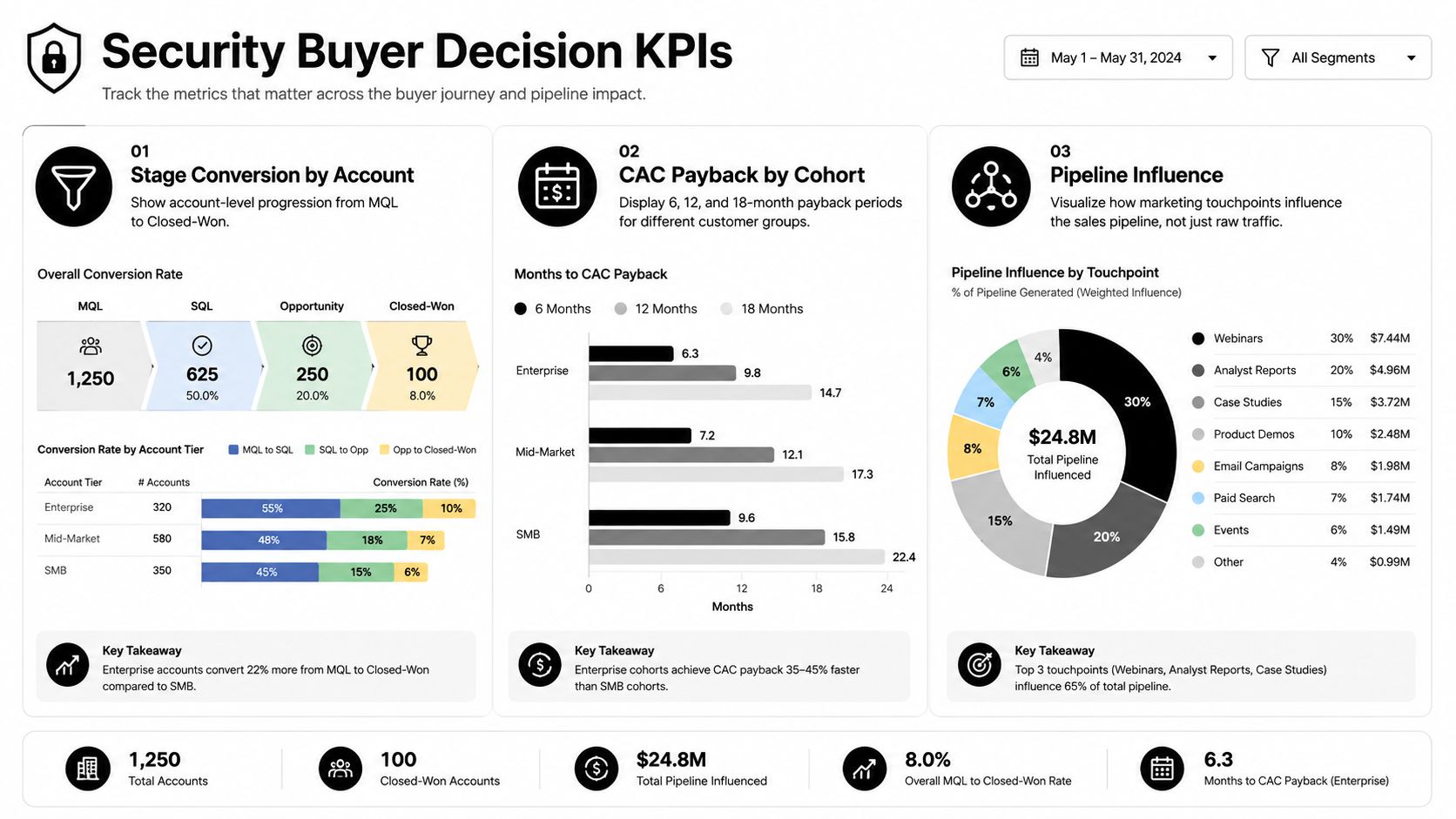
Here's the trap. Agencies love to celebrate top-of-funnel volume because it is easy to show and easy to defend. Meanwhile, proof-stage content starves, comparison pages underperform, and no one can explain why opportunities are not closing. If the reporting does not surface that quickly, it is decoration, not management.
If you are weighing agency help against doing it yourself, start with a launch or discovery platform for initial visibility, then hand the accounts that convert to a specialist once the proof base is in place. That does not replace strategy. It keeps you from paying a retainer before the fundamentals are ready.
When to Skip the Agency and Go DIY Instead
If you're early, cash-constrained, or still proving product-market fit, skip the retainer. Security buyers like to shortlist before they talk to sales, so your first job is to give them proof pages, comparison content, and a clear path to evaluate you on their own. That is the right move when the story is still being sharpened.
Hire later if the fundamentals aren't ready
Skip the agency when proof is thin, positioning keeps changing, or your team cannot answer integration questions without scrambling. Skip it too when your deal size cannot support cybersecurity CPCs and the committee-heavy nurture work that follows. An agency will spend money faster than it creates signal if the economics are not there.
A DIY stack gives you control. Platforms like ScrollLaunch can help founders publish SEO-ready product pages, keep them indexed, and get launch visibility without locking into retainers. Use that setup to build discoverability first, then pay for deeper execution once buyers have enough to evaluate.
Use this test before you sign anything
If you can answer yes to most of these, you are ready for an agency.
- You have proof: Case studies, testimonials, or enough product evidence to support real claims.
- You know the buyer: You can name the people in the committee and their objections.
- You have budget discipline: You can sustain channel costs without betting on one campaign.
- You need scale, not rescue: The agency will speed up a system, not invent one from scratch.
If most of that is still missing, stay lean and build the base first. Reps-free buying rewards clarity and trust, not polished fluff. Use the DIY phase to tighten the story, gather proof, and separate real demand from wishful thinking. Then bring in an agency when it can compound work that already has traction.
Decision Triggers and Final Recommendations
Hire a cybersecurity marketing agency when your economics can support the channel, your product story is stable, and you need committee-targeted content, SEO, or paid support that your team can't produce consistently. Stay DIY while you're still proving positioning, gathering proof assets, or waiting for the market to tell you which objections matter most. Fire an agency fast if it reports CTR and impressions without tying them to pipeline, opportunity quality, or account movement.
The timing matters. A good moment to hire is when you've got enough budget to survive a few months of learning and enough internal clarity to brief the work properly. A bad moment is when you want the agency to solve messaging confusion that your founders still haven't resolved.
Keep tool ownership in your contract. Review proof-stage content monthly. If the agency can't show that it's helping buyers shortlist you earlier and evaluate you more confidently, it's not doing the job.
Start with the hardest question in the room. “Would a security buyer trust this content enough to use it in a selection process?” If the answer is no, don't sign the retainer yet. If the answer is yes, move fast and hold the partner to pipeline, not polish.
If you're still deciding, use this article as a working checklist, then compare two paths side by side. One path is an agency built for technical credibility. The other is a lean self-serve setup that proves demand before you scale spend. Choose the one that matches your stage, not the one that sounds more impressive.