
Most career guides get growth marketing jobs wrong. They describe a friendly generalist who writes copy, manages social media, publishes SEO content, buys ads, and somehow owns revenue. That job description doesn't produce a growth marketer. It produces an overextended executor with unclear accountability.
The stronger definition is narrower: a growth marketer owns the loop between customer acquisition, activation, retention, and revenue. They instrument the funnel, form hypotheses, run controlled experiments, read the evidence, and decide what deserves more investment. Creative judgment still matters, but creativity without measurement is only activity.
Demand is moving toward people who can connect channels to business outcomes. The opportunity is real, but the hiring bar is more technical than the title suggests. If you're targeting growth marketing jobs in 2026, build proof that you can make better decisions with data, not just produce more marketing.
Table of Contents
- The Real Definition of Growth Marketing Jobs
- Market Demand and Employment Projections for 2026
- Roles, Seniority Levels, and Career Progression
- How Virtustant Jobs Can Help
- Core Skills and Tools That Actually Get Hired
- Building a Portfolio That Proves Growth Marketing Ability
- Finding Growth Marketing Jobs and Building a Career Path
The Real Definition of Growth Marketing Jobs
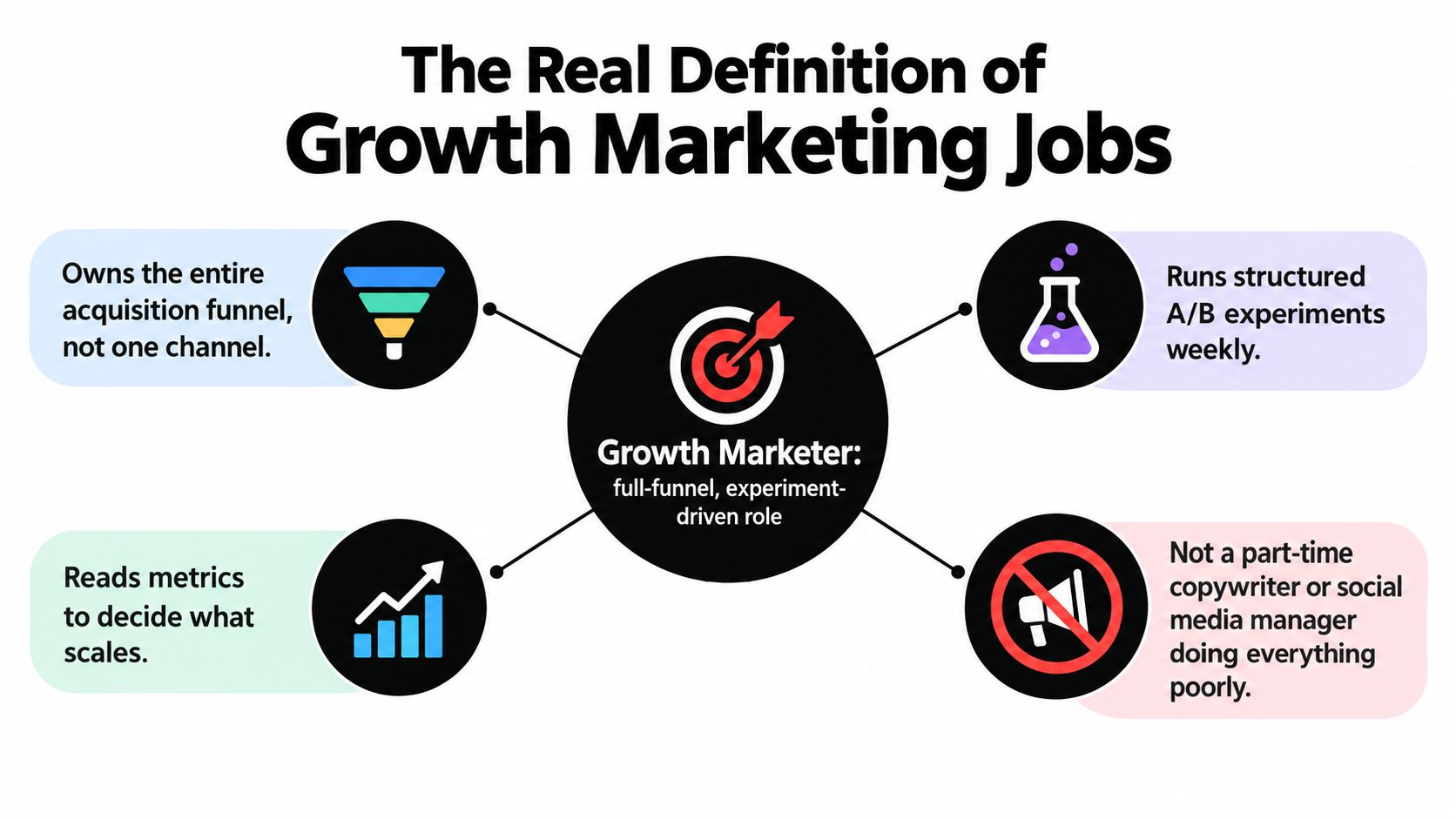
Growth marketing isn't “doing everything.” It's choosing the highest-growth problem, designing a credible test, and turning the result into an operating decision.
A content marketer may own editorial planning and distribution. A paid acquisition specialist may manage campaigns and creative testing. A lifecycle marketer may build customer journeys in a CRM. A growth marketer can work across all three, but the distinguishing responsibility is connecting the work into a measurable funnel.
That means defining the events that matter, checking whether tracking is trustworthy, segmenting users by behavior, and identifying where customers stop progressing. It also means knowing when a result is too weak to scale. A spike in clicks isn't meaningful if qualified traffic, activation, retention, or revenue doesn't improve.
The work sits between marketing and product
The technical boundary becomes clearer when you compare tasks.
A general marketing role might ask you to publish a campaign. A growth role asks you to define the campaign's target segment, connect it to a funnel event, establish a primary metric, set guardrails, and determine what happens if the result is positive or inconclusive.
Typical responsibilities include:
- Funnel instrumentation: Define events for signup, activation, trial conversion, purchase, referral, and retention.
- Experiment design: Create A/B tests with a clear hypothesis, audience definition, success metric, and stopping rule.
- Lifecycle operations: Connect CRM workflows to customer behavior instead of sending identical messages to every lead.
- Performance analysis: Use cohorts, conversion paths, and channel comparisons to distinguish growth from temporary noise.
- Commercial decisions: Recommend where to increase, reduce, or pause investment based on evidence.
In a U.S. analysis of 2025 digital-marketing postings, marketing-analytics roles represented 19% of all new postings, while marketing-automation-manager postings grew 10% year over year. The analysis points to roles that connect acquisition activity to funnel outcomes through CRM workflows, attribution, segmentation, lifecycle triggers, and reporting, as described in Robert Half's analysis of marketing and creative roles.
Practical rule: If you can't explain which user behavior your campaign is meant to change, you aren't ready to call the work growth marketing.
What growth marketers don't own alone
The role still overlaps with SEO, paid media, product marketing, sales operations, data analysis, and engineering. That overlap creates confusion in job descriptions, particularly at small companies where one person may perform several functions.
The distinction is ownership of the decision loop. A growth marketer doesn't need to personally write every landing page or build every SQL model. They do need to know what evidence is required, how the work affects the funnel, and whether the result justifies the next action.
That changes how you evaluate a job posting. “Own all marketing channels” may signal a poorly scoped role. “Own activation experiments, lifecycle conversion, and acquisition efficiency” signals a role with clearer outcomes, even if the team is small.
Market Demand and Employment Projections for 2026
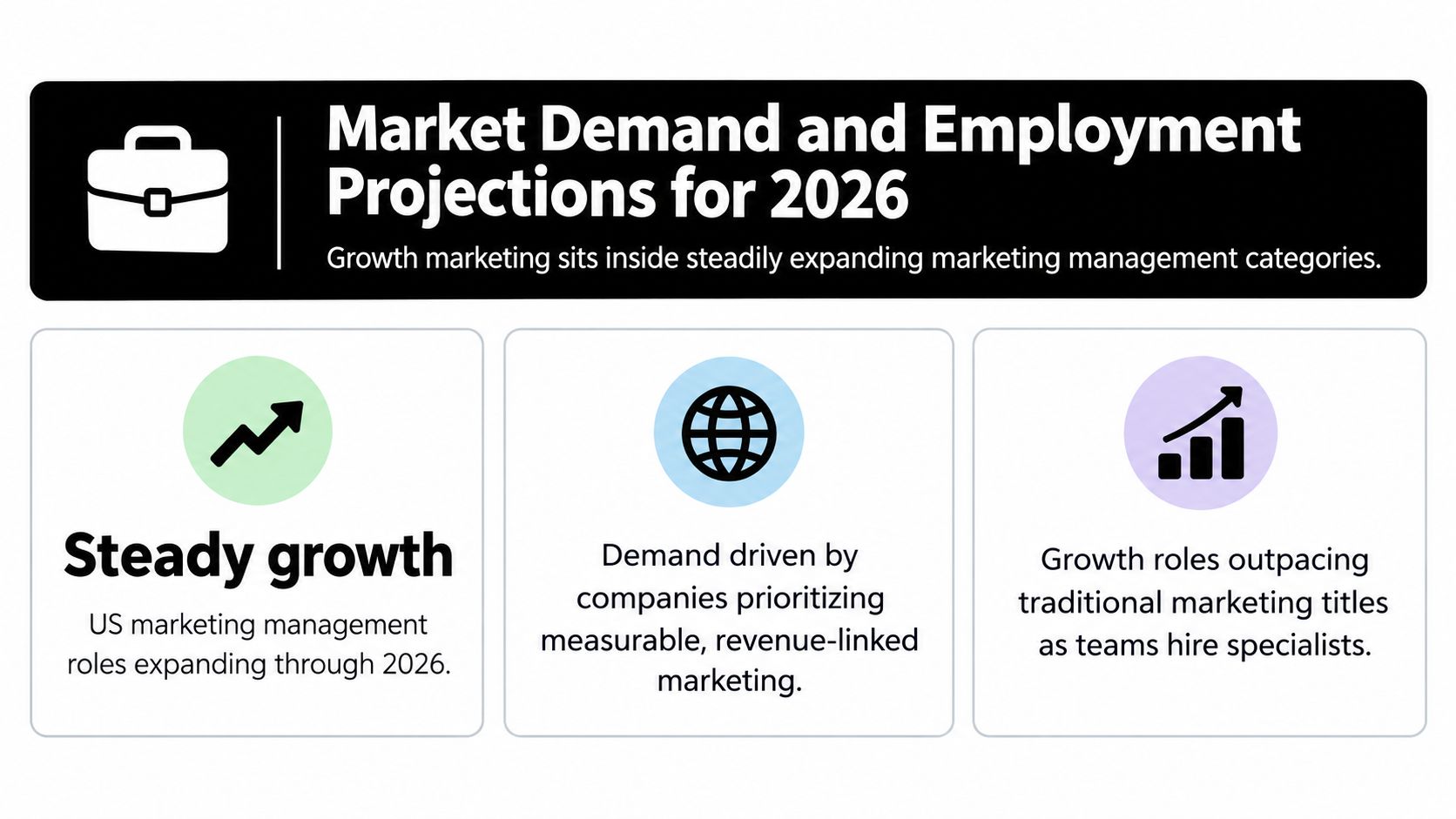
Growth marketing jobs don't appear as one standardized government occupation. They sit across marketing management, market research, marketing-specialist, demand-generation, customer-acquisition, and lifecycle functions. That makes broad labor-market categories more useful than searching for one perfect title.
The U.S. Bureau of Labor Statistics projects 6% employment growth for advertising, promotions, and marketing managers from 2025 to 2035, with approximately 36,300 openings per year, according to the BLS outlook for advertising, promotions, and marketing managers. Those openings include new positions and replacement demand as workers retire or move into other roles.
A related BLS-based estimate places marketing-manager employment at about 407,000 jobs in 2024 and approximately 433,700 by 2034, a net increase of roughly 26,700 positions, or 6.6%, using the same reference source. These figures don't mean every opening will carry the title “growth marketer.” They show that the broader management market where growth responsibilities often sit continues to expand.
Why analytical roles matter
The specialist side of the market is equally important. Market research analyst and marketing specialist roles accounted for approximately 941,700 U.S. jobs in 2024, with employment expected to increase by 7%, or about 63,000 jobs, between 2024 and 2034, based on the BLS-based projection cited above.
That category maps closely to growth work because it includes customer research, segmentation, campaign measurement, experimentation, pricing analysis, and behavioral-data interpretation. The projected 7% increase is slightly higher than the 6% growth projected for advertising, promotions, and marketing managers, which supports a useful conclusion: analytical execution isn't merely an entry route into management. It can remain a durable career track in its own right.
For candidates, the practical implication is to search broadly. Look for titles such as growth marketer, lifecycle marketing manager, performance marketing specialist, marketing analyst, demand-generation manager, product marketing manager, marketing automation manager, and CRM manager. Then read the responsibilities instead of relying on the title.
A startup may call a role “growth lead” when it needs a hands-on acquisition operator. An established company may distribute the same work across marketing analytics, lifecycle, and product marketing teams. Your skill evidence should travel across those naming differences.
If you're comparing internal growth teams with outsourced technical teams, the same principle applies: assess ownership, instrumentation, and decision-making rather than labels. A practical overview of adjacent technical hiring considerations appears in this guide to nearshore software developers.
The labor-market data validates the direction, but it doesn't remove the need for specialization. Companies aren't hiring people because “growth” sounds modern. They're hiring people who can explain which customer behavior needs to change and how the business will know whether it changed.
Roles, Seniority Levels, and Career Progression
The title stays broad, but the responsibility changes sharply with seniority. A junior marketer may execute a test someone else designed. A mid-level marketer owns the test plan and the reporting. A senior leader decides which growth problems deserve people, budget, and product support.
Entry level
Growth Marketing Coordinators and Junior Growth Marketers usually support campaign operations, reporting, audience preparation, analytics QA, and experiment execution. Employers may expect spreadsheet fluency, basic analytics-platform knowledge, and familiarity with a CRM such as HubSpot.
Your first objective isn't to claim strategic ownership. It's to demonstrate reliable execution and sound interpretation. Can you identify a broken event? Can you reconcile a campaign report with CRM data? Can you explain why a conversion rate moved without overstating the cause?
Mid-level
A Growth Marketer or Lifecycle Marketing Manager should own a defined section of the funnel. That might include trial activation, paid acquisition, onboarding, retention, or qualified demand.
The technical bar rises here. Recent job-posting analysis identifies HubSpot, SQL, and A/B testing among frequently requested skills, with SQL appearing in roughly 1,330 growth-marketing postings and A/B testing in about 1,178, according to the growth-marketing skills analysis from GetUHIRED. The same analysis describes SQL as a divider at mid-sized technology companies, while spreadsheets and analytics platforms form a baseline for entry-level roles.
At this level, you should be able to write queries that segment users, calculate funnel movement, compare cohorts, and identify the population affected by an experiment. You don't need to become a data engineer, but you can't outsource every analytical question.
Senior leadership
A Senior Growth Lead, Head of Growth, or Director of Growth takes responsibility for the system rather than a single channel. The work includes prioritization, budget allocation, hiring, cross-functional alignment, forecasting, and communication with leadership.
Senior candidates must also recognize when not to run an experiment. A weakly instrumented funnel, a tiny audience, or a poorly defined business objective can make a test expensive theater. Judgment includes protecting the team from false precision.
For indie makers and solo founders, the progression can happen without formal promotions. You may begin by running paid or organic acquisition, then take ownership of lifecycle automation, product analytics, and launch strategy. Your career advances when you can manage a repeatable growth system and make better trade-offs, not merely when you add more tools to your profile.
How Virtustant Jobs Can Help
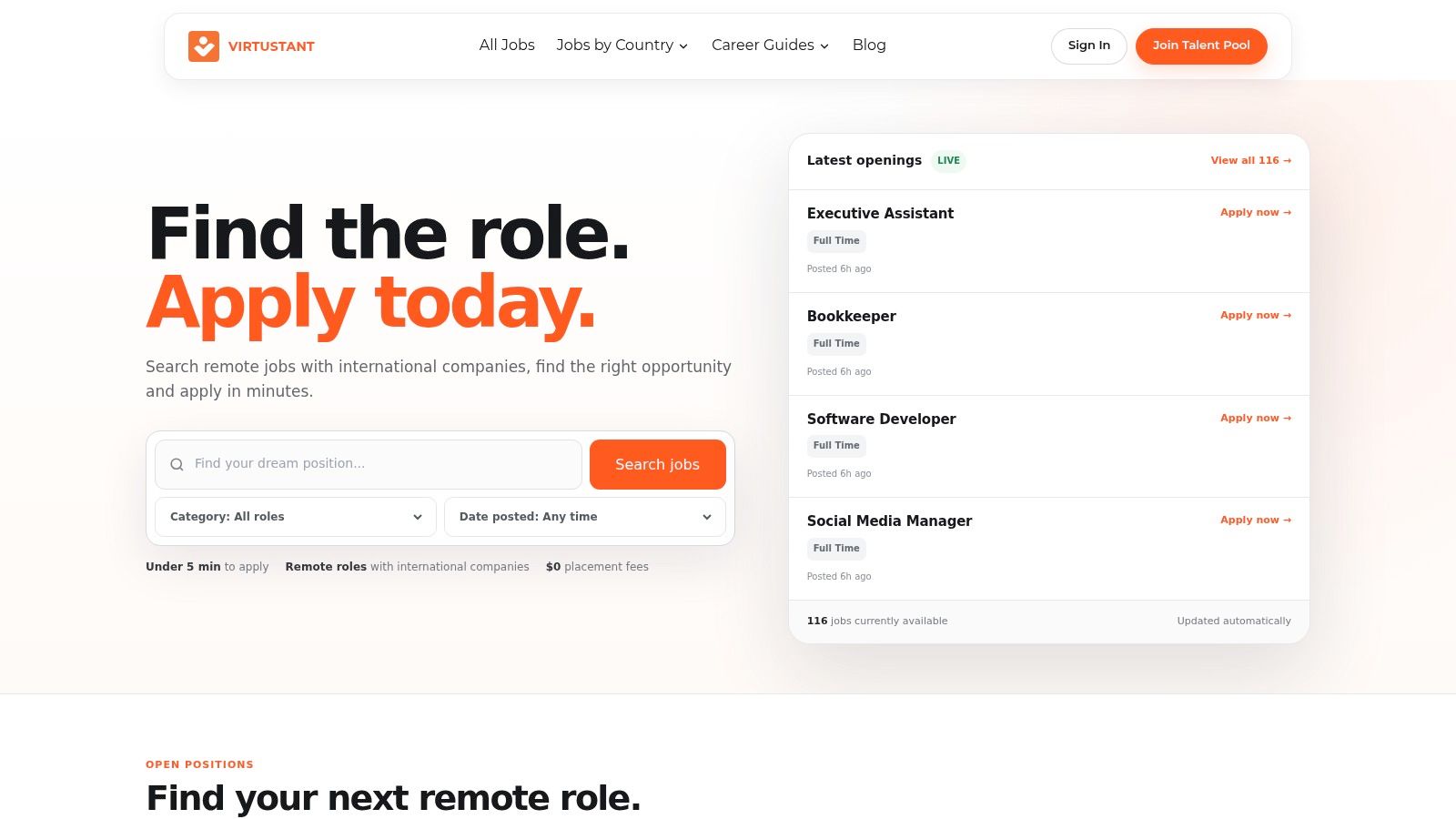
Remote candidates often lose time before the interview stage because relevant openings are scattered across unrelated boards. Virtustant Jobs focuses on remote roles for candidates across Latin America, with listings that cover marketing, growth, sales, customer service, operations, design, finance, and technical work.
For someone pursuing growth marketing jobs, the useful feature is specificity. Listings can describe responsibilities, required experience, software, schedules, and language expectations, including tools such as QuickBooks or Excel, U.S. Eastern Time availability, and advanced English requirements. That detail helps you reject poor-fit roles before spending time on an application.
When the platform fits
Virtustant Jobs is a sensible choice if you want:
- LATAM-focused discovery: Find remote opportunities framed around Latin American talent and bilingual collaboration.
- Clear working expectations: Review schedules, language levels, software requirements, responsibilities, and employment type before applying.
- A faster application path: Use Easy Apply and a short form rather than repeating a long application process for every listing.
- Broader adjacent options: Search marketing assistant, marketing manager, lifecycle marketer, affiliate and outreach specialist, paid media, PPC, analytics engineering, and AI or automation roles.
- Future matching: Create an account and optionally join the talent pool for consideration when suitable openings appear later.
The platform isn't a replacement for technical proof. A listing may help you find the opportunity, but your portfolio still needs to show event design, analysis, experimentation, and commercial judgment.
If your target is specifically lifecycle work, the curated growth marketing jobs resource offers a more focused starting point. It makes the most sense for candidates who want remote, cross-border roles and need clearer information about time zones, English requirements, and software expectations.
Core Skills and Tools That Actually Get Hired
Tool count is a weak proxy for employability. A candidate who lists ten platforms but can't explain attribution, test design, or data quality is less useful than someone who can operate a smaller stack with discipline.
The baseline stack usually includes spreadsheets, a web analytics platform, a CRM, an experimentation workflow, and enough SQL to answer practical funnel questions. The exact vendors vary. The reasoning doesn't.
A useful portfolio or interview exercise should show how you move from raw behavior to a decision. For example, identify users who reached a product milestone, compare their next-step conversion with users who didn't, form a hypothesis about the gap, and propose a test with a primary metric and guardrails.
The AI requirement is operational
AI is becoming a screening criterion, but copy generation alone won't distinguish you. The share of marketing job postings mentioning AI nearly doubled during 2025, rising from 8% in January to 15% in December, while 92% of surveyed marketers expected AI skills to become more important over the following five years, according to MarTech's analysis of valuable marketing skills.
The valuable capability is operational judgment. Use AI to generate creative variants, classify leads, flag anomalies, personalize campaign logic, or automate reporting, then validate the output against actual performance and privacy constraints. Marketing technology was considered important by 87% of respondents, while data privacy, compliance, and security were important to 84%, according to the same source.
| Skill category | Specific tools and platforms | Why employers value it | How to demonstrate it |
|---|---|---|---|
| Data analysis | SQL, Google Sheets, Excel, warehouse dashboards | Turns campaign data into decisions | Show a funnel query, cohort view, and plain-language recommendation |
| Analytics | GA4, Mixpanel, Amplitude, event pipelines | Reveals behavior after the click | Document an event taxonomy and explain tracking limitations |
| CRM and lifecycle | HubSpot, Salesforce, Customer.io, Braze | Connects segmentation to activation and retention | Build a journey with entry rules, exclusions, and success metrics |
| Experimentation | A/B testing tools, feature flags, landing-page platforms | Tests ideas without confusing correlation for causation | Present a hypothesis, primary metric, guardrails, and stopping logic |
| Paid acquisition | Google Ads, Meta Ads, LinkedIn Campaign Manager | Links spend to qualified demand | Explain audience structure, creative testing, and budget decisions |
| AI operations | LLM workflows, automation platforms, anomaly alerts | Improves speed without removing review | Show an automated workflow and the checks that prevent bad decisions |
| Governance | Consent management, access controls, documentation | Protects measurement quality and customer trust | Include retention, consent, bias, and attribution considerations |
SQL matters because it reduces the distance between a question and an answer. Start with joins, filters, aggregations, date logic, window functions, and cohort segmentation. Then practice explaining the business implication of the output.
For SaaS teams, you can also study how launch distribution, product pages, and acquisition experiments fit together in this guide to promoting a SaaS product. Treat the article as a planning reference, not a substitute for measurement.
Building a Portfolio That Proves Growth Marketing Ability
A creative portfolio shows what you made. A growth portfolio shows what you believed, what you tested, what happened, and what you changed.
You don't need to have managed a large advertising budget. You can work with a side project, a public product, a nonprofit, a local business, or a deliberately constructed dataset. The project must be honest about its limits. Don't label a directional observation as causal proof.
Use a decision record, not a gallery
Each case study should answer a practical sequence:
- Business problem: What outcome was blocked, and why did it matter?
- User segment: Which customers or prospects were affected?
- Baseline: What behavior or funnel stage did you measure?
- Hypothesis: What change did you expect to influence that behavior?
- Experiment: What did you change, and what remained constant?
- Metrics: Which primary metric and guardrails determined the result?
- Interpretation: What can the data support, and what remains uncertain?
- Decision: Would you scale, revise, stop, or run another test?
A strong example might examine a signup flow. You could define the activation event, compare behavior before and after a change, identify a cohort with unusual drop-off, and propose an experiment around onboarding friction. The point isn't to pretend the project has enterprise-grade certainty. The point is to show that you know how to make a claim responsibly.
Seniority changes the proof required
For an entry-level portfolio, clean tracking documentation and thoughtful analysis can carry significant weight. Show that you can inspect a funnel, create a useful report, and avoid obvious interpretation errors.
A mid-level portfolio should demonstrate ownership. Include prioritization, audience logic, SQL or spreadsheet analysis, test design, lifecycle reasoning, and a recommendation that affects budget or product work.
A senior portfolio needs operating judgment. Show how you selected one opportunity over another, handled conflicting stakeholder requests, protected attribution quality, and built a process that a team could repeat.
A 2026 hiring survey ranked problem-solving and critical thinking as the top priority for marketer recruitment, cited by 66% of respondents, ahead of technical expertise at 61%, as reported in the GetUHIRED growth-marketing analysis. Those figures reinforce an important distinction: technical tools support the work, but judgment determines whether the work is useful.
A certification proves that you completed a course. A decision record proves that you can think under uncertainty.
Contract work can become your evidence engine
Independent projects are especially valuable for indie makers and solo founders because they create real operating constraints. You may have limited traffic, incomplete data, no dedicated analyst, and no permission to spend freely. Those constraints force you to explain trade-offs that polished classroom exercises often avoid.
For contract positioning, sell a defined outcome rather than unlimited availability. Examples include an analytics audit, lifecycle segmentation project, activation experiment backlog, or reporting system. Document the scope, dependencies, data access, decision owner, and handoff requirements before discussing the fee.
That approach protects both sides. Clients know what they're buying, and you avoid becoming an on-call generalist whose work can't be evaluated.
Finding Growth Marketing Jobs and Building a Career Path
The best path depends on what you can already prove and how much uncertainty you can tolerate. Full-time work offers deeper access to a product, team, data, and internal context. Contract work offers breadth, faster repetition, and more control over the kind of problems you accept. Neither path is automatically more senior.
Available hiring data suggests employers are combining permanent employees, contractors, and fractional specialists. One survey found that 28% of business leaders, HR professionals, and hiring managers intended to hire marketing talent, while Robert Half reported that 65% of marketing and creative leaders planned to expand permanent headcount and 55% expected to increase contract or temporary hiring. The same reporting said 45% found skilled professionals harder to find than the previous year, according to the 2026 marketing-skills hiring overview.
Choose the operating model first
A full-time role fits candidates who want to develop deep product context, influence roadmap decisions, and build systems over time. Ask about data access, experimentation authority, engineering support, and how leadership defines success. A high-sounding title with no instrumentation or decision rights can stall your development.
A contract or fractional path fits candidates who can package a specific capability. You might specialize in lifecycle setup, paid acquisition diagnostics, analytics implementation, experimentation planning, or AI-enabled reporting. The trade-off is that you must manage sales, scope, cash flow, client communication, and proof of value alongside the marketing work.
For an indie maker, a third route is often practical: build growth systems for your own product while taking a small number of client engagements. Your product becomes a living laboratory, while client work exposes you to different funnels and buying contexts. Keep the boundaries clear, and never use confidential client data in public case studies.
Search by problem, not only by title
Search for responsibilities tied to outcomes. Useful terms include lifecycle, activation, demand generation, marketing analytics, marketing automation, CRM, performance marketing, product growth, experimentation, and revenue operations.
Review each posting for evidence of a serious role:
- Defined ownership: The company names a funnel stage, customer segment, or business outcome.
- Data access: The team identifies its analytics, CRM, warehouse, or reporting environment.
- Decision authority: The marketer can influence budget, messaging, onboarding, or product priorities.
- Reasonable collaboration: Engineering, product, sales, and data responsibilities are described rather than assumed.
- Measurable expectations: The role mentions qualified pipeline, activation, retention, acquisition efficiency, or another meaningful outcome.
Avoid roles that combine every channel, every audience, and every operational task without a priority order. They may provide exposure, but they rarely provide the focused ownership needed to build a credible career.
When applying, tailor your resume around decisions and outcomes. A tool list should support the story, not replace it. A practical starting point is this free AI resume builder and ATS resume checker, especially when you need to convert project work into clearer evidence for screening systems.
Your next move should be concrete. Pick one funnel problem, build one documented experiment, and publish the reasoning behind it. Then apply to growth marketing jobs where that evidence matches the company's actual need, whether the role is full-time, fractional, or remote contract work.
If you're an indie maker or SaaS founder, submit your product to ScrollLaunch to create a durable launch page, reach a discovery audience, and turn your launch work into a measurable distribution asset. Use the platform's product page, analytics, and launch documentation as part of the same experiment-first growth system you're building.