
Most advice on nearshore software developers starts in the wrong place. It sells you on cheaper labor and a friendly time zone, then acts surprised when the project still drifts, scopes expand, and nobody can tell who owns the mess. The actual advantage isn't discount, it's collaboration density, the ability to keep product, engineering, and delivery decisions moving inside the same workday.
That difference changes how software gets built. A team in Latin America can stay inside a 1 to 4 hour time-zone difference from U.S. headquarters, with 6 to 8 hours of daily overlap in places like Mexico City, Bogotá, and Buenos Aires, which makes synchronous code review and same-day sprint ceremonies practical instead of theoretical, while a much larger time gap turns every issue into a relay race nearshore business overlap guidance. If you hire nearshore just to save money, you'll usually get mediocre results. If you hire nearshore to shorten feedback loops and reduce delivery friction, you're buying the actual advantage.
Table of Contents
- Why Nearshore Beats Cheap and Far
- Nearshore vs Offshore vs Onshore
- Top Nearshore Countries and Time Zones
- Hiring and Vetting Checklist
- How Virtustant Can Help
- Nearshore Pricing and Contracting
- Team Models and Integration
- Risks to Mitigate Before You Sign
- A 90-Day Timeline to First Merge
Why Nearshore Beats Cheap and Far
Cheap labor doesn't ship products. Tight collaboration does.
That's why the best nearshore teams don't win because they're the lowest bid. They win because they can join a live incident at 2 PM Eastern, review a pull request before lunch in your time zone, and keep a release moving without waiting overnight for a reply. The economics improve because your team spends less time waiting, re-explaining, and reopening decisions.
Collaboration density is the real product
A six-hour overlap gives you a morning sync, afternoon code, and same-day review. That's a very different operating model from the old offshore relay, where a blocker gets written down at the end of your day and picked up after everyone's gone home. The six-hour gap compresses uncertainty; the twelve-hour gap stretches it.
That's why buyers who shop nearshore like they're buying discount offshore capacity usually underperform. They pick the vendor with the lowest hourly rate, then discover they still need a strong PM, sharper documentation, and more internal coordination than they planned for. Nearshore works when you treat it as a delivery model, not a labor arbitrage play.
Practical rule: choose nearshore when the work changes quickly, needs real-time decisions, or depends on product managers and engineers staying in the same conversation.
Market tracking also shows this model is no longer niche. Recent industry summaries place the nearshore software development market at $12.4 billion in 2022 with a projected 14.2% CAGR through 2030, while another estimate projects $50.8 billion in 2026 growing to $85.0 billion by 2035 at 5.2% CAGR market summary. That growth reflects a shift in buyer behavior, from cheap outsourcing to operational proximity.
Nearshore vs Offshore vs Onshore
Buyers usually waste time asking which model is “best.” That's the wrong question. The right question is which model reduces your delivery risk without forcing you into the wrong tradeoff.
| Dimension | Nearshore (LatAm/EU) | Offshore (Asia/E. Europe) | Onshore (US/EU) |
|---|---|---|---|
| Time zone alignment | Strong same-day overlap | Large sync delays, often 8 to 12 hours | Best possible overlap |
| Fully loaded cost | Lower than onshore, higher than offshore | Lowest cost profile | Highest cost profile |
| Talent access | Strong regional depth, especially in major hubs | Broad global talent pools | Limited by local labor market |
| Communication friction | Lower than offshore, more than onshore | Higher due to latency and handoffs | Lowest friction |
| IP control | Good if contracts and access are tight | Good if governance is strong | Strongest by default |
Nearshore is usually the middle path on price, and that's exactly why it wins in the right situation. It can run 40% to 60% less than U.S. onshore on a fully loaded basis in many cases, but it won't beat a pure offshore shop on hourly cost nearshore cost guidance. That tradeoff is fine if your real problem is slow iteration, not just payroll.
What each model is actually for
Nearshore is the right call when your product team needs live collaboration, but you still want to keep spend below a U.S. team. Offshore makes sense when the scope is stable, the work is well specified, and handoffs can happen asynchronously without much damage. Onshore is the premium option when regulation, proximity, or cultural alignment matter more than labor savings.
IP control follows the same pattern. Onshore is easiest to govern, nearshore is manageable if you put legal and technical controls in place, and offshore requires stronger discipline because the distance tends to magnify every process weakness. Don't choose a model because it looks cheaper in a spreadsheet. Choose the one that fits your operating style.
Top Nearshore Countries and Time Zones
For U.S. buyers, start in Latin America. For European buyers, start in Central and Eastern Europe. Don't build a country list for vanity, build one for the stack you need and the time window you can support.
Americas first if you need daily overlap
Mexico is the first stop for U.S. teams that want practical overlap and a broad hiring market. It's the safest default if your squad works in TypeScript, web platforms, and product engineering. Colombia is a strong second option for teams that need reliable collaboration and steady English use, especially for full-stack work. Brazil is worth prioritizing for front-end, mobile, and product-led builds, while Argentina is a stronger bet when you need Python, data, and systems-minded engineers. Uruguay and Chile are smaller markets, but they're useful when buyer teams want stronger process maturity and lower coordination noise.
For a U.S. founder, the practical split is simple. Start in Mexico or Colombia for a TypeScript squad, then widen to Brazil or Argentina if you need more specialization or broader seniority. If you want to sanity-check time-zone fit before sourcing, use the geo checker tool to confirm overlap before you write the first brief.
Europe for regulated and systems-heavy work
Poland should be near the top for a German, Dutch, or U.K. CTO hiring for .NET, Java, cloud, and embedded work. Portugal is a good first look when you want Western European cultural alignment with a more accessible cost base. Romania remains a sensible option for enterprise engineering, especially when the work needs deeper systems experience. Talent tied to Ukraine-adjacent networks is often strong on backend and infrastructure work, but buyers need to evaluate continuity and operational stability with more care.
If your release rhythm depends on same-day feedback, hire where your team can actually talk during the workday. If your project is mostly asynchronous, widen the geography.
A German CTO sourcing a Java team should start in Poland or Romania, then compare language fit and delivery maturity. A U.S. startup building a customer-facing app should start in Mexico, Colombia, or Brazil before looking farther away. Geography matters less than overlap, but more than most vendors want to admit.
Hiring and Vetting Checklist
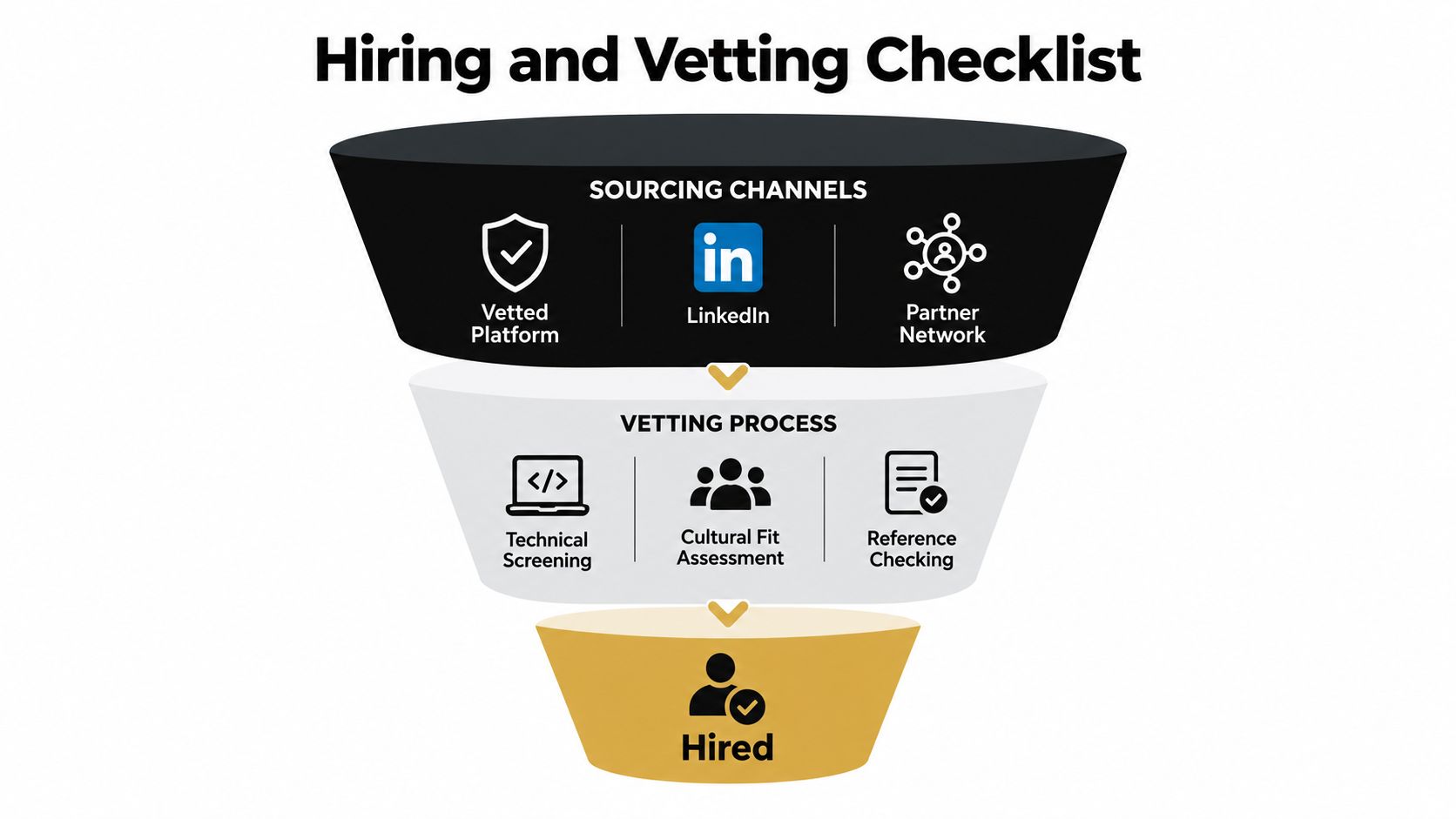
Stop treating nearshore hiring like a marketplace transaction. Build a funnel with clear rejection points, or optimism will become an expensive staffing decision.
Source from three channels at once
Use vetted platforms, local LinkedIn searches, and founder referrals in parallel. Generic listings attract resume spam and applicants with little context. Start with city filters, role-specific Boolean queries, and conversations with people who have managed distributed teams.
For a benchmark on structured hiring and talent sourcing, read this guide to how product development agencies build vetted teams. You can also hire nearshore software developers through an operational staffing channel. Treat either source as an input, not a substitute for your own assessment. The screening process matters more than the sales copy.
Run the same four filters every time
- Systems design conversation. Keep it to 30 minutes. Test tradeoffs, constraints, and reasoning rather than trivia.
- Paired coding on your real codebase. Use a 90-minute session on an actual repository. Skip algorithm puzzles.
- Paid trial sprint. Assign a small, real deliverable for one week at reduced scope. Define acceptance criteria before the trial starts.
- Reference checks. Speak with two former managers who can describe reliability, communication, and ownership.
Disqualify on behavior, not charm
Reject candidates who refuse a trial, cannot explain architectural tradeoffs, or disappear during scheduling. Red flags rarely improve after signing. Cultural fit appears in code review, written updates, and response to feedback, not in polished interview answers.
CTO rule: if you would not let the candidate land a real PR during the trial, do not sign a long-term contract.
Non-technical founders should hire a part-time engineering assessor. That cost is small beside the rework, delays, and management burden created by a candidate who interviews well but cannot work inside your stack.
How Virtustant Can Help
Virtustant is a remote staffing agency that connects U.S. companies with vetted professionals across Latin America for full-time remote roles. It handles sourcing, assessment, placement, contracts, payroll, HR, and compliance under a single all-in hourly rate, which matters when you want one vendor to own the administrative mess instead of handing it back to your ops team. If you want to evaluate its process directly, use the nearshore staffing resource and compare it against your own hiring checklist.
The right use case is straightforward. Virtustant fits teams that want nearshore hires with U.S. time-zone overlap, high English proficiency, and a managed process for compliance and payroll. It also makes sense when your internal team is too small to run sourcing, screening, and cross-border admin on its own.
What it solves
It's useful when the bottleneck is not access to resumes, but getting a vetted shortlist fast enough to keep the work moving. The agency says it delivers 3 to 5 pre-vetted candidates within 48 hours, uses a four-stage vetting process with a live English screen, cognitive assessment, role-specific skills test, and experience verification, and supports roles beyond developers, including customer support, marketers, project managers, data analysts, and recruiters.
It also removes a painful hidden cost: cross-border admin. If you don't want to create a foreign entity or manage local payroll and contract details yourself, that packaging can save a lot of operational overhead. Use it when speed, compliance, and convenience matter more than building a fully internal sourcing function.
Nearshore Pricing and Contracting
Price only matters after you account for the hidden costs. Teams that compare hourly rates alone usually miss turnover, ramp time, and the coordination tax that lands later in the quarter.
Use ranges, not fantasy bids
A practical budgeting model looks like this:
| Seniority | Hourly USD | Monthly USD | Annual USD | Hidden Cost Multiplier |
|---|---|---|---|---|
| Junior | 35 to 55 | about 7,000 | lower annual seat cost | Depends on ramp and supervision |
| Mid-level | 55 to 85 | about 11,000 | mid-range seat cost | Depends on scope and turnover |
| Senior | 85 to 130 | 15,000+ | higher annual seat cost | Highest if ownership is vague |
Latin America usually sits toward the lower end of those ranges. Eastern Europe is often a bit higher. That is not the question buyers should obsess over. The core issue is whether the engineer owns a clear module or whether your team expects them to absorb vague architecture decisions without support.
Hidden costs break budgets. Replacing a developer can add $50,000 to $90,000 in fully loaded turnover cost and 12 to 20 weeks of lost productivity, according to turnover and labor cost guidance. Recruiting, onboarding, and coordination can narrow the labor-cost advantage fast. If you are moving money across borders, fast international transfer options for Cadremit payments also affect the total cost of the contract.
Contract structure beats rate negotiation
Use 6 to 12 month commitments with a 30-day exit clause. Put IP assignment in a signed work-for-hire addendum. Add jurisdiction-specific data clauses if you touch GDPR or CCPA-covered data. If a vendor offers time-and-materials without a burn cap, they are protecting margin, not delivery.
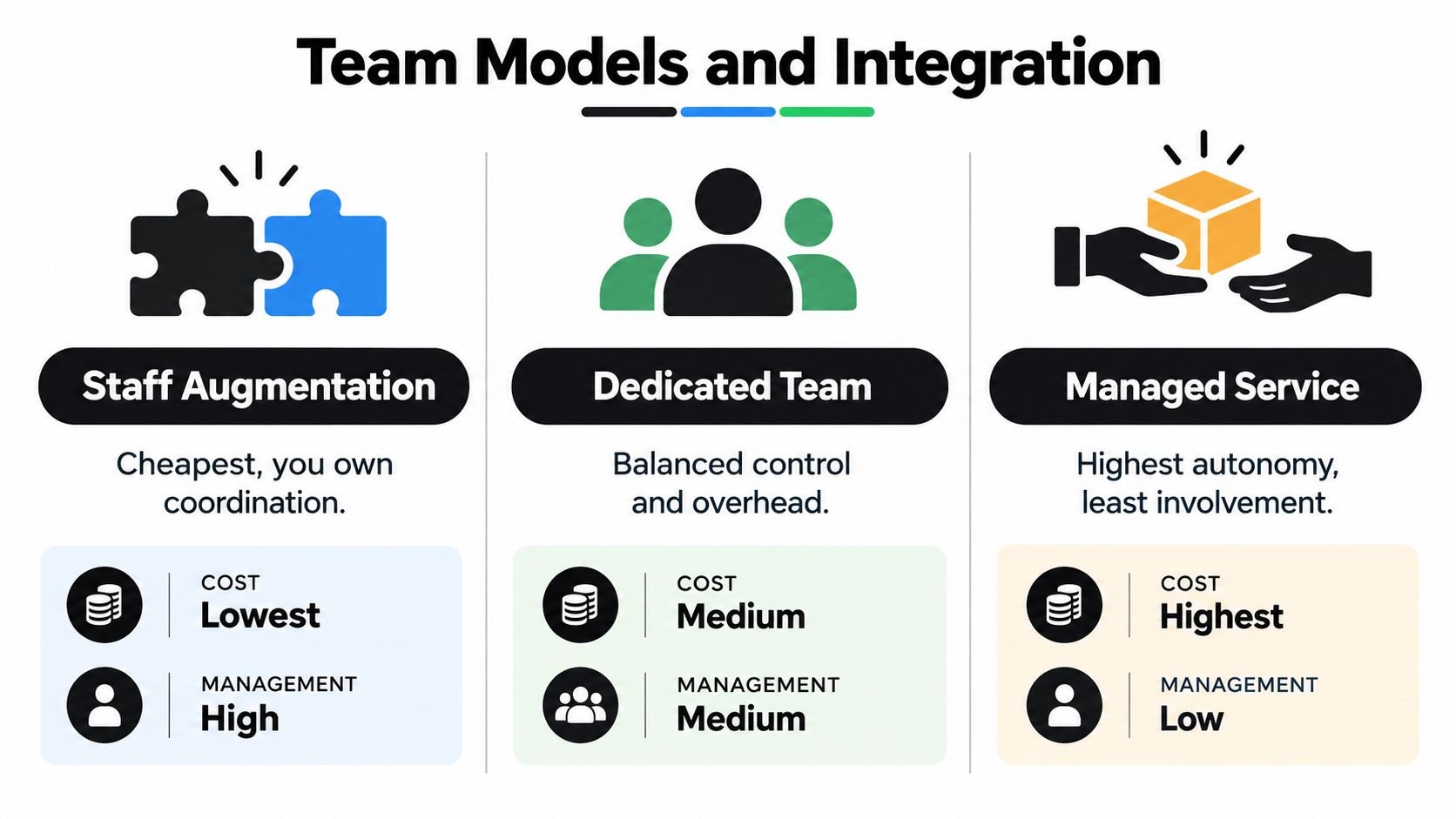
Pick the model that matches your management capacity. Staff augmentation is cheapest and puts coordination on your team. Dedicated squads work best when you want vendor throughput but still need control over priorities and acceptance. Managed delivery fits teams that care more about outcomes than headcount. If your product team is lean, a tool like ScrollLaunch can help with discovery and distribution outside engineering, but it will not replace disciplined delivery governance.
Team Models and Integration
The biggest mistake buyers make is thinking vendor model solves management. It doesn't. It just shifts who feels the pain.
Pick the model that matches your leadership bandwidth
Staff augmentation works when you already have strong engineering leadership and need specific hands. Think one to three nearshore developers adding capacity to an existing squad. It's the cheapest setup, but your PMs and tech leads own onboarding, code quality, and release pressure.
Dedicated squad works when you need a vendor to absorb more of the delivery load. A vendor builds a small team, usually with a tech lead, and your side keeps product priority and acceptance criteria. This is the sweet spot for most startups that need scale without adding a lot of internal management layers.
Managed delivery is the right choice when you don't have enough senior bandwidth to run the team yourself. The vendor owns the outcome, while you define business goals and approve major technical decisions. It costs more, but it prevents the silent failure mode where nobody is clearly responsible for the actual release.
Integration rules that keep teams sane
- Shared Slack access: Put the vendor in the same channels as your in-house team.
- Weekly demos: Force visible progress every week, not every milestone.
- Shared code review: Let your senior engineers review the important PRs.
- Same CI/CD and observability stack: Don't split the tooling if you want clean handoffs.
- One internal owner: Assign one in-house engineer to own the relationship.
Skip any vendor that wants to use a separate workflow just because that's how they've always done it. Tooling mismatch becomes process drift fast, and process drift becomes product drift even faster.
Risks to Mitigate Before You Sign
Most nearshore failures come from predictable damage, not rare disasters. If you handle the obvious risks up front, the relationship usually behaves.
The four failure modes that matter
Communication gaps show up when teams don't overlap enough or documentation is too thin. Set a minimum of 4 hours of live overlap, require async-friendly docs, and define a written escalation path before work starts. That alone prevents a lot of expensive confusion.
Scope creep happens when discovery is fuzzy and change requests are handled casually. Lock a discovery sprint with fixed deliverables before build work begins, then tie every change order to written approval and a clear cost impact. If the scope keeps changing and nobody records the tradeoff, you're funding drift.
IP and data security need both legal and technical controls. Require code-only assignment clauses, repo and infrastructure audit access, and security standards that map to SOC 2 or equivalent practices. Treat NDA language as a floor, not the finish line.
Vendor dependency is the quiet killer. Make sure source code, CI pipelines, and documentation transfer with 30 days notice, and add a sunset clause plus a knowledge-transfer trigger if turnover rises above 15%. If the vendor can hold your product hostage, the contract is broken.
Don't sign until you know exactly how you'll get the code, the docs, and the people back if things go sideways.
A 90-Day Timeline to First Merge
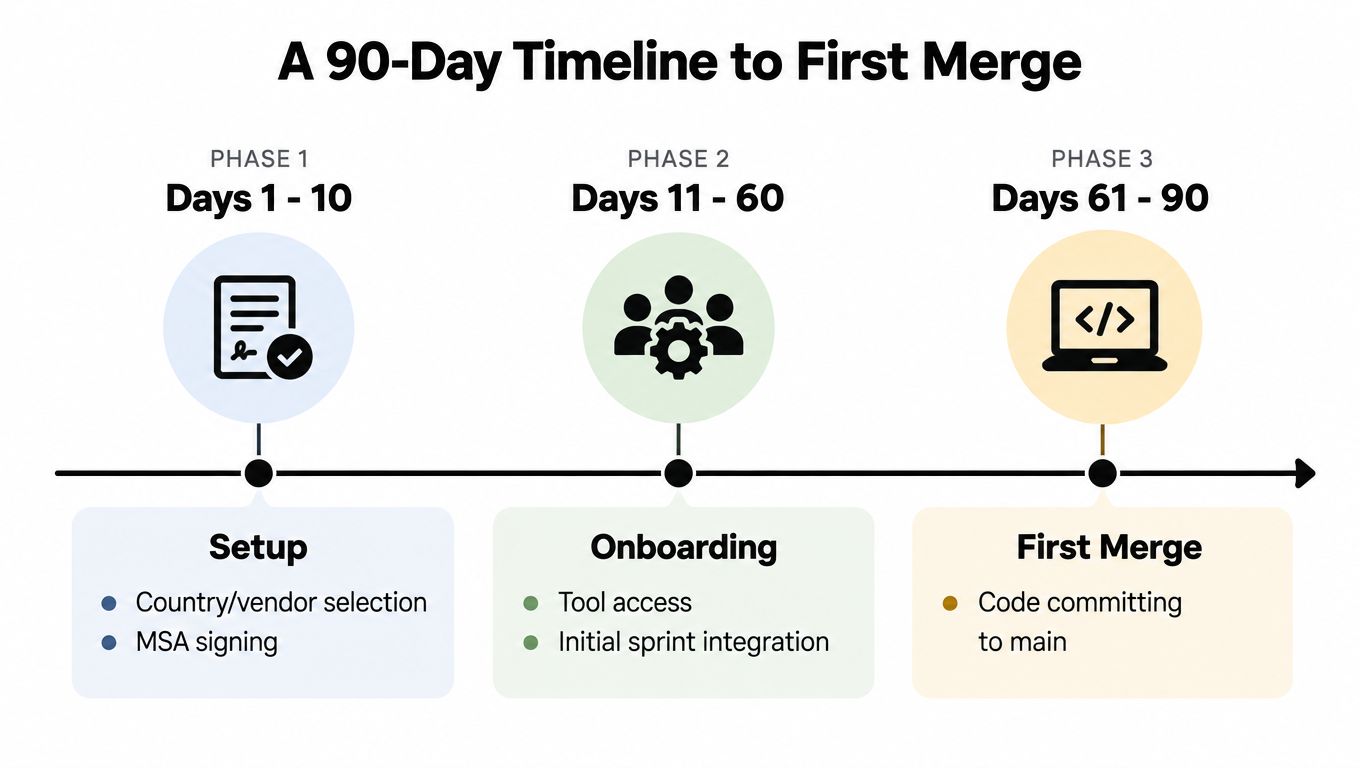
A nearshore team should ship merged code inside 90 days if the setup is tight and the handoffs are clean. If it can't, the process is already leaking.
Days 1 to 30
Days 1 to 10 are for country selection, vendor selection, MSA and SOW signing, and a paid 3-day trial sprint. Days 11 to 30 are for repo access, CI setup, design system onboarding, and a small refactor done with a real reviewer on the inside. By the end of the first month, the team should know the first release scope and the review path.
Days 31 to 90
Days 31 to 60 should produce the first user-facing feature, with weekly demos and retros that change behavior. Days 61 to 90 should add two more features, formalize the definition of done, and hand off ownership of one module. If you don't have a merged PR by then, your onboarding is too slow or your requirements are too vague.
Before you sign, verify the legal entity, IP terms, security posture, references, overlap hours, and exit clause in writing. If any of those are vague, keep looking. If you want a nearshore team that behaves like an extension of your company, start with the vendor that makes governance boring and delivery visible.