Most founders still hire a product development agency like they're buying a bundle of deliverables, a spec, a design file, a build, and maybe some launch support if the scope allows it. That mindset is outdated. The better question is whether the agency can help you make the right product decisions, reduce avoidable risk, and tie the work to commercial outcomes after launch.
That shift matters because the category has become a serious market, not a boutique service. The global product design and development services market was estimated at USD 17.06 billion in 2023 and is projected to reach USD 32.93 billion by 2030, with 10.08% CAGR from 2024 to 2030 (Fortune Business Insights). In North America alone, the market was estimated at USD 4.82 billion in 2024 and forecast to reach USD 5.22 billion in 2025 (Fortune Business Insights). That scale tells you something simple, agencies that can own outcomes are in demand because product work is expensive to get wrong.
Table of Contents
- Redefining the Product Development Agency
- Software Houses vs End-to-End Product Firms
- The Gated Development Process and Risk Reduction
- How Refact Can Help
- Evaluation Criteria and RFP Questions
- Integrating Agency Outputs with Indie Maker Launches
- Market Scale and Final Hiring Checklist
Redefining the Product Development Agency
A product development agency is not just a team that turns Figma into code. The strongest firms connect research, design, engineering, prototyping, launch support, and post-launch iteration into one working process. That changes how you evaluate them, because you are not buying tasks, you are buying judgment.
Outcome ownership beats output obsession
The agencies worth hiring are the ones judged on commercial acumen and measurable KPI impact, not only code quality or visual polish (Anml). For founders, that means asking whether the team can talk about CAC, LTV, conversion, and retention without hiding behind generic product language. If they cannot connect product decisions to revenue and retention, they probably do not own enough of the lifecycle to help after handoff.
Practical rule: If the first conversation centers on deliverables, you are talking to a vendor. If it covers customer behavior, pricing friction, onboarding drop-off, and launch feedback loops, you are closer to a real product partner.
AI has changed the baseline too. Industry guidance treats AI-enabled workflows as expected capability, not a novelty (Anml). That does not make “we use AI” impressive on its own. It means the agency should already use it to speed up research synthesis, tighten handoffs, and shorten iteration cycles, while still keeping humans accountable for taste and product judgment.
The buying decision that actually matters
Indie makers rarely need a large team. They need a partner that can challenge assumptions, cut scope without breaking the product, and keep discovery active after launch. That is what separates shipping a feature set from building something that can earn its keep.
A concrete test helps here. If discovery shows that the original MVP is too broad, an outcome-owning agency should be willing to narrow the scope to one clear job, rewrite the launch plan around that job, and treat early user behavior as input for the next round instead of defending the original spec. That is a better signal than a polished proposal from a team that only wants to build what was first requested.
Teague appears in some agency roundups for its long history in product design, including Elsner, but age alone does not tell an indie founder much. What matters is whether the partner knows when to validate, when to simplify, and when not to build at all.
Software Houses vs End-to-End Product Firms
Choosing the wrong partner type is one of the fastest ways to waste budget. A software house, a product studio, and an end-to-end product firm can all build software, but they own different parts of the problem. Treat them as interchangeable and you get mismatched expectations, weak handoffs, and a team that is good at delivery but weak at commercial judgment.
Agency Partner Types Compared
| Partner Type | Strategy & Research | Post-Launch Support | Best For |
|---|---|---|---|
| Software house | Usually light, often limited to implementation | Often minimal or separate | Teams with a locked scope and in-house product thinking |
| Product studio | Usually involved early, before build starts | Sometimes included, depends on the engagement | Founders who need help shaping the product, not just shipping it |
| End-to-end product firm | Typically involved from discovery through launch and ongoing evolution | Usually part of the model | Teams that want continuity, iteration, and one accountable partner |
A software house works well when you already know what to build and only need execution. That fits a mature team with product management, research, and design already in place. It breaks down quickly if you expect the partner to rescue a weak concept or translate vague business goals into a product plan.
Why early-stage founders get tripped up
Independent explainers consistently describe product development firms as bringing strategy, user research, and design earlier than fixed-spec dev shops, while end-to-end models cover discovery through launch and ongoing evolution (Octopus Intelligence). That difference matters because continuity has real value. The team that learned your users, constraints, and trade-offs during discovery is better positioned to improve the product after launch than a new team coming in cold.
The same evaluation logic applies when choosing a specialized partner such as a Webflow development agency. If the work is mostly implementation, a narrower shop can be fine. If you still need help testing the product shape, fixing the offer, and deciding what not to build, a partner with broader product judgment is the safer fit.
The hidden cost of a cheap implementation partner is usually not the build itself. It's the lost context when you need iteration.
For indie founders, the right choice depends on internal capability. If you can write the roadmap, own research, and manage launch testing, a software house may be enough. If you are still testing whether the product deserves to exist, a product studio or end-to-end firm is usually the better bet because it can help you learn before you overbuild.
The real test is support. A true product development agency should be comfortable with the uncomfortable questions, what happens if onboarding fails, if the first workflow is too confusing, or if the first release needs to be pared back. A dev shop may not be set up to own those conversations, and that gap shows up exactly when the product meets reality.
The Gated Development Process and Risk Reduction
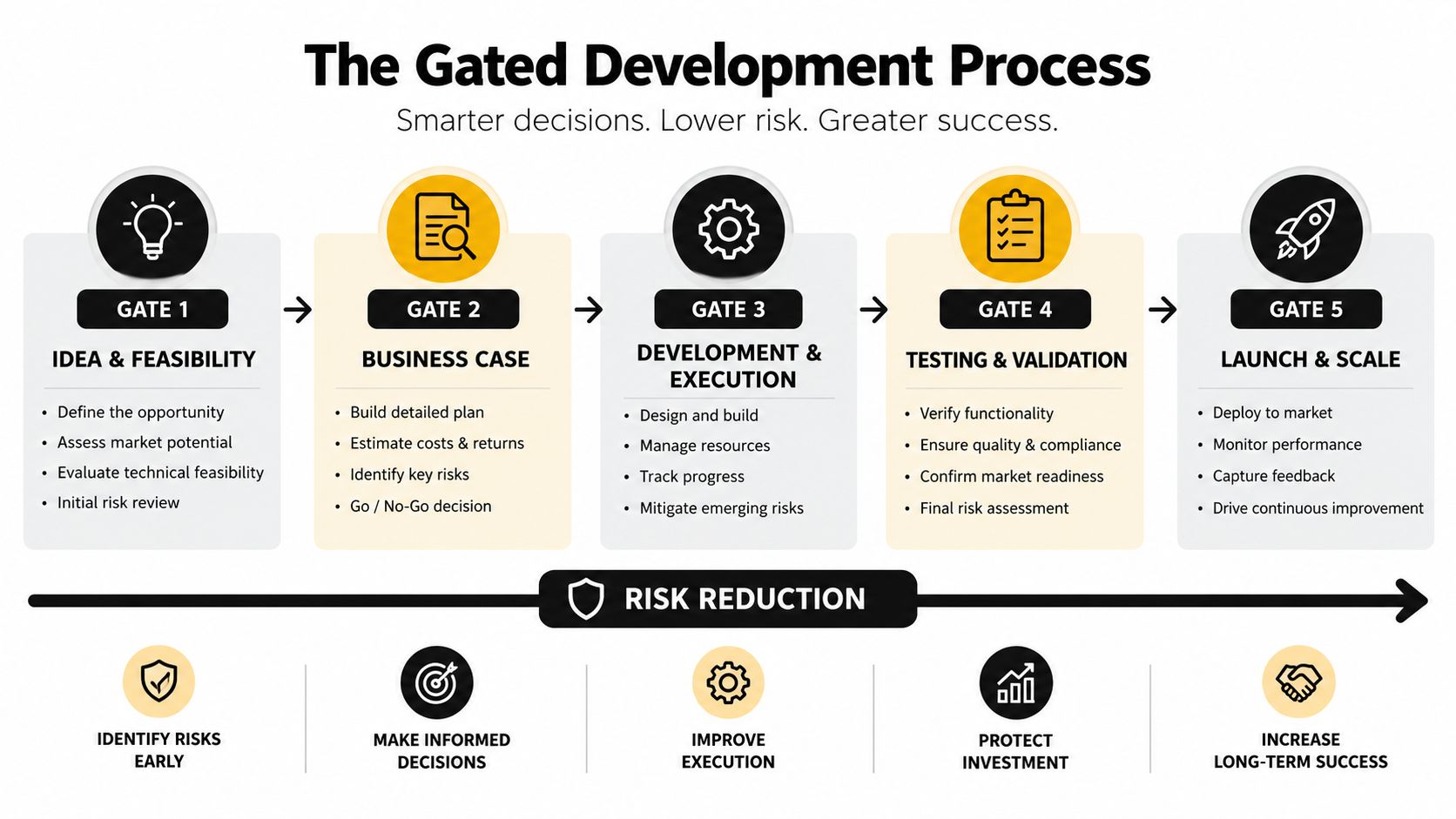
Strong product teams do not jump from idea to build. They use gates so each phase answers a different risk before money gets tied up in tooling, code, or manufacturing. That sequencing keeps a weak assumption from turning into an expensive product decision.
Discovery filters the wrong problem
A serious agency starts by testing whether the problem is real, whether users feel it, and whether the market will care enough to pay attention. Discovery is about stripping away false certainty. Skip it, and teams often build the first version of the wrong thing, then pay again later in design and engineering to correct the mistake.
The next gate is concept design. That stage turns the problem into candidate solutions and tests rough workflows, information architecture, and value propositions. Good agencies simplify hard at this point, because early complexity usually shows up again in the shipped product.
Engineering and prototyping expose the expensive failures
The source material from LanPDT describes a gated sequence that runs through discovery, concept design, technical design and engineering, prototyping, and design-for-manufacturing before launch (LanPDT). Each gate checks a different failure mode. Discovery catches bad assumptions, engineering exposes architecture and integration issues, and prototyping surfaces material, usability, or interaction problems before they become costly to fix.
For digital products, measurement discipline belongs in the gate as well. Akendi notes that baseline metrics for usability, engagement, conversion, and satisfaction should be set at the start of the engagement, then tracked through the work (Akendi). Without that baseline, it is hard to tell whether a redesign improved the product or whether the market merely changed. With it, decisions can be defended with evidence instead of instinct.
Why the sequence matters after launch
Once a product is live, the question shifts from “can we build it?” to “did we build the right thing?” A disciplined agency should make that handoff clean. The goal is not a perfect launch, it is protecting capital while keeping enough room to learn quickly.
If an agency wants to skip discovery because “the build is straightforward,” it usually has not thought hard enough about failure modes.
I trust gated process more than optimistic scheduling. A team that can explain what each gate prevents is usually safer than one that only promises speed. Speed without gate discipline is how you end up paying twice, once to build, and again to correct the assumptions underneath it.
How Refact Can Help
A strong agency relationship starts with commercial clarity, not with a prettier roadmap. Refact is a product development studio for non-technical founders and domain experts who need strategy, design, and full-stack engineering in one place, then want to keep learning after launch instead of starting over with another vendor. If you want a concrete example of that model, their product development agency page is a useful reference point.
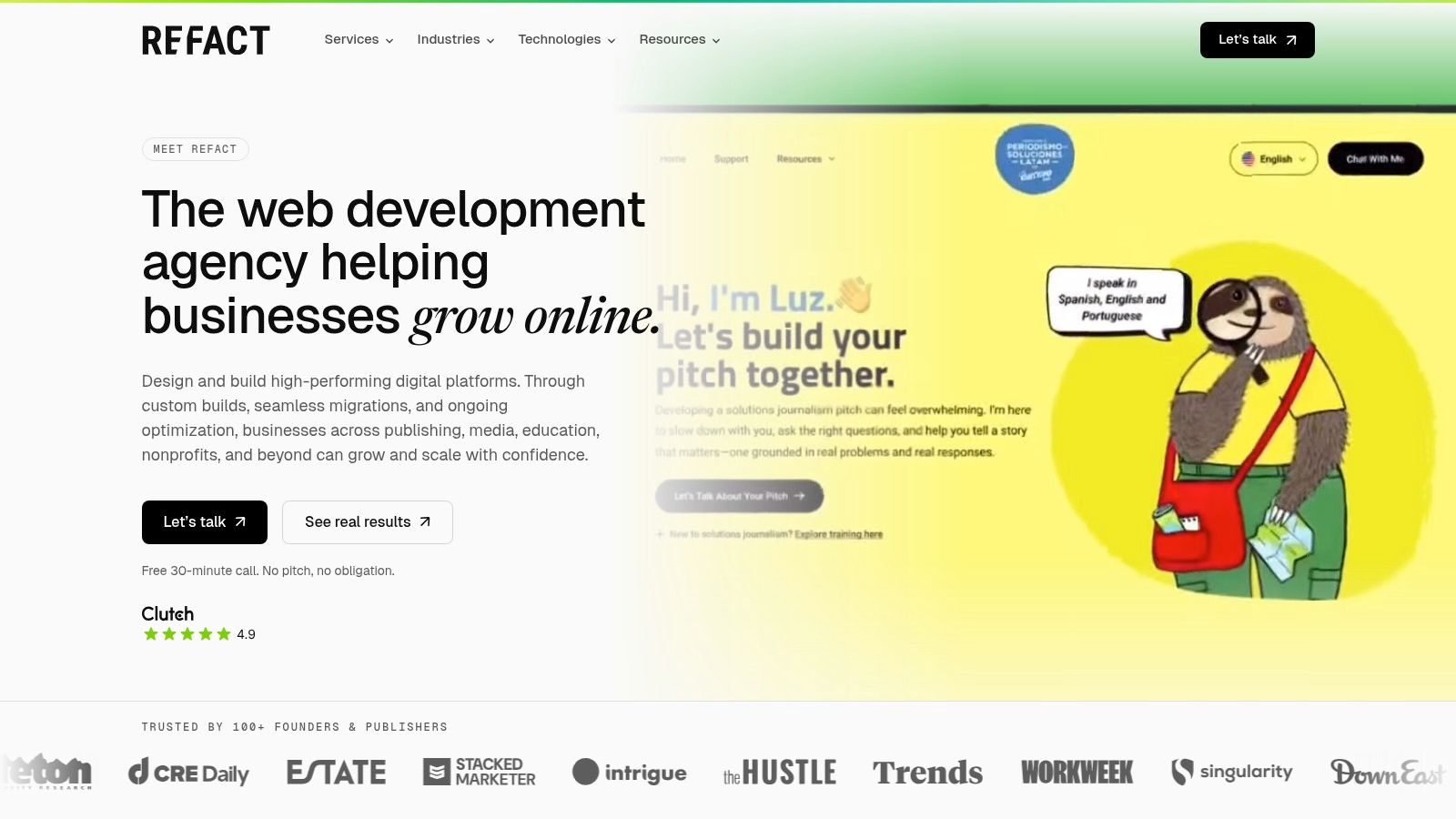
Refact is a better fit when the problem is still fuzzy, the founder knows the domain but not the implementation path, or the product needs both build quality and commercial thinking. That includes SaaS applications, MVPs, WordPress and ecommerce platforms, publishing systems, AI-powered tools, and platform migrations. The service list matters less than the operating model. The better question is whether the team starts with what to build, why it matters, and what evidence will show the work is working before the code gets too far ahead of the market.
What to ask any agency before you sign
A mature agency should answer these questions clearly:
- What happens if discovery shows the original idea is weak? A strong partner will talk about reframing, scope reduction, or validation paths.
- How do you tie the work to business metrics after launch? If they cannot discuss measurement, they are probably not thinking beyond delivery.
- Who stays involved once the build is shipped? Continuity matters more than a polished handoff doc.
- What do you do when feedback conflicts with the original plan? Good agencies know how to adapt without losing the product's core logic.
- Which parts of the process are handled by the same people who will build the product? Separate sales and delivery teams can create a dangerous gap.
Red flags that usually matter
Be cautious if the agency leans heavily on generic credentials, promises fast delivery without discussing trade-offs, or treats post-launch support like an optional extra. Those patterns usually signal a team optimized for throughput, not outcomes. A better partner will tell you where the product is likely to fail, not just how pretty the screens will look.
Evaluation Criteria and RFP Questions
A good RFP does more than compare bids. It forces the agency to show how it thinks about commercial risk, not just design, code, or staffing. If the answers stay at the level of deliverables, you are probably dealing with a team that sells production capacity, not product judgment.
Questions that expose commercial maturity
Ask how the agency would judge success after launch, not only on handoff day. If the answer stops at “the feature shipped,” that is a warning sign. Better agencies talk about user behavior, conversion paths, retention signals, and the assumptions they expect to test once real traffic arrives.
Also ask how they handle uncertainty. A team with real product experience will not pretend the scope is fixed from day one. It should explain what needs to be learned early, what can be checked with prototypes, and what should wait until the market gives clearer feedback. Commercial maturity also shows up in how an agency thinks about niche visibility, as in this cybersecurity marketing agency guide.
Questions that reveal operational discipline
The most useful questions are plain ones:
- Who owns product decisions when priorities conflict? If nobody does, you will feel the drift later.
- How do you document decisions and carry them forward? That shows whether the team protects context or just writes tickets.
- What does onboarding look like for a new project? A serious agency can describe intake, discovery, and alignment without improvising.
- How do you keep launch work from breaking the build? That matters when deadlines and quality collide.
One industry report on product development agencies points to a shift in the market, with product-focused services gaining importance while some broader app-development work becomes less central. That is another reason to look for outcome ownership. The agencies moving upmarket are the ones that can connect delivery to business continuity, not just code throughput.
What a weak answer sounds like
If the agency keeps talking about velocity, headcount, or tools, but never explains how it will reduce product risk, keep going. If it cannot describe how it handles post-launch optimization, keep going. If it treats every engagement as a clean handoff instead of a living product, keep going.
A solid RFP response should read like a plan for decision-making, not a brochure for staffing.
The goal is not the cheapest bid. It is the partner that stays useful after the first release. That usually means the agency has to understand handoff, analytics, iteration, and what it takes to launch into a noisy market.
Integrating Agency Outputs with Indie Maker Launches
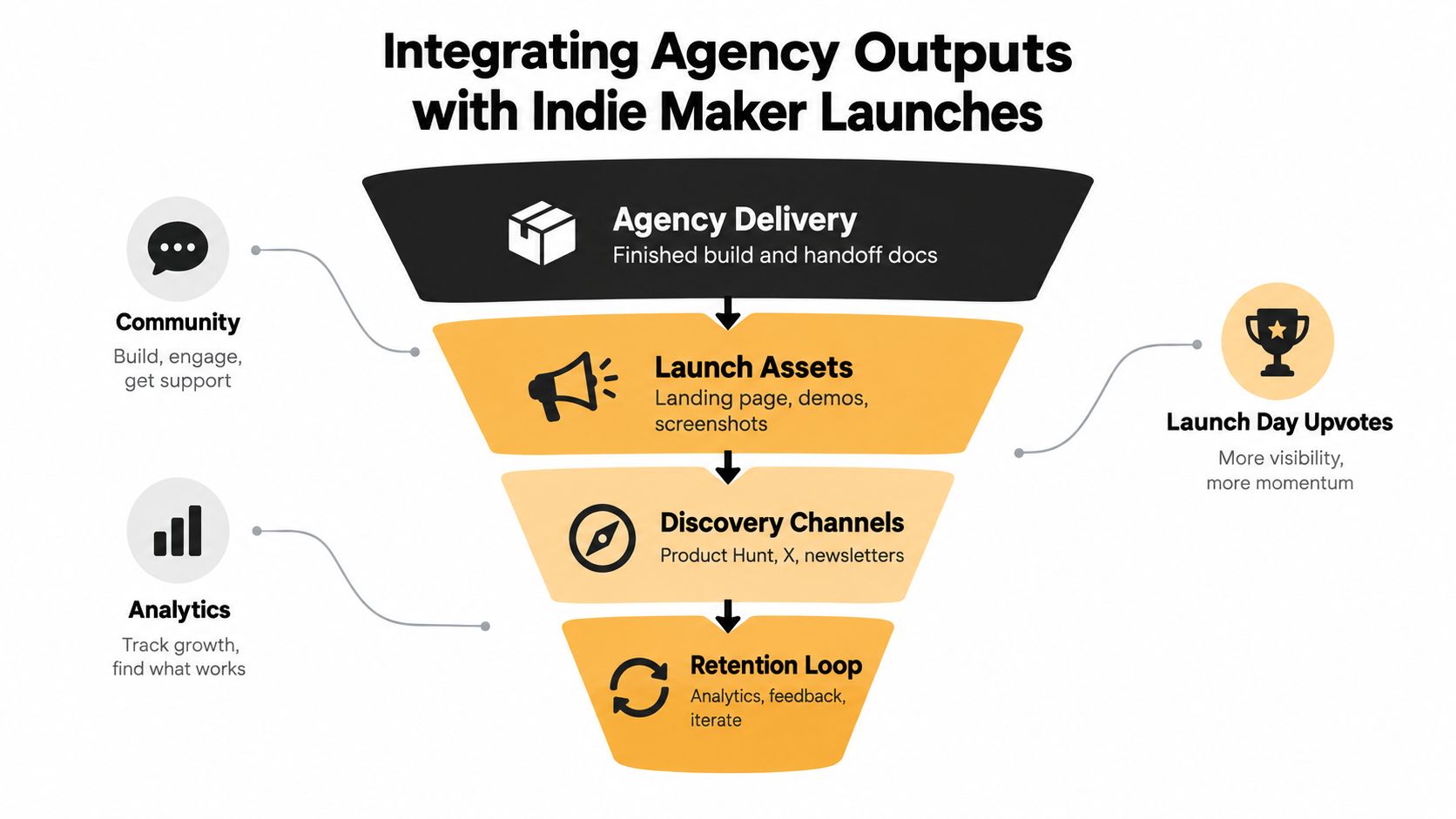
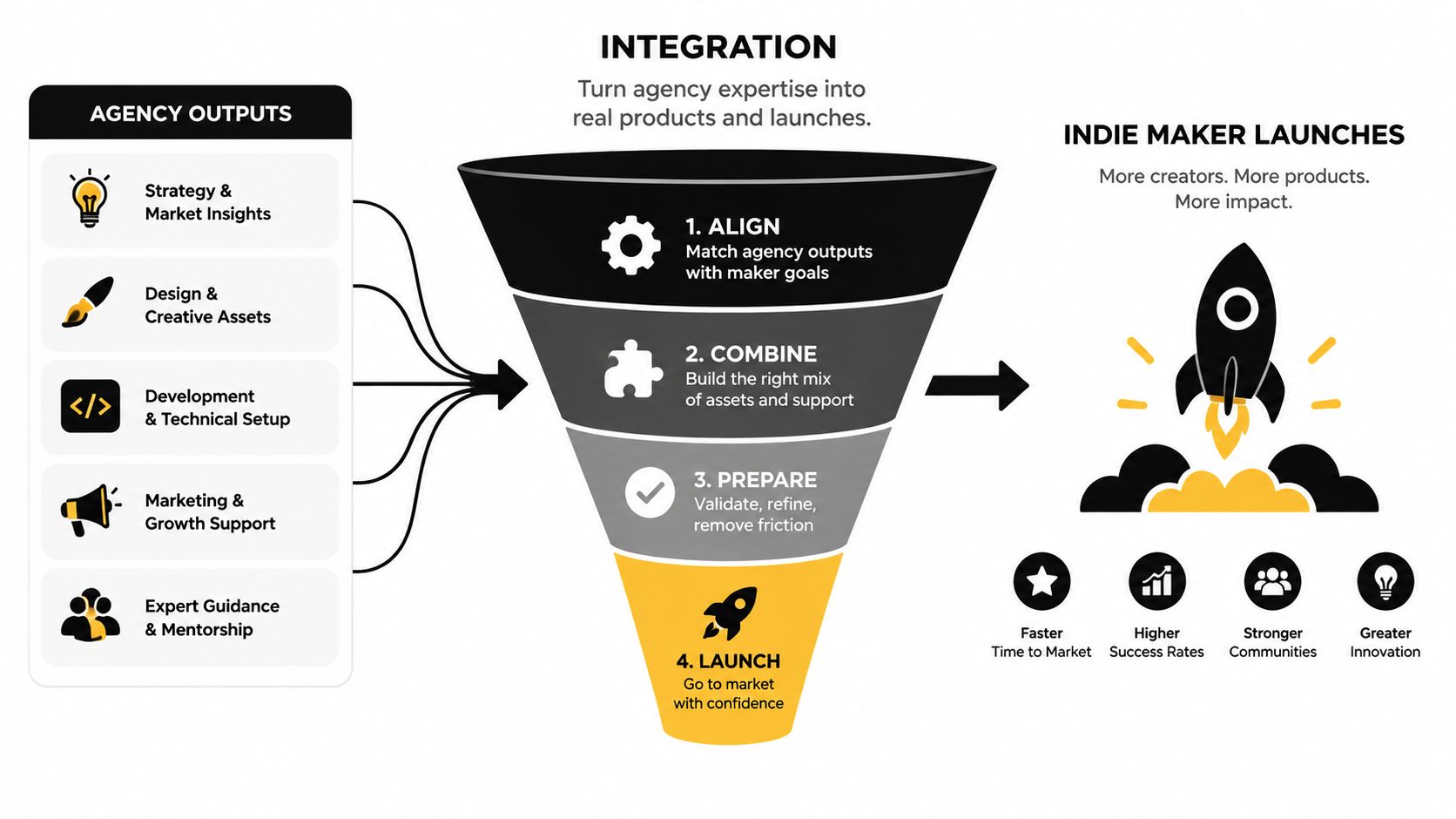
A finished product still has to be found. That is where many agency engagements fail in practice, because the team stops at release and the founder is left to improvise positioning, distribution, and the early feedback loop. For indie makers, that gap is costly. The first burst of visibility often decides whether the product gets momentum or disappears.
The handoff should include launch-ready assets
A practical handoff includes more than source code. It should leave you with launch copy, page structure, screenshots, onboarding flows, FAQ material, and the analytics setup needed to see what happens after traffic arrives. If the agency does not think about those assets early, you end up rebuilding the product story under deadline pressure.
That matters because indie launches are discovery exercises as much as shipping exercises. A product page that clearly states the problem, the use case, and the outcome will do more for launch performance than a generic repo handoff ever will.
Discovery channels need product context
A useful launch workflow connects the build to the places where people first encounter the product, read a longer explanation, and decide whether it deserves a second look. Strong agency handoff makes it easier to turn product work into launch assets that can be indexed, shared, and revisited.
The ScrollLaunch guide for indie makers and SaaS founders explains how launch platforms can support SEO-ready product pages, canonical backlinks, and AI-readable markdown that helps products surface in discovery tools. That matters because post-launch visibility usually depends on more than one channel. The product has to make sense to humans, be findable in search, and remain readable to systems that summarize the web.
What founders should ask before signing
Before you commit, ask whether the agency will help define the launch narrative, what analytics it will instrument, and how the first iteration loop will work after release. Those answers show whether the team is thinking like a product partner or a project shop.
The best agencies do not disappear once the build is done. They help shape the first real feedback cycle, then stay involved long enough to turn that feedback into a better next release.
Market Scale and Final Hiring Checklist
With a market this mature, differentiation comes from fit, not size. The question is whether an agency can own outcomes, handle the trade-offs after launch, and support the discovery work indie makers need once the first version is live.
Start with this checklist:
- Commercial alignment: Does the agency talk about revenue, retention, activation, or another outcome that matters to your business?
- Discovery depth: Will it challenge the product before it starts building, or just accept the brief?
- Continuity: Does the same team stay close enough to learn from launch feedback?
- Measurement: Can it explain what will be tracked inside the product, not just in a reporting slide?
- Iteration support: Is there a clear plan for what happens when users behave differently than expected?
- Launch readiness: Will you leave with pages, messaging, and assets that help the product get found after handoff?
One practical test: ask the agency how it would handle a launch page that ranks but does not convert. A good partner will discuss messaging, tracking, and iteration. A weak one will drift back to code quality and ticket flow.
If you can answer those questions confidently, you are probably ready to sign. If you cannot, keep interviewing. The best product development agency is not the one with the slickest portfolio, it is the one that helps you waste less, learn faster, and connect the product to business reality from day one.
If you are preparing to hire, use this checklist as a scoring sheet for your shortlist. Compare each agency on commercial ownership, post-launch support, and launch readiness, then choose the team that can stay useful after the first release.