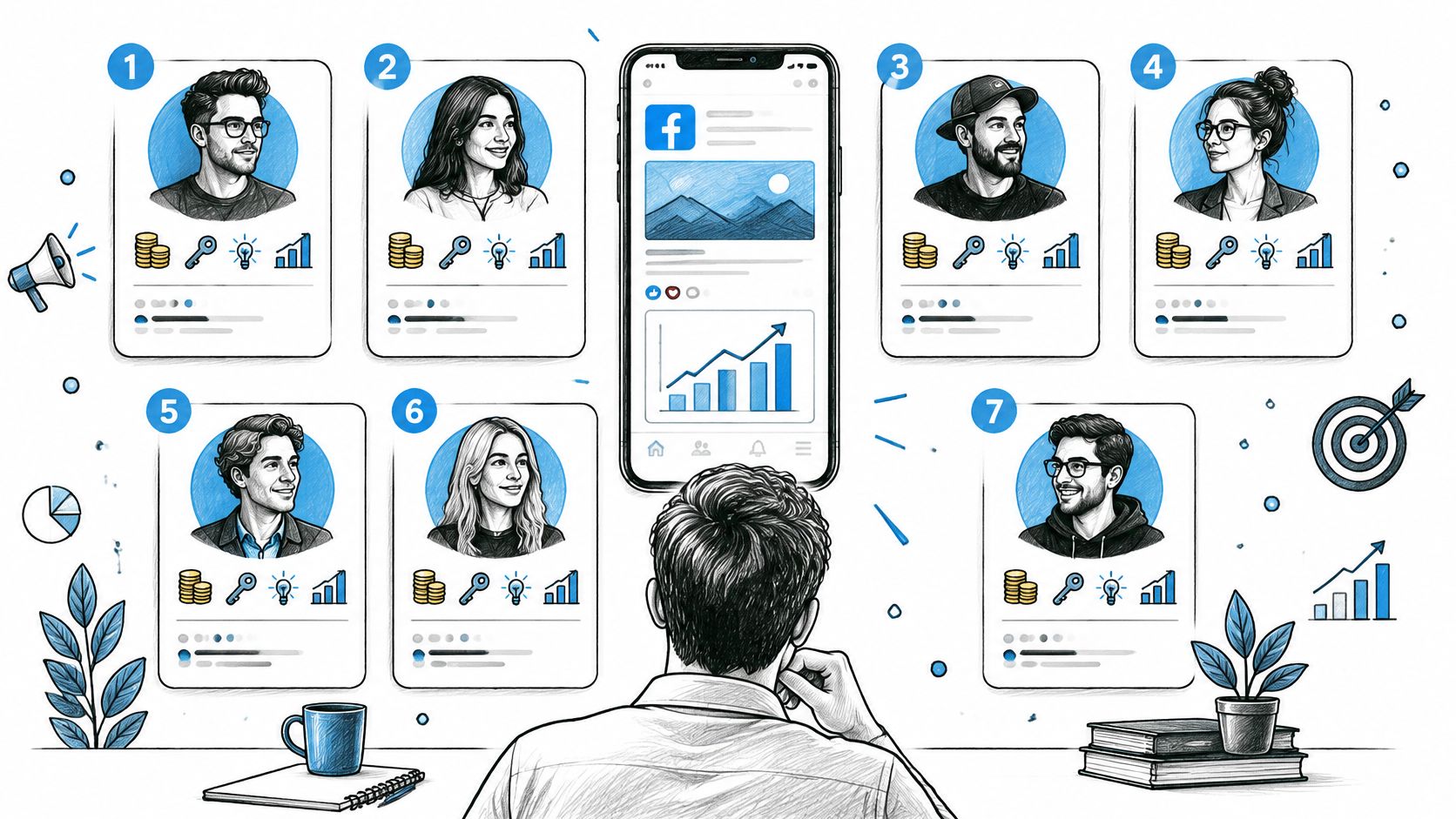
The wrong Facebook ads agency does not fail loudly. It locks the ad account, treats creative as an add-on, and reports wins without connecting spend to revenue.
The benchmark data published by Influee puts the median Facebook campaign at a $14.19 CPM, $38.19 CPA, 2.19% CTR, 1.60% conversion rate and 1.86 ROAS. That is a sober baseline. If the middle of the market returns under 2x, the difference between a good partner and a bad one lives in measurement discipline, not in creative awards.
I would not book a call until an agency answers four questions plainly. What exactly is included each month? Who owns the ad account, pixel and campaign history? How many finished ads sit inside scope, and what counts as finished? Which case study resembles my margins, sales cycle and budget?
The shortlist below runs from Knowlify, a featured done-for-you AI video advertising shop, through WebFX, LYFE Marketing, OpenMoves, Straight North, SmartSites, Ignite Visibility and Avalaunch Media. Each pick is judged on transparent pricing, client-owned ad accounts, creative included in scope, and proof that fits your business size. A comparison table further down sets pricing model, ownership and creative scope side by side, so read it before you book anything.
Your choice comes down to two variables: monthly budget, and whether you need new-customer acquisition or a social presence.
An agency that will not publish or explain its scope is asking you to buy a black box. The real price of that box is a share of your media spend and the account history you lose when you leave.
Table of Contents
- 1. Knowlify, Featured Pick for Creative Volume
- 2. WebFX, Published Pricing for Bigger Budgets
- 3. LYFE Marketing, Social-First Packages for Small Teams
- 4. OpenMoves, Measurement-Led Paid Social
- 5. Straight North, Lead Generation Inside a Wider Retainer
- 6. SmartSites, Boosted Posts or Real Conversion Campaigns
- 7. Ignite Visibility, Multi-Location and Franchise Campaigns
- 8. Avalaunch Media, Video Ads With Media Buying Attached
- Best Facebook Ads Agencies at a Glance
- How to Choose Your Facebook Ads Agency (and What to Do Next)
1. Knowlify, Featured Pick for Creative Volume
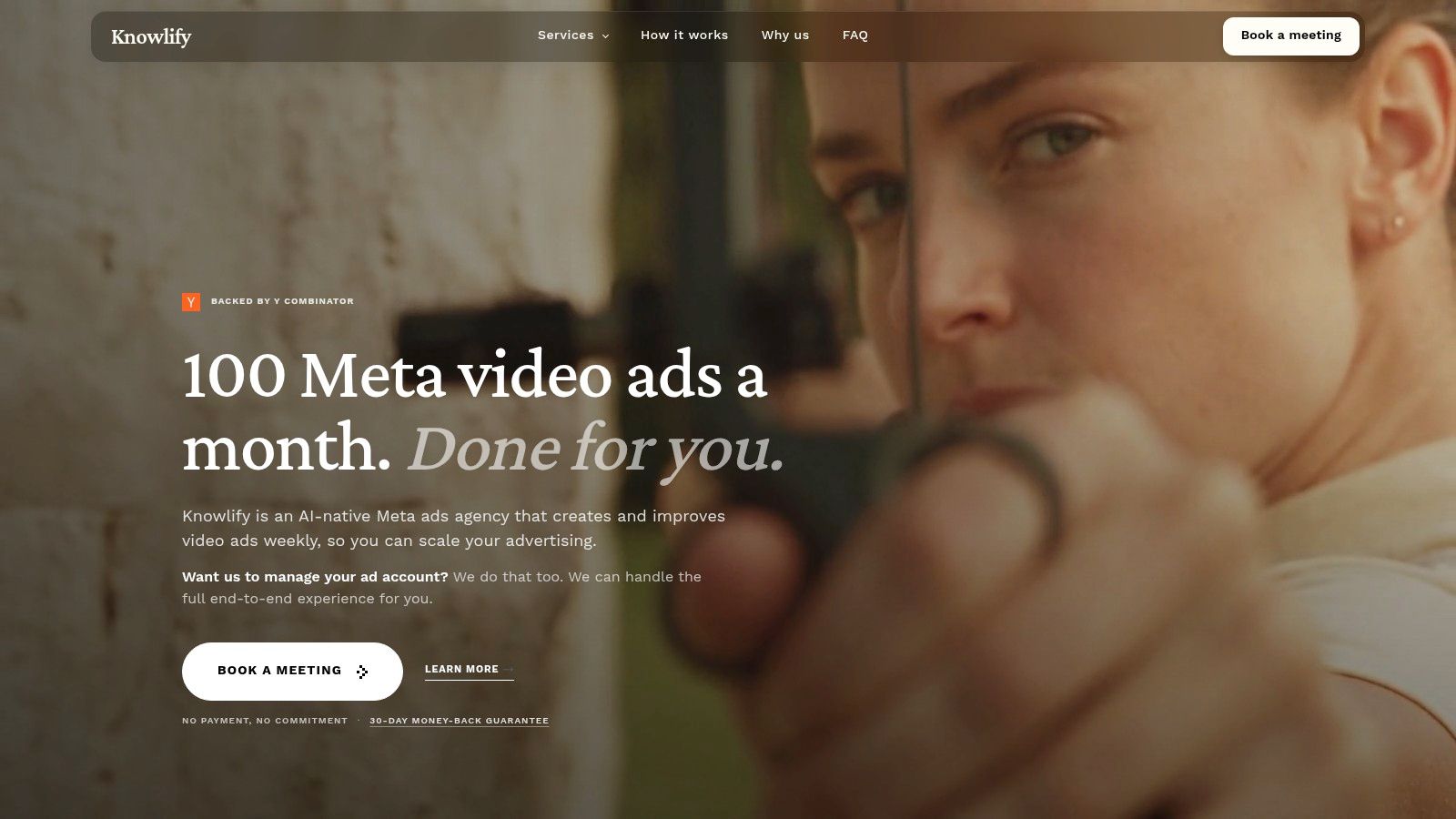
Most Facebook ad accounts stall on stale creative before they stall on bad targeting. Knowlify is a done-for-you AI video advertising agency for B2B and B2C companies running paid social: the team writes concepts and scripts, produces AI UGC ads, Pixar-style character animation ads and AI commercials, then handles editing and sound. Every finished ad passes a human quality check before it reaches the client. That last step is the difference between a usable ad and a file your media buyer refuses to upload.
What the first month looks like
Knowlify lays out its onboarding clock on its Meta ads agency page: a 20-minute kickoff call covers product, audience, goals and brand assets, creative direction comes back for approval within 48 hours, and the first finished batch lands five days after that call. Monthly plans then ship new batches every week at roughly 25 finished ads per week, with campaign results feeding the next round of concepts. The Y Combinator-backed company puts responsibilities and pricing in a written proposal, so scope is fixed before work starts.
That cadence is the product.
You can hire the team to run Facebook and Instagram campaigns end to end, or keep media buying in-house and buy creative production only. Media spend stays separate either way, and clients keep their ad accounts plus every finished ad.
Why creative volume is the right instinct
Format mix on Meta keeps drifting toward commerce-shaped creative. A survey of more than 170 agency and in-house advertisers, reported in Fluency's 2026 Meta ads benchmarks, found Collection Ads used by 39% of respondents in 2025, up from 34% in 2024, while use of single image ads fell by more than 8% and static carousel ads declined by 7%. The same client dataset reported a 63% increase in Meta spending alongside a 97% increase in conversions, an aggregate result rather than a promise you can bank.
The practical read: the advertiser who tests more formats finds the winner faster, and a fixed weekly supply of distinct concepts is what makes that testing possible.
Ask before signing: how many distinct concepts ship per week, and what happens after one of them wins? An agency that can't answer the second half is a production vendor, not a media partner.
Where it fits
Pick Knowlify when the bottleneck is ad supply and you want fixed weekly output without hiring editors or animators. It's a weaker fit if you need a handful of evergreen ads, a full SEO retainer, or organic social management. Before signing, ask how revisions work on a rejected ad, whether the weekly cadence is contractual or a target, who holds the ad account, and whether the quality check covers Meta's advertising policies as well as brand tone.
2. WebFX, Published Pricing for Bigger Budgets
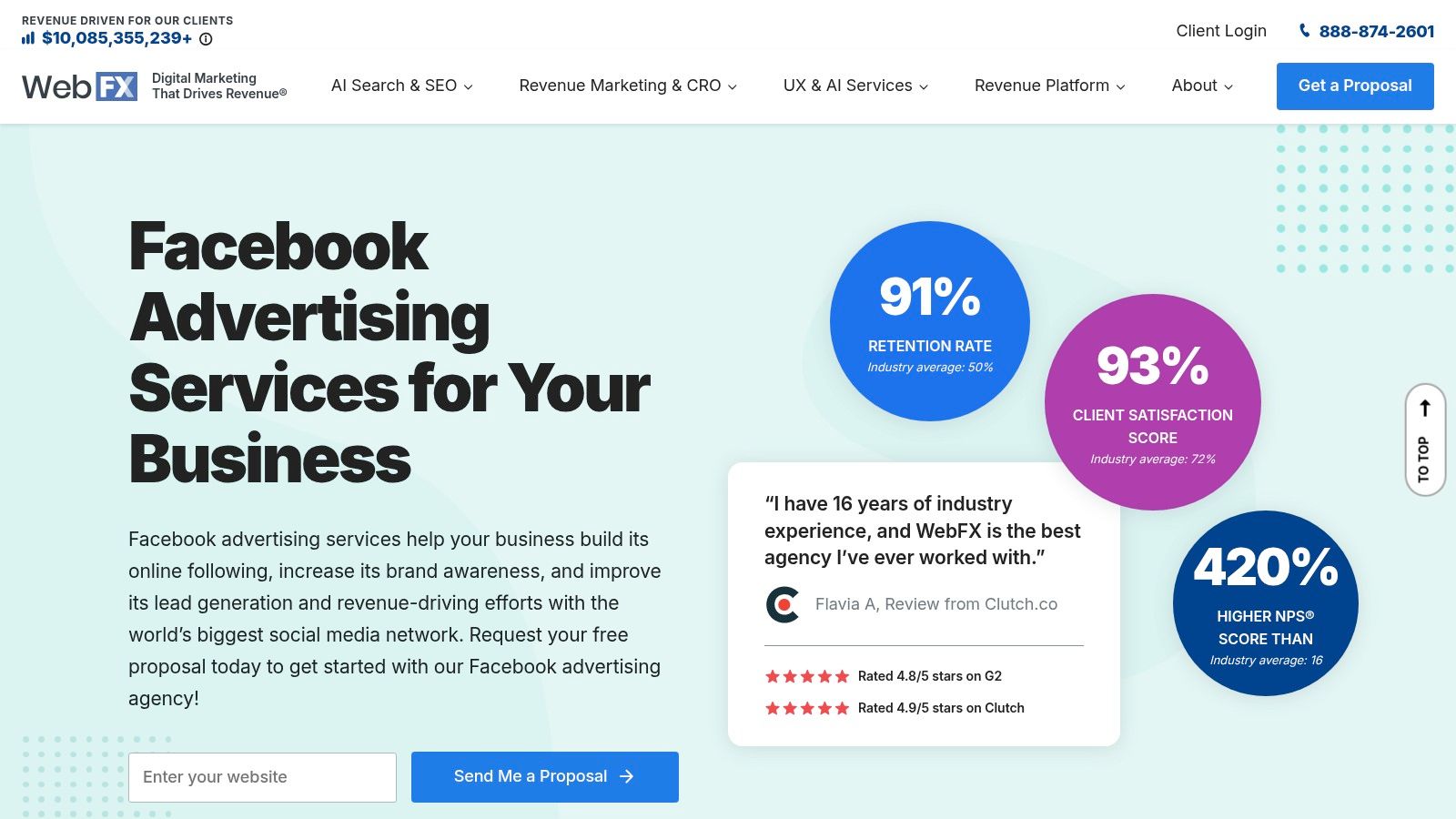
WebFX runs Facebook campaigns inside a wider digital marketing offering, which makes it a reasonable pick when paid social has to sit next to SEO, email or CRO under one contract. Its Facebook work covers account audits, ad creative and copywriting, landing-page support and conversion tracking, with results reported through its RevenueCloudFX platform. Publishing package prices and ad-spend ranges is uncommon in this category, and it lets you size a budget before a sales call.
The cost math to run first
Management fees in this market usually land at 10% to 20% of ad spend, or roughly $500 to $1,500 monthly for smaller accounts, before creative, tracking or setup costs, according to Rankure's Facebook ads cost guide. Read any published entry price through that frame. A $1,000 monthly management fee on a $2,000 media budget is a 50% markup, and it competes directly with the testing budget that produces learning.
Scope the landing page before you sign, too. Our breakdown of how a product development agency prices and hands off work applies just as well to page builds that sit under ad traffic.
- Account ownership: get it in writing that the ad account, pixel and audiences stay in your Business Manager after the contract ends.
- Named manager: with a larger agency, confirm who touches the account weekly and whether that person is senior or junior.
- Scope edges: creative volume, landing pages and CRO are the line items most often quoted separately.
The trade-offs are real. The published entry price can be steep for a pre-revenue startup, the agency's scale may exceed what one narrow campaign needs, and third-party review feedback isn't uniformly positive. Ask which team would run your account before you compare fees.
3. LYFE Marketing, Social-First Packages for Small Teams
Say you sell a physical product from a store you also run yourself, you've never built a video ad, and your monthly media budget sits in the low four figures. That's the profile LYFE Marketing's packages are built for.
What's inside the packages
Image ads, video ads, or image plus video combined, with targeting, ad creation, bid management and optimization inside the management scope. Retargeting, reporting and monthly consultations are part of the described service. The agency also runs organic social, which matters if your Facebook page is thin and the ad click is the first thing a prospect checks.
Published package examples give you a starting point for budget comparisons, which is more than most agencies offer. Packages are also less flexible than a custom scope, and the starting price may not cover every campaign goal or creative requirement. Confirm the minimum ad spend, the contract term and notice period, and exactly what management includes before you sign.
Practical rule: if the package covers management but not video production, add the cost of producing ads yourself before you compare it to a custom retainer.
Questions that change the answer
Ask whether the spend runs inside your own Business Manager or theirs, who owns the creative files at the end of the engagement, and how retargeting audiences are built from your site traffic. A social-first agency that runs organic and paid together will also want posting access, so decide up front how much control you hand over.
4. OpenMoves, Measurement-Led Paid Social
OpenMoves opens an engagement with an account review of campaigns and analytics, then rebuilds audiences, bidding, campaign structure and creative approach around agreed goals. It runs paid social across Facebook, Instagram, LinkedIn and other platforms for both B2B and B2C clients, covering lead generation and ecommerce. Creative testing and measurement sit in the same scope, which is the right pairing.
The number that separates good from lucky
Platform-attributed ROAS overstates impact, because it counts people who would have converted without seeing an ad. Independent lift testing shows how wide that gap gets. In a conversion-lift experiment involving Cyberclick and an online university, documented in Goodway Group's incrementality case study, the test group produced 3,211 conversions against an estimated counterfactual of 2,045, a gap of 1,166 incremental conversions, with landing-page views up 31%.
The same source reports a national fitness organization matching 89% of new-member sign-ups to a Meta person ID, where people exposed to prospecting and retargeting together signed up at 10 times the rate of those exposed only to prospecting. Users who saw both video and image ads signed up at 7 times the rate of those who saw a single format.
Questions that expose a weak measurement story
- Holdouts: how do you design a holdout, how long does it run, and who reads the result?
- Reconciliation: do platform conversions get checked against CRM records before you report ROAS?
- Cross-channel: how do you account for search demand the ads create?
Pricing isn't posted on the service page, and a multi-platform scope usually needs a bigger budget than a Facebook-only one. Ask how much original creative production is included and how often new tests launch.
5. Straight North, Lead Generation Inside a Wider Retainer
Straight North builds Facebook campaigns for awareness, leads, sales or ecommerce revenue, creates the ad content, sets campaigns up in Ads Manager and manages them ongoing. The Facebook work sits inside a broader paid advertising and digital marketing practice, so it fits a business that wants one relationship across search, social and site.
Lead costs moved the wrong way
If your goal is qualified leads rather than traffic, the direction of benchmark costs matters more than the level. Data compiled by ThePricer shows traffic campaigns improving, with average CPC falling 6.7% year over year to $0.70 and CTR rising to 1.71%, while lead campaigns deteriorated: average cost per lead rose 21% to $27.66 and conversion rate slipped from 8.67% to 7.72%.
That split tells you where to aim the first audit. Cheap clicks are easy to buy and rarely pay for a B2B funnel, so the useful conversation is about lead quality and close rate, not cost per form fill.
The question that sorts pretenders: which KPI decides whether you keep the budget, and is it measured inside Meta or inside my CRM?
Where the model fits
Pricing is custom and not fully detailed on the Facebook service page, and a broad agency relationship may be more than a single test campaign needs. Ask for examples from your industry, pin down the reporting cadence in the contract, and confirm whether offline or CRM conversions get imported back into Meta so optimization has a real signal.
6. SmartSites, Boosted Posts or Real Conversion Campaigns
SmartSites splits its work in a way worth understanding before you buy. Social media marketing covers content, graphics, scheduling, boosted posts and monthly reporting, with package-specific budgets published for boosting. Lead and sales campaigns that need landing pages and conversion tracking are handled by the PPC team instead.
Why the split matters
Boosting a post buys reach for content you already made. A conversion campaign buys signups, and it needs a tracked event, a page built for the offer, and enough budget to exit the learning phase. Treating the two as the same purchase is the most common way small advertisers burn a quarter's budget on engagement.
What a tech advertiser should expect
In the technology industry, Facebook campaigns averaged a 1.04% CTR, $1.27 CPC and 2.31% conversion rate in 2025, according to Bestever's Facebook ads benchmark analysis. At that click rate a realistic budget buys a modest number of sessions, so the landing page has to convert well above average for the math to work.
If your site runs on Webflow, our comparison of Webflow development agency options covers who can ship pages fast enough to keep pace with tests. Ask which team owns your account, whether boosting budget and conversion budget come from the same pot, and what reporting you get beyond reach and engagement.
7. Ignite Visibility, Multi-Location and Franchise Campaigns
Ignite Visibility manages paid social across Facebook, Instagram and other platforms with customized cross-channel campaigns, and its published examples include Meta lead-generation work across multiple locations. For a franchise, a clinic group or a brand with regional marketing teams, that pattern matters more than a generalist portfolio.
Ownership terms worth copying
Ignite states that clients retain ownership of ad accounts, content and data after an engagement ends. That should be standard. It isn't. Use the sentence as a benchmark when you read other proposals, because an agency that won't put account and data ownership in writing has made your exit cost part of the price.
How custom scoping changes the comparison
Most engagements here are custom-quoted, which makes prices harder to line up against published packages. It also means most work may exceed a small business budget, and a multi-channel approach can be overkill for a startup testing one offer. Ask for a fixed-scope pilot with a defined deliverable and a named owner rather than a broad annual plan.
Paid social rarely runs alone at this scale. If the organic side needs the same review, our roundup of best AI SEO agencies covers how to scope that work next to paid. Then ask how budget splits across locations, who approves creative for each market, and how per-location results get reported.
8. Avalaunch Media, Video Ads With Media Buying Attached
Avalaunch Media runs Facebook and Instagram advertising with ad creative, audience targeting and campaign management, and it produces video ads in-house. That combination suits consumer and ecommerce brands whose catalog needs motion instead of stills, since one team handles both the footage and the spend behind it.
The mobile-first case
Facebook has been a mobile advertising business for a long time. Facebook advertising statistics from Shno put mobile at approximately 84% of Facebook's advertising revenue by the fourth quarter of 2016. Any video produced now has to be built vertical-first and survive being watched with the sound off, so captions, safe zones and a hook in the first seconds matter more than cinematic polish.
A useful test: ask for the raw files behind one ad they produced. If the deliverable is a single 16:9 export, the team isn't building for the placement where most of your spend lands.
What to verify before you sign
Video production is the reason to call, so confirm whether it's inside the management fee or quoted separately. A bundled rate can look cheaper until you learn reshoots and extra hooks are billed per revision.
Pricing isn't published on the service page, so expect a proposal cycle before you can compare numbers against the agencies that list package rates. Use that call to ask who writes the hooks, how many iterations each concept gets, and whether ad copy is included with the edit. Two examples in your own category tell you more than a general showreel.
Best Facebook Ads Agencies at a Glance
Read each row as a set of terms to verify. Cells written as questions mark what the agency leaves unstated on its public pages, and those are the points to get in writing before signing.
| Agency | Published Pricing | Best For | Creative Production | Ad Account Ownership |
|---|---|---|---|---|
| Knowlify | Custom proposal; media spend separate | B2B and B2C teams needing AI-powered video ads, with optional Meta campaign management | AI UGC, animated ads, and commercials; human quality check | Clients retain their ad accounts and finished ads |
| WebFX | Publishes package prices and ad-spend ranges | Businesses seeking Facebook campaigns alongside broader digital marketing | Multimedia creative and ad copy | Get account ownership in writing before signing |
| LYFE Marketing | Publishes package examples | Small and midsize businesses seeking paid and organic social support | Image and video ad options | Ask whether spend runs in your Business Manager |
| OpenMoves | Custom proposal scoped around tracking and testing requirements | B2B and B2C lead-generation or ecommerce campaigns across paid-social platforms | Creative development and ongoing testing | Ask who owns the ad account and conversion data |
| Straight North | Custom quote, typically inside a broader lead-generation retainer | Businesses integrating Facebook ads with broader lead-generation or ecommerce marketing | Ad content creation | Ask whether the account sits inside the retainer or stays with you |
| SmartSites | Publishes budgets for boosted posts; conversion campaign pricing unspecified | Businesses needing social content plus paid acquisition support | Social content and graphics; confirm conversion-ad creative scope | Ask whether boosted-post budgets run through your ad account |
| Ignite Visibility | Custom-scoped proposal | Franchises and multi-location brands coordinating campaigns across markets | Campaign content; confirm production scope | Clients retain accounts, content, and data |
| Avalaunch Media | Not published on the service page; expect a proposal cycle | Ecommerce and consumer brands needing Meta campaign management and video support | Ad creative and video production | Ask whether the ad account and finished video assets stay with you |
Read the ownership column first. Spend run through an agency's own ad account takes your pixel history and audience data with it when the contract ends.
How to Choose Your Facebook Ads Agency (and What to Do Next)
Work through three filters in order. Pricing transparency comes first: published packages at WebFX and LYFE Marketing let you model a budget today, while OpenMoves, Straight North, Ignite Visibility and Avalaunch Media require a proposal before you can compare. If your media budget is small, a percentage-of-spend fee reduces the testing money, so a fixed fee or a one-time creative sprint usually produces more learning per dollar.
Business type comes second. Small teams without production capacity do well with a social-first package. Ecommerce brands that need motion should weight video capability heavily. Multi-location and franchise operations should weight per-market reporting and account ownership terms, which is where Ignite's stated policy gives you a useful benchmark.
Verification comes third, and it's the part buyers skip. Ask every agency the same four questions in writing:
- Who holds the account: does the ad account, pixel, catalog and audience data live in my Business Manager on day one and on day 365?
- What creative is included: how many concepts per month, who writes hooks, and what does an extra round cost?
- How results are measured: which conversion event is optimized, is the Conversions API in place, and are CRM outcomes reconciled with platform numbers?
- What ends the contract: notice period, data handover, and who keeps the finished assets.
If you're running an indie SaaS or a product launch rather than hiring an agency, ScrollLaunch's one-time launch tiers and always-dofollow product pages give you a lower-commitment way to buy visibility, with no subscription attached. Ad placements are sold per ISO week, including the $19 per week Product Center Ad and the $29 per week Right Sidebar Ad, both carrying dofollow links and click analytics in the dashboard.
Then act this week. Shortlist two names from this list, send both the same four questions, and ask for a fixed-scope proposal that states the pricing model, the ownership terms and the creative volume in writing. Compare each proposal against the table above before you talk price, and if the media math still doesn't clear your margin, put the $19 Product Center Ad behind your launch page instead and revisit the agency question when spend catches up.