
Posting more on X doesn't automatically create growth anymore. In a feed that's less forgiving and more crowded, volume without conversion just gives you more chances to be ignored. The old advice was built for a different platform, and it still gets repeated because it's easy to say, not because it works now.
The better question is how to grow on Twitter when attention is scarce and engagement is structurally weaker. That means optimizing for repeatable engagement density, profile visits, bookmarks, and follower conversion, not chasing a pile of likes that never turns into an audience. In practice, small accounts can look “healthy” on paper while still failing to build meaningful reach, so the key is getting the right people to act, not just showing up more often.
Table of Contents
- Why the Old Twitter Growth Playbook Is Broken
- Optimizing Your Profile as a Conversion Funnel
- Content Formats That Drive Bookmarks and Replies
- How TweetBoost Can Help
- Building a Daily Engagement System
- Measuring Growth with the Right Benchmarks
- Tools, Automation, and Pitfalls to Avoid
Why the Old Twitter Growth Playbook Is Broken
The most common mistake is still treating X like it's 2022. People keep recommending more posts, more threads, more hustle, as if the feed hasn't changed and the audience still behaves the same way. That advice can even make things worse, because a noisier posting pattern can dilute the signal that tells X who your content is for.
The platform is structurally harder to grow on now. Multiple 2025 and 2026 analyses point to sharp engagement declines on X, including a drop to 0.015% engagement in 2025 after 0.029% in 2024, plus another dataset showing a 48% year-over-year decline in overall engagement. That's a very different environment from the one most “post ten times a day” guides were written for, and it explains why brute-force output now backfires for a lot of accounts. The Blue Social's 2025 engagement benchmark analysis captures that shift clearly.

Why frequency stopped being the main lever
Higher posting volume only helps when the account already has a clear content-market fit. If your posts aren't getting the right kind of response, more posts just multiply the weak pattern. Off-topic posting is especially risky in a lower-engagement feed, because it confuses the system and trains your audience to skip you.
The smarter framing is simple. Growth now means converting attention into owned audience behavior, which starts with getting profile visits, replies, bookmarks, and follows from the same person across repeated touchpoints. Raw follower count matters, but it's the trailing result of a good conversion path, not the strategy itself.
Practical rule: if a post gets attention but doesn't produce profile clicks or follows, it may be good content but bad growth content.
That's why the old obsession with “posting more” misses the point. You can publish constantly and still stay flat if the feed doesn't see a reason to distribute you and visitors don't see a reason to follow. Growth in 2026 is less about adding noise and more about building a clear path from discovery to trust.
Optimizing Your Profile as a Conversion Funnel
A profile isn't a bio page, it's a conversion page. Every high-performing post you publish should lead curious visitors to the same question, “Why should I follow this account?” If the answer isn't obvious in a few seconds, you lose the follow even when the post performs well.
Make the name, bio, and header do different jobs
Your handle and display name need to be searchable and memorable. If people can't tell what you do, who you help, or why your account matters, they won't remember you after leaving the post. The bio should state your positioning in one line, then give enough context that a visitor can place you into a category quickly.
The header image should reinforce the same promise visually. The worst mistake is treating it like decoration. Use it for proof, context, or a simple claim about what you build, because the profile visitor is scanning for cues that your account is worth keeping in their feed.
The pinned post is usually the highest-value asset on the page. Pin a post that shows your best thinking, your strongest proof, or your clearest product angle. If your audience is likely to follow because they want practical ideas, the pinned post should show that exact style, not a random announcement.
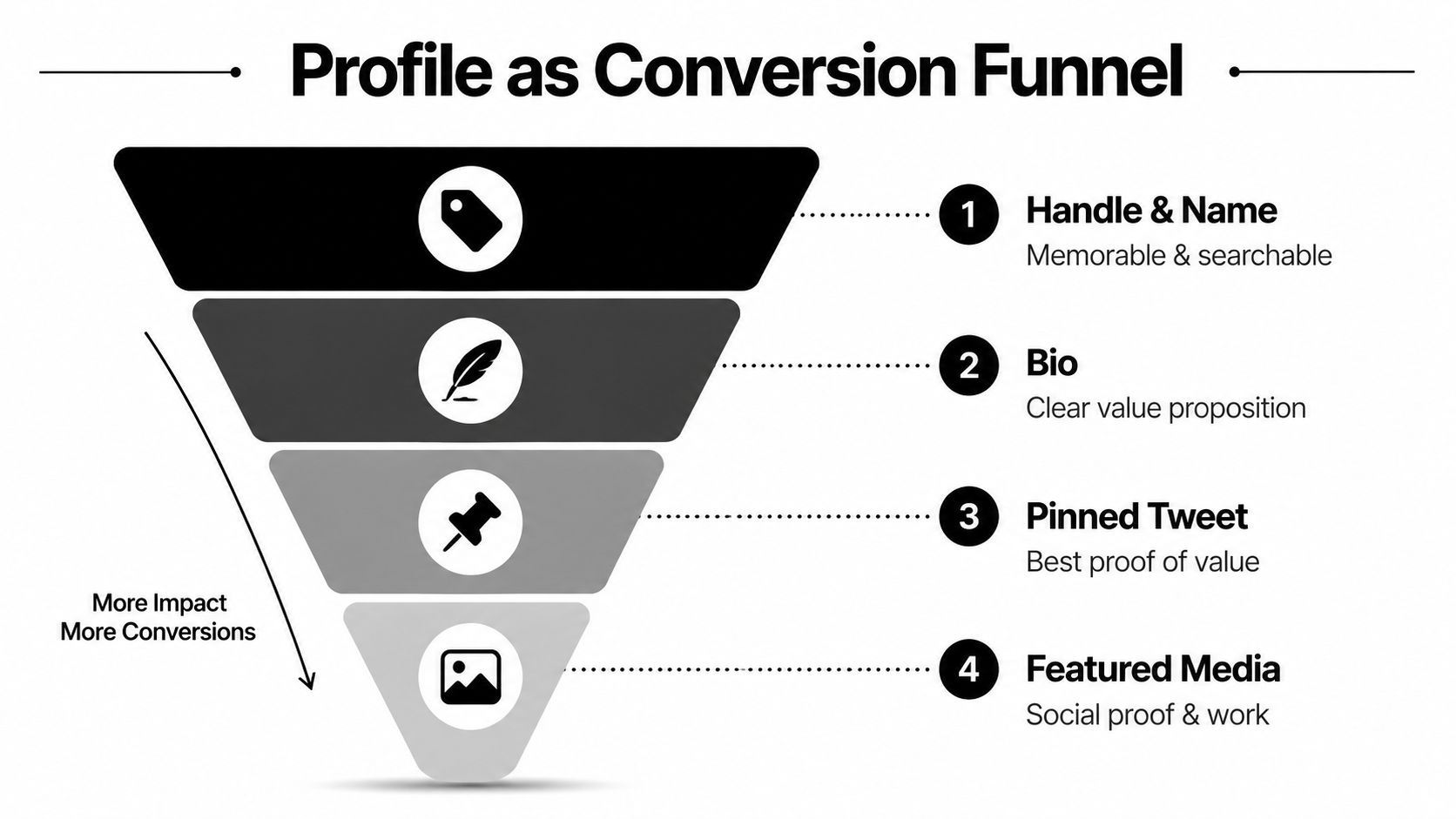
A profile audit that actually changes follow conversion
A useful indie-maker bio usually does three things, it says what you build, who it helps, and what kind of signal visitors should expect from your posts. A weak bio says you're “building in public” without explaining what the public should care about. A strong one makes the account feel like a useful feed to subscribe to.
Use this quick audit:
- Name and handle: easy to remember, easy to search, and not overloaded with symbols.
- Bio: clear niche, clear value, no vague identity talk.
- Pinned post: your strongest proof, strongest insight, or strongest offer.
- Link: one destination that matches the profile promise, not a junk drawer of options.
- Recent posts: the last few posts should look like the bio's claim is real.
The most important test is behavioral. Check whether high-performing posts convert into net new followers over a 30-day window using the follower-growth formula from the benchmark section below. If impressions are good but follows are flat, the problem isn't content alone. It's the path from post to profile to follow.
Your profile should reduce uncertainty. If a visitor has to guess what follows them, they'll leave.
For product founders, the best profiles usually feel narrow, specific, and repeatable. For creators, they feel opinionated and consistent. Either way, the profile's job is to make the next follow feel like the obvious move.
Content Formats That Drive Bookmarks and Replies
Not every tweet is designed for growth in a low-engagement environment. Some formats earn attention but almost no downstream action. Others create the exact signals that matter now, especially when bookmarks, replies, and profile visits carry more strategic value than vanity metrics.
Threads, single tweets, and quote tweets each serve a different job
Threads work when you want people to save the idea, not just skim it. The opening has to earn the click, because the first line is the gate. A strong thread hook usually promises a useful result, a sharp contrarian angle, or a concrete teardown of something people already care about.
Single tweets work better when you want replies. They should be opinionated enough that someone wants to add to them, disagree with them, or tell their own story. If a tweet can't prompt a response, it probably isn't doing much besides filling space.
Quote tweets are underrated when they contain real commentary. They're weak when they're lazy agreement, but strong when you attach an explanation, a correction, or a sharp extension of the original idea. That's often what gets people to visit your profile, because they want to know whether you always think that clearly.
Here's a simple structure that works for build-in-public threads, teardown threads, and contrarian takes:
- Hook: state the promise or tension immediately.
- Context: explain why the topic matters now.
- Evidence or steps: show the thinking, process, or example.
- Close: make the next action obvious, usually by inviting a reply or pointing to a profile visit.
Hooks that earn bookmarks instead of bounce-outs
Bookmark-worthy content tends to be specific, reusable, and dense. Generic inspiration doesn't get saved nearly as often because it doesn't help anyone later. A teardown of a SaaS onboarding page, a breakdown of a pricing mistake, or a build log with clear decisions has much more staying power.
Strong hook pattern: “I tried X so you don't have to” works only when X is specific and the takeaway is actually useful.
If you're an indie maker, your best content usually comes from the work itself. Talk about failed launches, surprising customer replies, pricing changes, onboarding fixes, and the small decisions that improved the product. Those posts feel honest because they are, and honesty is easier to trust than polished theory.
For a practical drafting workflow, a tool like ScrollLaunch's tweet generator use case can help turn rough ideas into structured drafts, but the judgment still has to be yours. The draft should sound like a person who knows the product, not a generic content machine.
Image-heavy posts can still stop the scroll, but they often underperform on depth. They're useful when the visual itself tells part of the story, like a product screenshot or a clear before-and-after. If the image is just decoration, the post may get noticed without earning the kind of engagement that compounds.
How TweetBoost Can Help
When organic growth stalls, the problem is often distribution, not just content. That's where a service like TweetBoost can be relevant, especially if you want human followers delivered through organic promotion instead of trying to force growth through posting alone. It uses a Day‑0 audit, periodic rescans, and a 30‑day comparison dashboard, so you can see whether the account is moving instead of guessing.
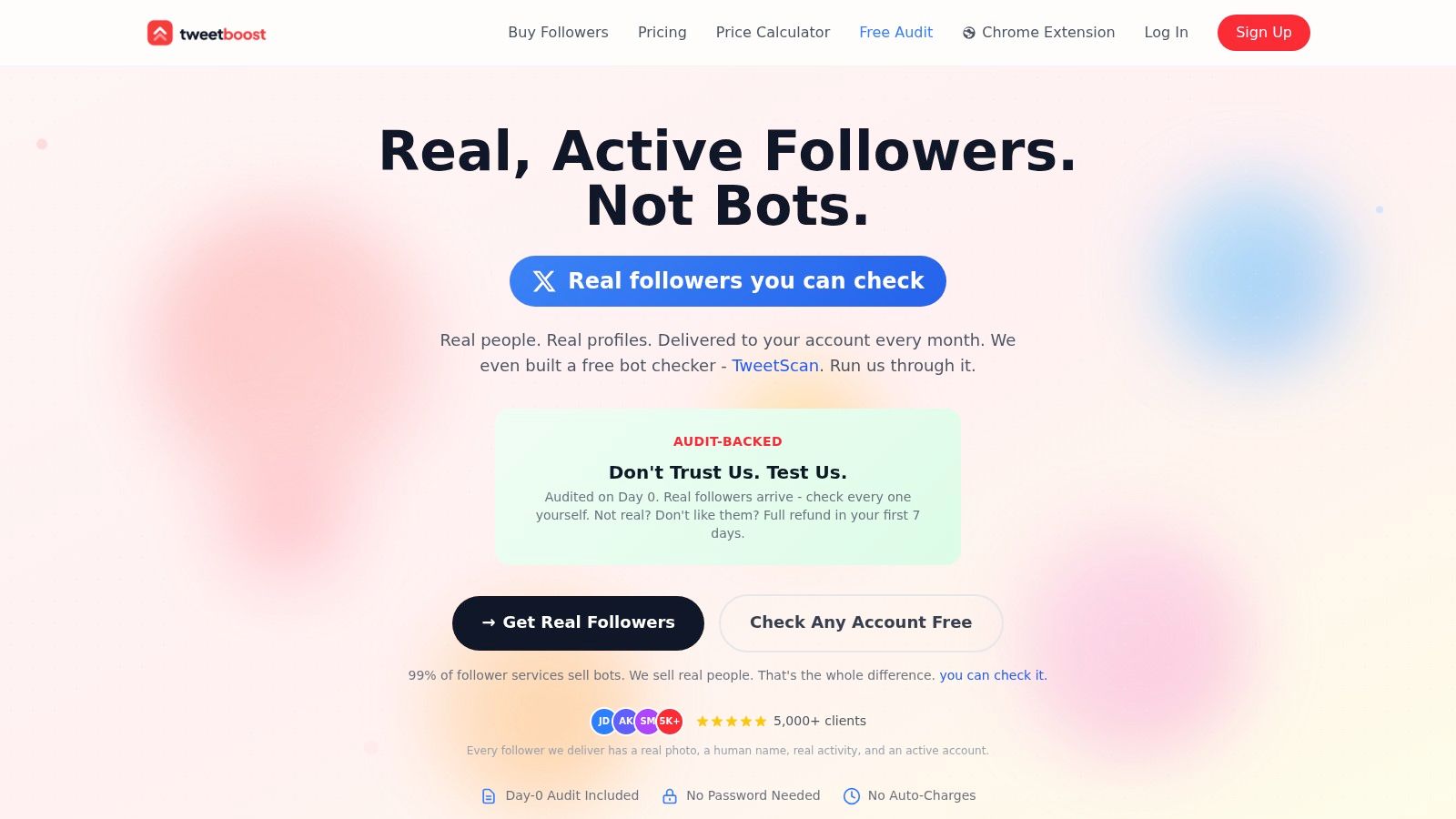
When it makes sense and what it's trying to solve
TweetBoost is built for a few common pain points. If you're worried about fake followers hurting credibility, the service says it focuses on real photos, human names, post history, and active accounts. If you've worked with growth providers before and couldn't verify what changed, its audit-first workflow and recurring rescans are designed to make results inspectable.
The service also addresses the awkward middle stage where an account needs to look established but still lacks momentum. For founders, that matters because early social proof can change how people judge the account before they follow. It may be useful if you want a steadier growth layer while you keep doing the content and reply work yourself.
There are practical constraints, too. TweetBoost says it doesn't require client passwords, doesn't use automatic renewals, and doesn't store payment cards, which lowers operational friction for users who don't want a custodial setup. It also offers tools like fake follower checks, shadowban testing, and follower count utilities, which are useful if you're trying to diagnose an account rather than just buy movement.
If you're already getting good profile visits but poor conversion, the service can complement the playbook rather than replace it. If you have no clear positioning, no useful pinned post, and no daily engagement habit, paid growth won't fix those gaps. It works best as a distribution layer for accounts that already know what they want the audience to do next.
Building a Daily Engagement System
Growth on X is still a relationship game. The difference is that relationships now have to be managed with intent, because the feed won't do the work for you. That means building a repeatable daily system instead of hoping inspiration turns into distribution.
Morning replies, midday starters, evening cleanup
The morning window should be reserved for high-signal replies under posts from larger accounts in your niche. Don't chase famous accounts outside your field, because their audience overlap is often weak. Focus on the 20 to 30 accounts whose followers resemble the people you want to reach, then reply with a useful angle, a contrary observation, or a short example from your own work.
Midday is the right time for a conversation starter from your own account. This can be a short take, a question with a real point of view, or a mini-thread that invites response. The point is to give your audience something easy to react to while your reply work is still warming up the network.
Evening should be for cleanup and community. Answer mentions, respond to thoughtful replies, and check which conversations are pulling people into your profile. That's where you'll see whether your content is attracting the right kind of attention or just attracting noise.
Collaboration plays that compound instead of distract
The highest-value collaborations are usually simple. Thread swaps, co-authored posts, and shoutout exchanges work when both accounts have overlapping audiences and a reason to trust each other. Random cross-promotion with no fit wastes attention and makes both accounts look smaller than they are.
A practical workflow helps here:
- Build a target list: 20 to 30 accounts with audience overlap and complementary expertise.
- Track reply outcomes: note which replies bring profile visits, not just likes.
- Schedule collaboration ideas: one thread swap or co-post idea per week is enough.
- Use lists, not the main feed: keep your daily targets organized so you don't disappear into random scrolling.
The broader point is that reply quality matters more than reply volume. A sharp reply under the right post can create more meaningful traffic than a dozen weak replies that nobody reads. If the reply doesn't give the reader a reason to click your name, it's just activity, not growth.
Measuring Growth with the Right Benchmarks
Vanity metrics can make a weak strategy look healthy. The better move is to track a small set of numbers that tell you whether the account is improving, especially once you're past the excitement of early posting. You want to know if your content is resonating with the right audience and whether that resonance turns into follows.
| Follower Tier | Expected Engagement Rate | Monthly Growth Baseline | Strong Growth Signal |
|---|---|---|---|
| Under 1,000 | 2% to 5% | Around 1.5% | 3%+ |
| 1,000 to 10,000 | 1% to 3% | Around 1.5% | 3%+ |
| 10,000 to 100,000 | 0.5% to 1.5% | Around 1.5% | 3%+ |
| 100,000+ | 0.1% to 1.5% | Around 1.5% | 3%+ |
Those engagement ranges come from benchmark guidance that also warns smaller accounts can look healthier than larger ones even when absolute reach is low, so size-adjusted expectations matter more than raw totals. UpGrowth's X engagement rate calculator makes that point directly. For monthly follower growth, benchmark guidance treats roughly 1.5% as a common organic baseline, with 3%+ as strong and 5%+ as exceptional, while 0.4% or below is often a warning sign of weak distribution. Social Status's growth-rate benchmark frames it that way.
The measurement stack that keeps you honest
Use the same engagement formula every week, likes plus replies plus reposts, divided by followers, times 100. Then compare posts inside the same follower band, because follower-based engagement is more stable than raw count comparisons. If a post beats the median in your size tier, it deserves another look, even if it didn't go “viral” by loose standards.
A simple weekly review is enough:
- Sort posts by engagement.
- Flag the top three by format and topic.
- Check profile visits and follows after those posts.
- Repeat the winning format with a nearby angle.
For product teams, a tool that tracks cohort performance can save time, and ScrollLaunch's freemium performance analytics use case fits that kind of monitoring approach if you want to compare content experiments against a lightweight analytics workflow. The point isn't fancy dashboards. It's seeing whether your best content is improving conversion.
If engagement rises but followers don't, the problem is usually the profile, the follow path, or the audience fit, not the post alone.
Tools, Automation, and Pitfalls to Avoid
The right tools help you stay consistent, but they can't replace judgment. Scheduling, analytics, and drafting support are useful because they remove friction, not because they create taste. If you automate too much, you'll end up with a smooth workflow around a weak strategy.
A practical stack usually has three parts. First, a scheduler for keeping cadence steady. Second, a lightweight analytics view for spotting what gets replies, profile visits, and follows. Third, a drafting aid that helps you move faster without flattening your voice.
For teams that want to keep content production moving, ScrollLaunch's AI video generator and scheduler is one option in the broader automation space, but the key rule stays the same: automate planning and publishing, not judgment or conversation. Replies, quote tweets, and relationship-building should stay human, because those are the parts followers notice most.
The mistakes that quietly kill momentum
- Overposting: too much output can dilute engagement density and make each post weaker.
- Engagement bait: cheap prompts may create activity, but they rarely build trust.
- Ignoring replies: original posts alone rarely carry growth in a crowded feed.
- Benchmarking against the wrong accounts: raw platform averages can hide the reality of your cohort.
- Skipping profile maintenance: a weak bio or pinned post wastes the traffic your content earns.
The monthly growth baseline from the benchmark section is useful here too, since roughly 1.5% is a common organic marker and 0.4% or below is a warning sign of weak distribution. That's the kind of signal that tells you whether to keep the current plan, sharpen the profile, or change the content mix. Use the number as a diagnostic, not as a vanity target.
A solid 30-day action plan is straightforward. Tighten your profile, publish a consistent mix of short takes and threads, run a daily reply system, and review the account every week against the right benchmark band. If you do that while avoiding the usual traps, you'll know whether your X growth strategy is real or just busy.
Start by auditing your profile and last 10 posts today, then commit to a 30-day reply-and-publish cycle that you can repeat. If you want a structured way to test your content and conversion setup, pick one workflow, run it for a month, and measure whether profile visits turn into follows before you add anything else.