
Most startup advice gets virtual assistants backward. Founders are told to hire one as a quick fix for overload, then hand over everything from inboxes to billing and hope coordination sorts itself out. That approach burns time, creates security risk, and often adds a layer of management work that nobody budgeted for.
The better move is to treat virtual assistants for startups as a deliberate operating choice. Decide what should be automated, what needs human judgment, and what can be delegated under tight scope. Done well, a VA doesn't replace founder effort, it protects it by taking on repeatable work, exception handling, and admin that would otherwise sit on the founder's desk.
Table of Contents
- Deciding What to Delegate and What to Automate
- Sourcing Candidates and Running Practical Interviews
- How LatHire Can Help
- Building a Secure Access and Offboarding Lifecycle
- Management Practices and KPI Tracking
- Pricing Models and the First 30 Days Workflow
Deciding What to Delegate and What to Automate
The first mistake is assuming every task is equally suitable for a human assistant. It isn't. If a workflow is rule-based and stable, automation should usually get first look. If the work changes constantly, affects customers directly, or requires judgment under uncertainty, human ownership still matters.
Use task volatility as the first filter
Task volatility tells you how often the work breaks, shifts, or needs context. Inbox triage, calendar coordination, CRM enrichment, research formatting, and invoice preparation usually follow patterns, which makes them good candidates for documented delegation. By contrast, customer escalations, product feedback interpretation, fundraising communications, and access to billing or administrator controls carry enough sensitivity that the founder should stay involved.
Practical rule: If a task can be described as a sequence of steps with few exceptions, automate it first. If the task depends on judgment, context, or damage control, assign it to a human with clear boundaries.
That distinction matters because AI-enabled tools now cover more routine admin than they used to. A human assistant is most valuable where automation breaks, where quality control matters, or where a response needs tone, discretion, or context. For startups, the point isn't to have a generalist touch every system. It's to create a narrow operator role that handles exceptions cleanly.
A simple decision matrix helps. Score each task on volatility, customer impact, confidentiality, and required judgment. If the work is low-volatility, low-impact, and easy to document, automation wins. If it's high-impact or high-judgment, keep it in the human lane, but keep the lane narrow.
Define the role before you post it
A good VA scope for a startup is often smaller than founders expect. The role should be explicit about what's in bounds and what stays with the founder. That clarity reduces back-and-forth, avoids accidental overreach, and gives the assistant a stable operating surface.
Many teams overspend coordination time here. They hire a generalist, then use them as a catch-all for every loose end. The result is more Slack pings, more review cycles, and more hidden context switching than the founder had before.
A tighter scope usually works better:
- Automate first for repeatable workflows like form routing, calendar sync, and status updates.
- Delegate to a human for vendor follow-ups, research compilation, and lead list cleanup.
- Keep founder-owned anything tied to pricing, billing permissions, escalation handling, or investor communication.
When you're mapping that scope, a useful outside reference is this workflow lens on automating business operations with AI. It's most helpful when you want to separate systems work from human judgment instead of treating them as interchangeable.
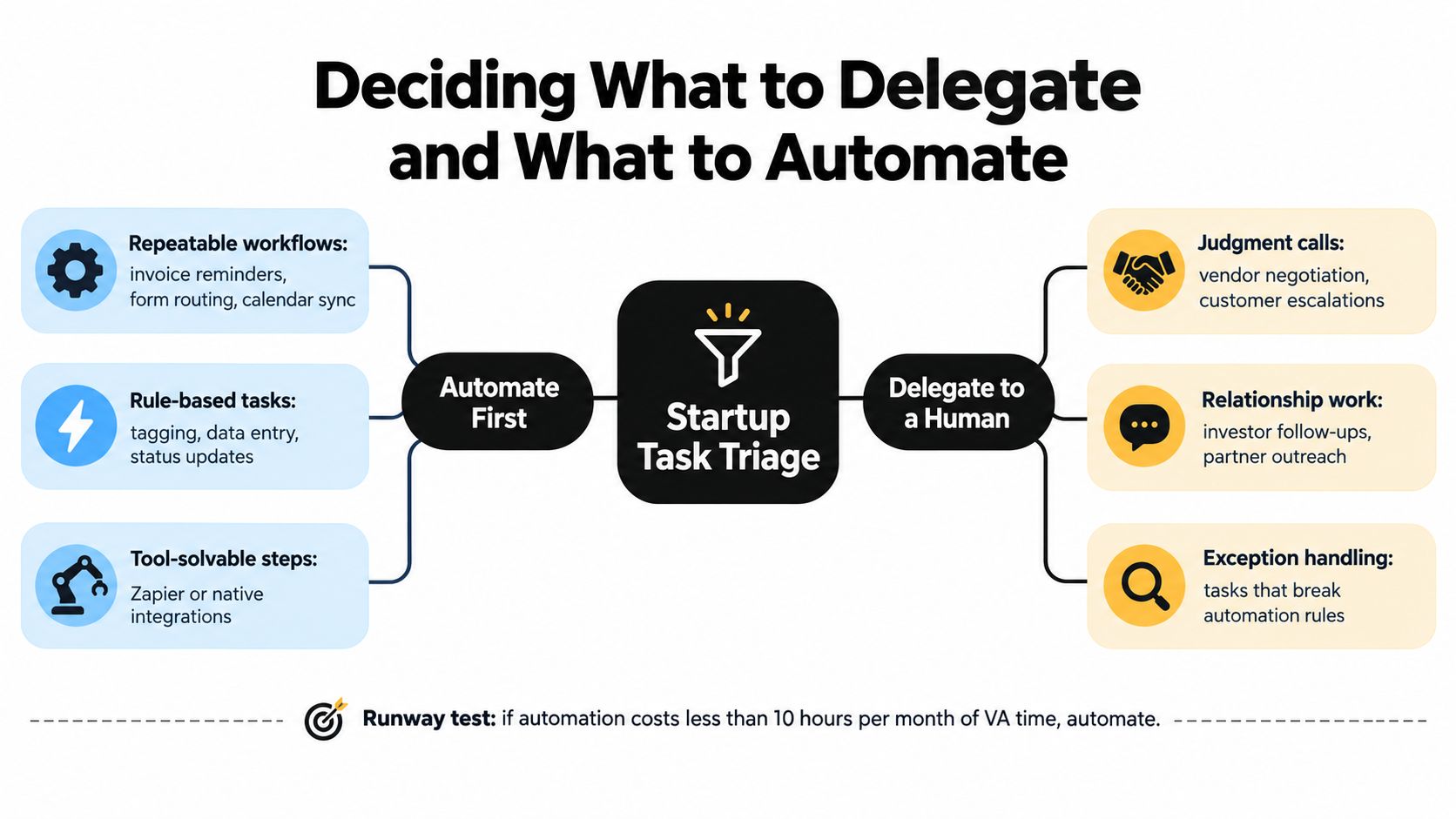
The strongest startup setups use a VA as an exception-handler, not a full-stack replacement for the founder. That framing keeps the role useful even as AI tools improve. It also makes the delegation decision reversible, which is what early-stage teams need most.
Sourcing Candidates and Running Practical Interviews
Strong sourcing starts with one hard truth. A startup VA is not a corporate admin in a prettier wrapper. The best candidates usually like ambiguity, write clearly, and don't panic when the process changes halfway through the week. Your job description should say that out loud.
Write for operators, not order takers
A lot of job posts attract people who want rigid instructions because the language sounds tidy and safe. Startups need the opposite. Call out that the environment is fast-changing, that priorities will shift, and that the assistant will be expected to flag edge cases instead of pretending certainty.
That wording acts as a filter. Candidates who need a fixed playbook every time will self-select out. Candidates who enjoy lightweight structure, fast feedback, and practical ownership will stay in the funnel.
Include the systems you use, such as Notion, Slack, Google Workspace, HubSpot, Airtable, or ClickUp. Name the kinds of work that matter, like scheduling, CRM hygiene, research cleanup, support routing, or follow-up tracking. The more concrete the scope, the better the signal.
A useful benchmark for where to look is the same one you'd use for any remote operator search, including niche startup communities and specialized agencies. If you want an example of how agencies position startup support roles, this software engineer staffing agency page is a decent reminder that specificity beats broad outreach.
Interview for output, not charm
Abstract interviews produce polished nonsense. Practical tests show how someone works. Give candidates a paid micro-project that mirrors real work, then judge the output, not just the conversation.
A strong test might ask the candidate to research a short list of prospects, format the findings into a CRM-style structure, and note any gaps or assumptions. That single task reveals more than twenty minutes of interview talk because it shows how they organize information, ask clarifying questions, and handle ambiguity.
Look for three things:
- Accuracy under constraints, meaning they follow the format you asked for without needing repeated correction.
- Communication style, meaning they explain trade-offs clearly and don't hide uncertainty.
- Resourcefulness, meaning they solve the small problems without turning every detail back to you.
Keep the test short and paid. You're not outsourcing a project, you're observing work habits. If they can't finish a small, real task cleanly, they won't become easier after onboarding.
Don't hire for the story they tell about themselves. Hire for the way they handle one specific task when the instructions aren't perfect.
The interview itself should stay practical. Ask what they do when a task conflicts with a process. Ask how they document recurring work. Ask how they escalate problems. Those answers matter more than fluency with buzzwords because they show whether the assistant can operate in a startup environment where the playbook changes often.
If the candidate passes the test, use the debrief to check how they think. Ask what they'd improve in the workflow. Good operators usually spot friction immediately, and they'll tell you where a process is brittle before you do.
How LatHire Can Help
LatHire is useful when the hiring problem is bigger than your bandwidth. It connects US and Canadian companies with pre-vetted Latin American professionals across technology, marketing, sales, and operations, which can make sense when you need startup-ready support without building a long sourcing pipeline from scratch. The platform's appeal is less about “finding a VA” and more about compressing the search, screening, and cross-border admin that usually slow founders down.
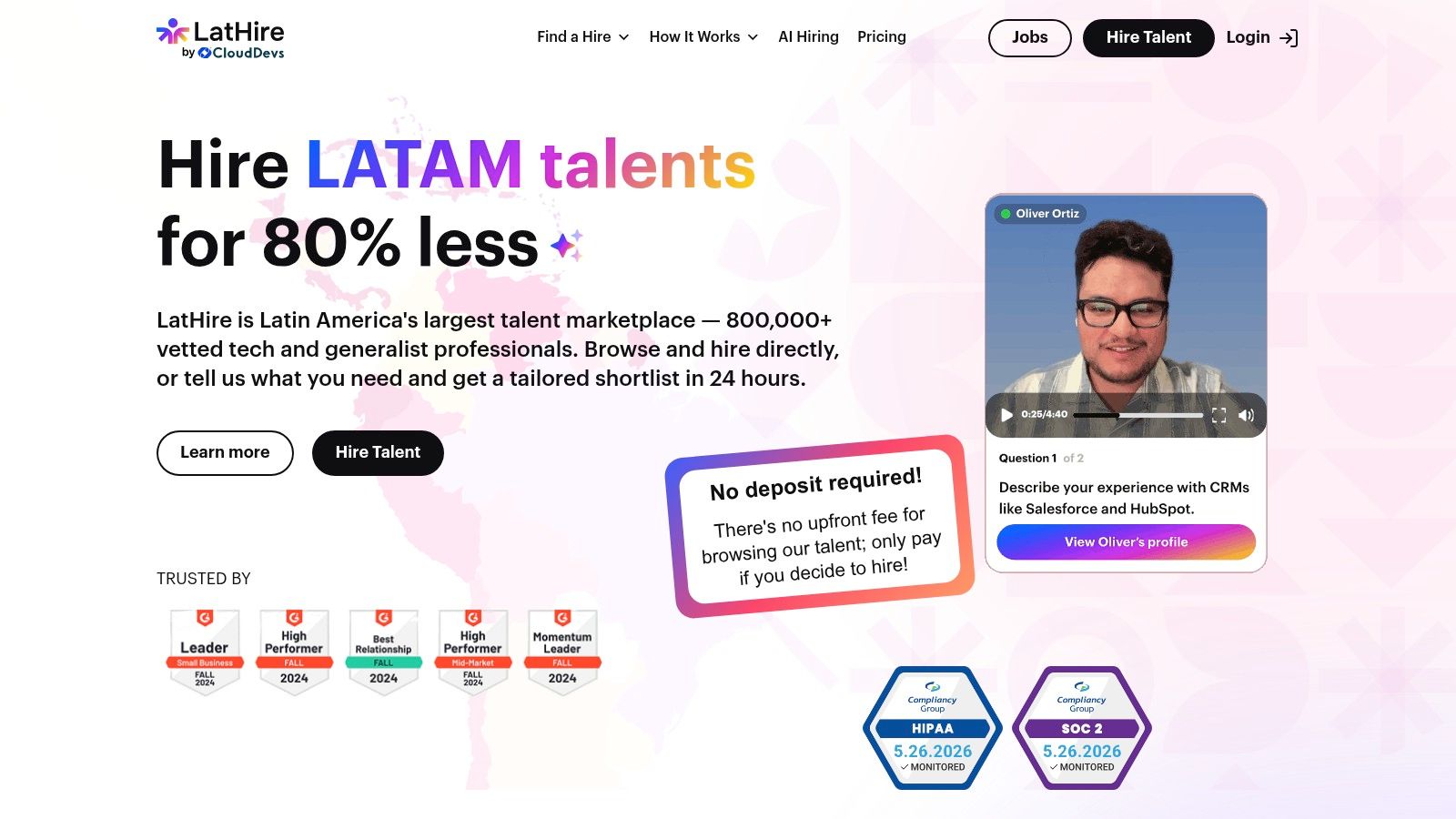
For founders comparing options, the main value is operational efficiency. LatHire says it can import an existing job description or generate one with AI, match candidates quickly, and support HR, international payroll, benefits, and legal compliance. That matters most if you're hiring across borders and want fewer moving parts in the background.
The other useful angle is talent breadth. If your need is a generalist assistant today and a more specialized operator later, a platform with a broad candidate pool can reduce churn in the search process. The linked resource on virtual assistants is worth a look if you want to compare that hiring model against sourcing independently.
The right fit is a startup that wants speed, remote collaboration, and less administrative drag around hiring. The wrong fit is a team that hasn't defined scope yet. A platform can't fix vague delegation, but it can shorten the path once the role is clear.
Building a Secure Access and Offboarding Lifecycle
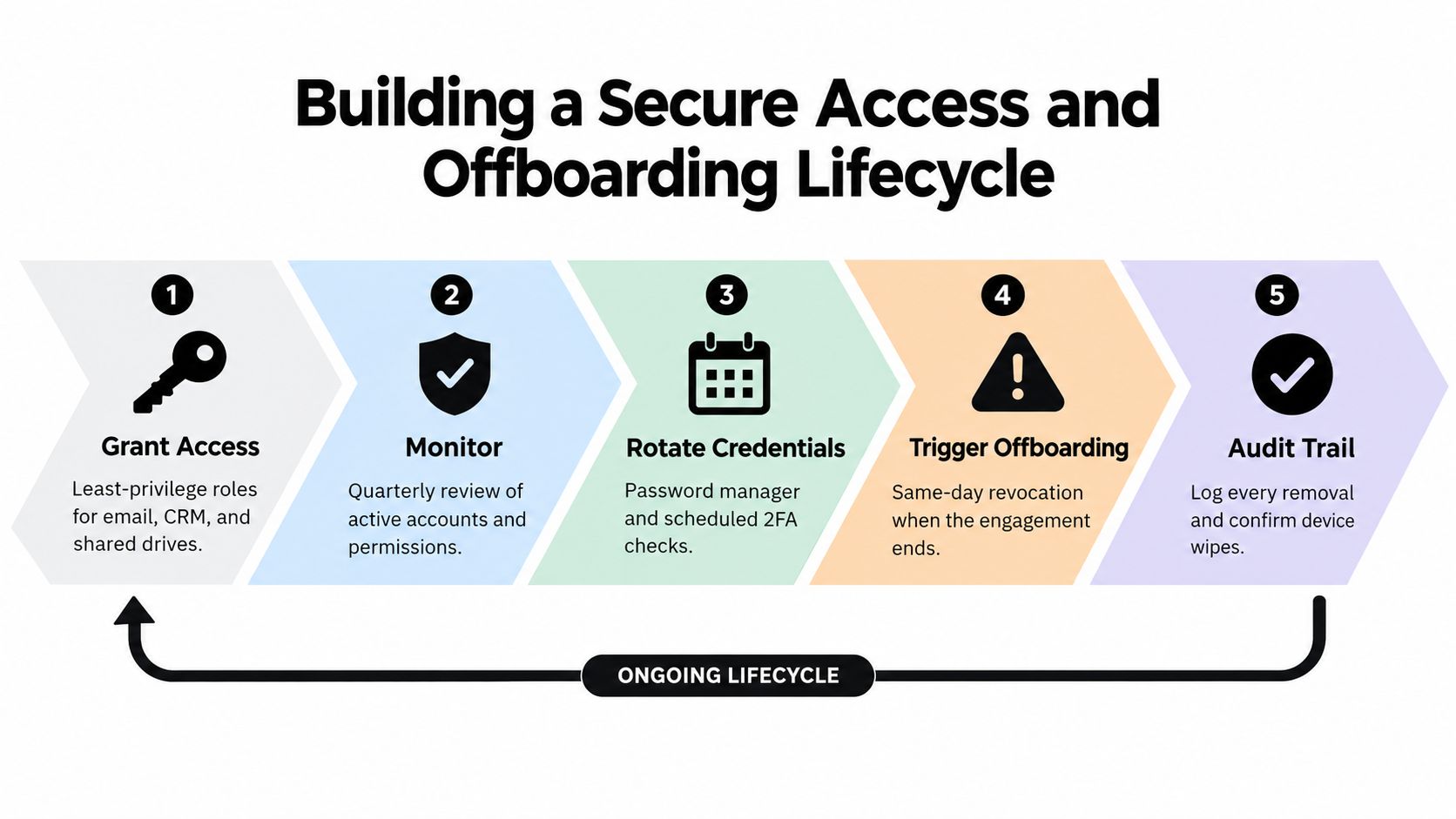
A virtual assistant often needs access to email, calendars, CRM records, support tickets, and financial tools. That kind of access is convenient, but it also widens the attack surface quickly. A single compromised account can expose enough of your operations to cause real damage, so access control must be treated as an ongoing lifecycle with scheduled reviews and verifiable offboarding steps.
Start with least privilege, then keep tightening it
The safest setup is an individual identity for every assistant, no shared founder logins, and permissions that match the actual task list instead of the org chart. If someone handles scheduling and CRM updates, they should not have billing access or admin rights in unrelated systems. A password manager with approved sharing can handle credentials without exposing the founder's personal account.
MFA should be on by default for every system the assistant touches. That is the baseline. Access still needs periodic review, because roles change, temporary permissions linger, and old access often survives after the work no longer needs it.
Trust is not a security control. Narrow access is.
Startup teams do not need enterprise tooling to stay disciplined. They do need a written rule for who approves access, how it is logged, and what gets reviewed. A lightweight access register in Notion, Airtable, or even a well-maintained spreadsheet is better than memory. For a practical reference on web security best practices for startup teams, the same principle shows up across access control, credential handling, and review discipline.
Make offboarding same-day and verifiable
Offboarding fails when teams treat it like admin work instead of a risk event. The moment the engagement ends, permissions should be revoked, shared secrets rotated, and any device access removed. If the assistant handled sensitive systems, log the removal and confirm that every access point was closed.
The same discipline applies to data handling. Ordinary confidential information is one thing, regulated data is another. If the assistant touches data with legal or contractual retention obligations, the startup needs a proper data-processing agreement, clear subcontractor terms, retention rules, and a breach notification process that someone can reliably execute.
For a practical lens on access controls and sensitive workloads, this guide on HIPAA-compliant virtual assistants is a useful reminder that permissions, logging, and revocation matter more than assumptions about trust. Even if you are not in healthcare, the lifecycle approach still applies.
Management Practices and KPI Tracking
Hiring a VA only works if the management system stays lighter than the hours you're getting back. The trap is obvious. Founders save time on admin, then spend it all on repeated instructions, status chasing, and fixing inconsistent output. Good management turns the assistant into a reliable operator, not another inbox.
SOPs should be built by the person doing the work
The fastest way to create useful standard operating procedures is to have the assistant document them while they work. Loom videos, Notion pages, and short checklists are enough for most startup tasks. The value isn't the tool, it's the habit of making the process visible before it becomes tribal knowledge.
A simple SOP should capture the trigger, the exact steps, the tools involved, and what counts as done. That's usually enough for scheduling, research formatting, lead updates, invoice prep, and support routing. If the task has recurring exceptions, the SOP should list the exception path too.
When the founder becomes the only reviewer, bottlenecks appear fast. Work piles up waiting for approval, and the assistant starts guessing instead of executing. A better rhythm is asynchronous review with a predictable weekly sync for edge cases, process changes, and priority shifts.
Rule of thumb: if the assistant keeps asking the same question twice, the SOP is too vague or the feedback loop is too slow.
Track outcomes, not just activity
Task completion is not the same as value. A VA can be busy all day and still not move the business forward. Outcome-based tracking is more honest because it focuses on whether the work helped the founder regain time, reduced errors, or improved response quality.
A practical KPI matrix for startup VA work looks like this:
| Task Category | Delegation Level | Primary KPI |
|---|---|---|
| Inbox triage | High | Response-time improvement |
| Calendar coordination | High | Founder hours returned |
| CRM enrichment | Medium | Error cost reduction |
| Research formatting | Medium | Time saved per deliverable |
| Customer follow-up routing | High | Missed-request reduction |
| Invoice preparation | Medium | Exception rate |
The point of the table isn't to turn management into surveillance. It's to make expectations visible. If a task category creates too many corrections, the scope is too broad or the process is too loose.
The best teams also track a softer metric, whether the founder is still the bottleneck. If every task needs a founder decision before it moves, the VA isn't really operating yet. They're just waiting.
Pricing Models and the First 30 Days Workflow
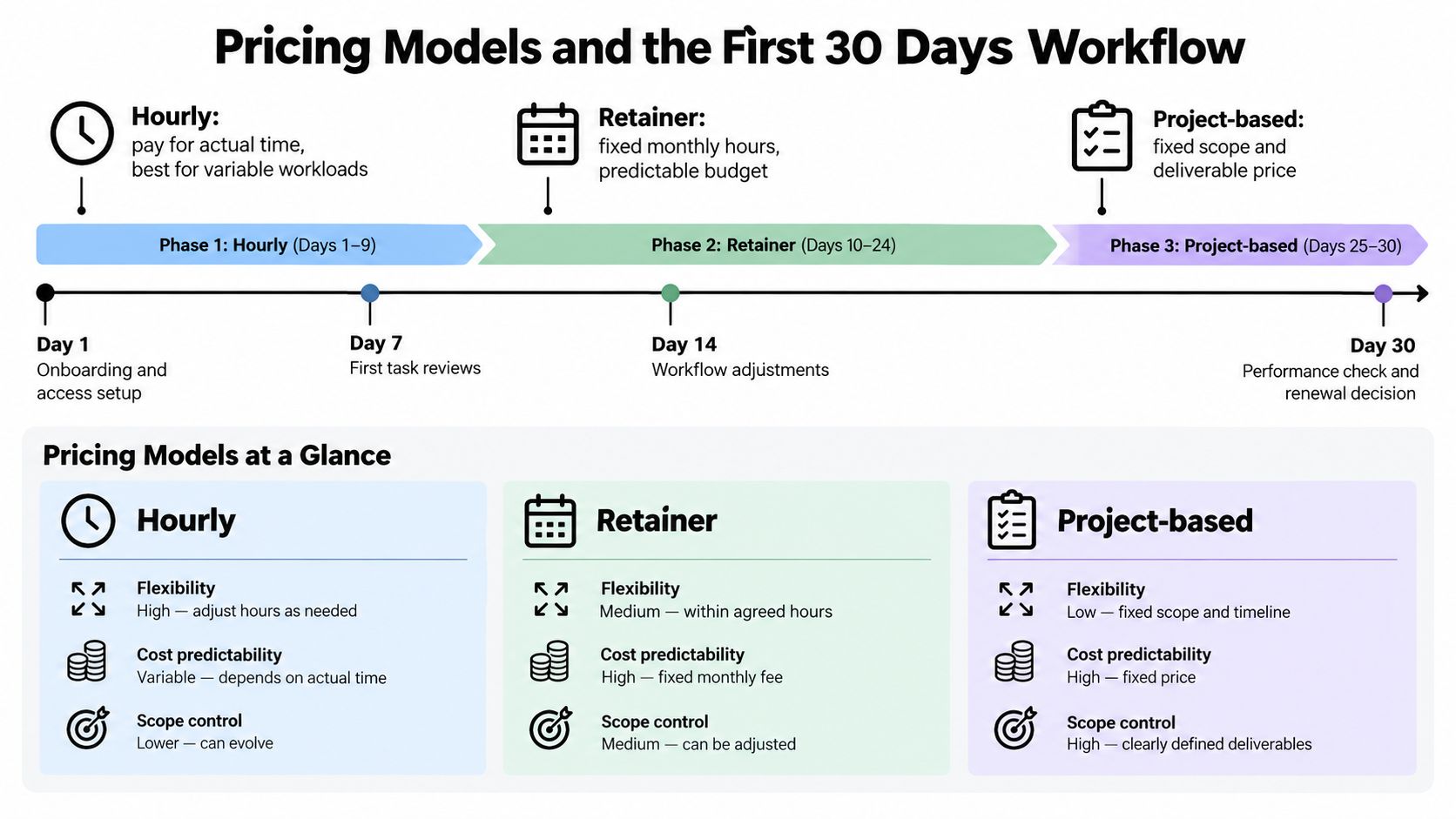
Pricing should match task predictability. Hourly works when the workload shifts a lot or the scope is still unclear. Retainers fit stable ongoing support where a monthly rhythm is easier to manage. Project-based pricing makes sense for a fixed deliverable with a clean beginning and end.
Choose the model that matches the work
Hourly pricing is usually the least committal and the easiest to start with. It's useful when you're still testing fit or when the work changes too often to estimate cleanly. Retainers are better once you know the workload pattern, because they create a predictable budget and a steadier working relationship.
Project-based pricing is different again. It works when the output can be defined in advance, like a migration, a research package, or a documentation sprint. The mistake is forcing a project structure onto ongoing admin, or using hourly work for something that really needs a clear deliverable.
The first month should be a ramp, not a sink-or-swim test. Day one is access setup and context. The first week is supervised execution. By the middle of the month, the assistant should own a few narrow tasks independently. By the end of the month, you should know whether the scope, rhythm, and communication style fit.
A practical workflow looks like this:
- Kickoff and context, define scope, tools, escalation paths, and what not to touch.
- Access provisioning, grant only the systems needed for the initial task set.
- First independent task, assign something small but real, then review the output.
- Workflow adjustment, tighten the SOP, remove friction, and clarify edge cases.
- Month-end review, decide whether to expand scope, keep it steady, or stop.
If you want a broader view of how distributed work changed the operating model for startups, the shift described in the evolution of virtual assistance into a global workforce model makes the point clearly. The bigger lesson is that flexible, digitally coordinated labor isn't a side trend anymore, it's part of how lean teams operate.
The strongest startup use of a VA is never just “cheap help.” It's a controlled way to buy back founder time, reduce operational noise, and build a remote operating style that can scale without bloated headcount. If you're ready to put that system in place, publish the role with a narrow scope, test with real work, and then review it like a product process. If you're also distributing content, launches, or SEO assets around the same startup motion, ScrollLaunch can help you keep that visibility work organized without adding more operational sprawl.