
You're staring at a roadmap that won't move until you fill the backend seat, and your best two engineers just got an offer they can't ignore. The product team wants dates, finance wants predictability, and your recruiters are forwarding profiles that look fine until you read them closely. That's usually the moment people start shopping for a software engineer staffing agency.
That's the wrong frame. This isn't a vendor beauty contest, it's a workflow design problem. If your intake is vague, your feedback is slow, and your hiring manager won't own retention, even a strong agency will look mediocre. If you fix the process, a good agency can compress hiring pain, reduce churn, and keep your roadmap from slipping into chaos.
Table of Contents
- Why the Right Software Engineer Staffing Agency Matters
- How Software Engineer Staffing Agencies Actually Operate
- Vetting Checklist for Picking the Right Agency
- How TekRecruiter Can Help
- Pricing Models and Hidden Costs in Agency Contracts
- Choosing the Right Engagement Model for Distributed Teams
- Onboarding Engineers and Tracking Agency Performance
- When to Stay, When to Switch, and Alternatives to Consider
Why the Right Software Engineer Staffing Agency Matters
A VP of Engineering doesn't usually call an agency because they love outsourcing. They call because two backend developers left, a release is slipping, and the remaining team is carrying production, feature work, and on-call at the same time. At that point, the question isn't “Which firm has the flashiest pitch?” It's “Which partner can run a disciplined hiring workflow without creating more drag?”
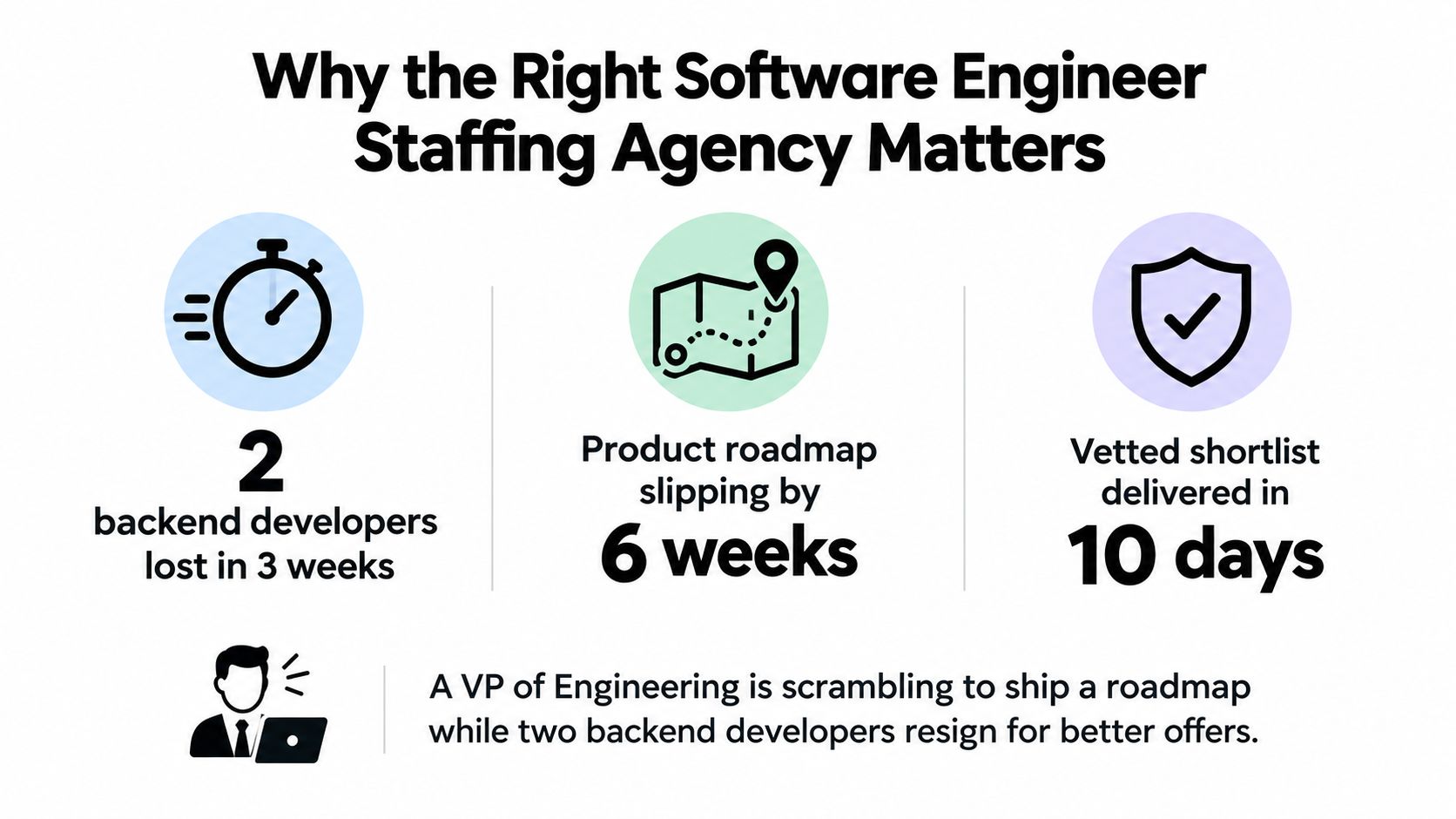
A strong agency matters because engineering hiring is still tied to a large staffing ecosystem. In the U.S. staffing industry, companies employed an average of 2.4 million temporary and contract workers per week in 2023, and they hired 12.7 million temporary and contract employees over the full year, with annual sales of about $142.4 billion (WorkStaff staffing industry statistics). That scale matters because software hiring often runs through contract placements, contract-to-hire, and project-based assignments, not just direct hire.
The real problem is process, not access
The wrong agency makes churn worse. It sends résumé-heavy candidates, drags its feet on feedback, and lets weak screening hide behind a polished first call. The right agency gives you a pre-vetted shortlist, a structured interview flow, and a clean handoff into onboarding so the team can get back to building.
Practical rule: don't evaluate an agency only on candidate volume. Evaluate it on how well it enforces discipline on both sides of the table.
You also need to think about credibility. If you keep missing hires, your team starts treating recruiting as noise. If you overpromise and underdeliver, leadership stops believing you have the hiring system under control. A good agency protects your reputation by making the process tighter, faster, and more predictable.
Pick the model before you pick the vendor
The market also isn't one thing. Some agencies are built for permanent search, some for contract staffing, some for contract-to-hire, and some for global engineering pods. The first decision is operational, not brand-driven. Decide whether you need direct hire, contract capacity, or a hybrid arrangement, then evaluate agencies that are built for that motion.
That's the lens to use for the rest of this process. Once you see agency selection as workflow design, the next question becomes much sharper, and much easier to answer.
How Software Engineer Staffing Agencies Actually Operate
A software engineer staffing agency should work like a controlled pipeline, not a résumé dump. If the agency can't show you the handoffs, artifacts, and timing at each stage, you're buying hope, not hiring support. The best firms make their process visible because they know the process is the product.
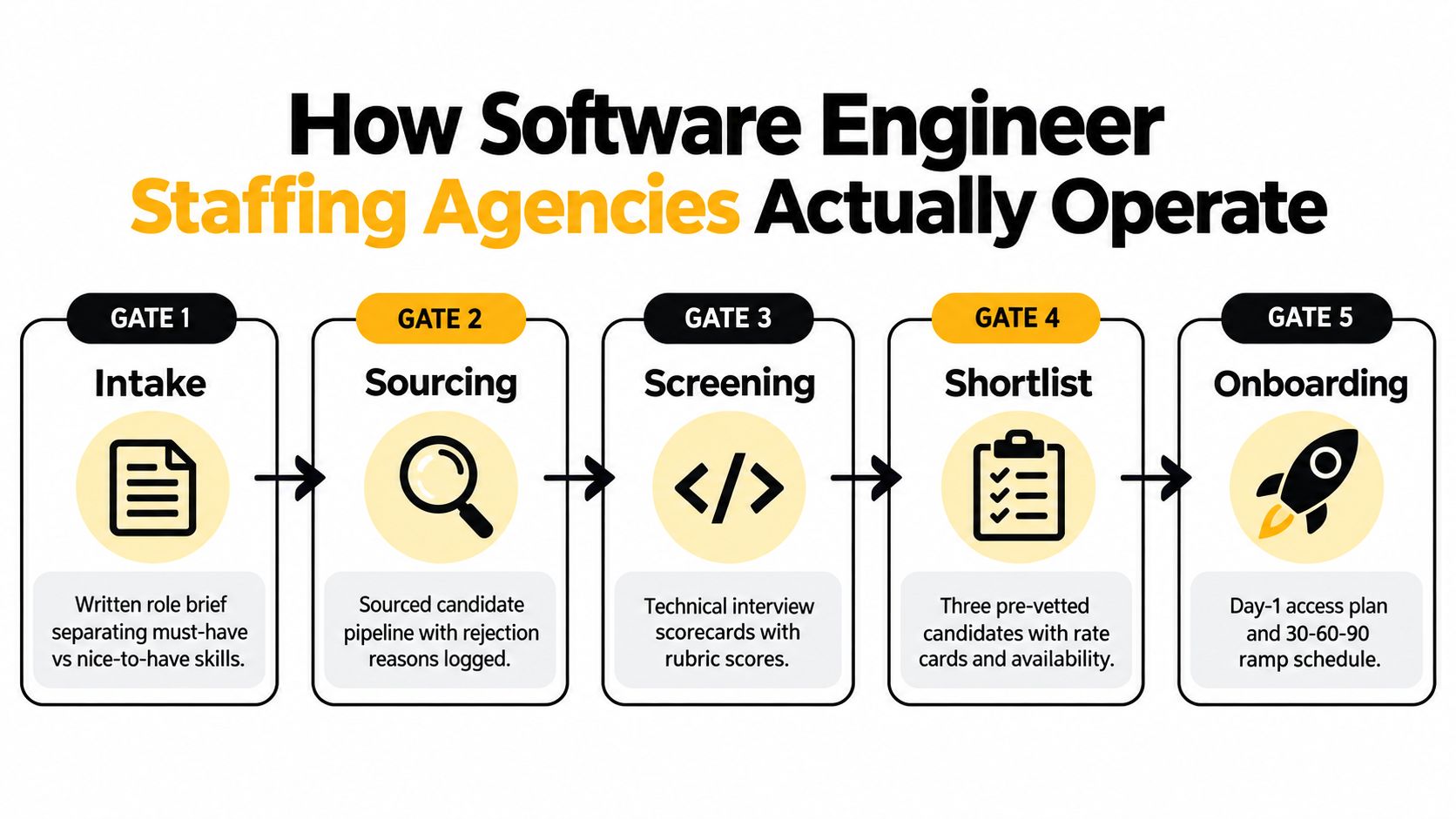
Intake should end with a written role brief
The first deliverable you should demand is a written role brief. It needs to separate must-have skills from nice-to-haves, define the team context, and lock compensation expectations before sourcing starts. If an agency takes a vague request and starts sending candidates anyway, it's already failing you.
A solid intake also protects the hiring manager from late surprises. It forces the agency to translate “need a senior backend engineer” into something the market can respond to, like language stack, systems scope, production ownership, and seniority signals. You want the agency to commit in writing, not improvise from memory.
Sourcing should come with a real channel mix
Once intake is set, the agency should explain where it's looking and why. That means more than saying “our network.” You want to see whether it's using referrals, inbound candidates, outbound search, or regional pipelines, and you want a target slate size tied to the role's difficulty.
The sourced pipeline should also include rejection reasons. If candidates are being ruled out for salary, seniority mismatch, or missing architecture depth, you need to know that early. Otherwise the agency will keep pushing the same type of wrong profile and call it momentum.
Screening needs proof, not vibes
Screening should be documented and repeatable. A legitimate partner will show you the rubric behind the technical evaluation, the coding assessment, and the reference check criteria. It shouldn't be a recruiter's personal opinion wrapped in confident language.
For specialized engineering roles, the agency should already be operating inside the kind of structured funnel described in the research. That means competency matrices, work samples, anchored scoring, and behavioral interviews rather than informal chats (Cogn-IQ technical hiring guidance). If the agency can't explain how it measures quality, assume quality is the least controlled part of its process.
Interview coordination should be tightly managed
The strongest agencies don't just schedule interviews. They manage the interview matrix, distribute debrief templates, and enforce a feedback SLA. If your panel takes a week to respond, you're training candidates to disappear.
The agency can help or hurt your close rate. A good one keeps the client honest, makes the next step obvious, and prevents internal delay from turning a strong search into a stale one.
Offer and onboarding are part of the same system
A lot of agencies stop caring once the offer is accepted. That's a mistake. Offer stage should include background verification, notice-period planning, and a simple success plan for the first 30, 60, and 90 days. If the agency doesn't stay involved here, it's not managing the full workflow.
The operating cycle for a specialized engineering search should be treated as a multi-week process, not an instant placement. Recruiting benchmarks put technical-role time-to-fill around 45 to 60 days (recruiting metrics and KPIs), which is why any agency promising magic should raise suspicion. Good process beats frantic promises every time.
Vetting Checklist for Picking the Right Agency
You should score the agency before you ever score the candidates. Otherwise you end up judging output without testing the machine that produced it. I'd treat this as a two-sided audit, one half focused on the agency, the other on your own readiness.
| Dimension | Agency Must Prove | Client Must Provide |
|---|---|---|
| Domain specialization | Evidence of real engineering placements in your role family | Clear role scope and business context |
| Tech-stack depth | Recruiters who understand the stack beyond keywords | Accurate must-have and nice-to-have skills |
| Candidate quality | A repeatable technical screening process | A defined evaluation panel |
| Replacement guarantee | Written terms with a real clock and conditions | Fast feedback and decision-making |
| Time-to-fill discipline | Historical search cadence, not vague optimism | Signed-off compensation band |
| Reference depth | Similar-stage clients and similar stack examples | Named sponsor with budget authority |
| Interview-to-offer ratio | A credible funnel view | Consistent scorecards |
| Retention outcomes | 6- and 12-month retention signals | A retention plan and manager ownership |
| IP and confidentiality | Strong clauses in the MSA | Security expectations and access controls |
| Coverage and insurance | The right protection for your risk profile | Timely legal review |
The agency-side list is straightforward. Ask for proof of specialization, not broad claims. Ask how it screens for quality, how it handles replacements, and how it measures whether its placements stick. If the answers sound promotional instead of operational, keep looking.
Don't ignore your own readiness
Most failed searches aren't caused by weak sourcing. They die because the client side is messy. If your team can't define the role, won't commit to a feedback timeline, or keeps changing the compensation band after sourcing starts, even a strong agency will burn time.
Hard truth: an agency can't fix an undefined job, a split hiring committee, or a hiring manager who won't decide.
Use the same logic you'd use when evaluating a product development partner. The question isn't whether the external team is talented. It's whether both sides can run a clean operating model. If your internal process is sloppy, you're not ready for a premium agency, you're ready for process cleanup. For a useful parallel on how external delivery should be framed, see this product development agency guide.
A simple scorecard beats a gut feeling
Give each dimension a yes, maybe, or no. Anything with too many maybes means the agency is not ready, or your intake isn't. That's how you avoid picking a firm because its sales deck looked polished.
The biggest mistake buyers make is confusing responsiveness with rigor. A recruiter who answers quickly but can't explain screening is not a good partner. A recruiter who asks uncomfortable questions about your role, your pay band, and your decision process usually is.
How TekRecruiter Can Help
TekRecruiter is a useful fit when you want a partner that understands both engineering talent and the operating reality around it. The firm says it focuses on tech and engineering talent, including software engineers, product owners, GTM engineers, and technical account executives, with a structure that supports direct hire, contract-to-hire, staff augmentation, nearshore hiring, executive search, and supplier search. That breadth matters if your staffing need isn't one-dimensional.
Its founder-led engineering background is also relevant. A staffing agency built by someone who understands how software teams work tends to ask better questions about architecture, ownership, and execution. That doesn't make it the right agency for every company, but it does mean the conversation is more likely to stay grounded in real hiring needs than in keyword matching.
For buyers who want a resource to compare their own process against a technical staffing model, TekRecruiter also publishes a guide on software engineer staffing agency. Use that kind of material as a signal, not a substitute for diligence. The key test is whether the firm can align sourcing, screening, and client-side workflow without hiding behind generic recruiting language.
If you're hiring for AI-heavy, cloud-heavy, or product-critical roles, the value is simple. You want recruiters who can talk to engineers like engineers and still keep the search moving. That combination is rare enough to matter.
Pricing Models and Hidden Costs in Agency Contracts
Agency pricing looks simple until you read the MSA line by line. The headline number is only part of the story. What moves your total cost is the structure around that number, especially when you add compliance, replacement terms, and conversion language.
| Fee Model | Client Pays | Payment Timing | Best For |
|---|---|---|---|
| Contingency | Percentage of salary on hire | After acceptance | Standard direct-hire searches |
| Retained | Upfront retainer plus balance | In stages | Senior or confidential searches |
| Contract hourly markup | Hourly bill rate above worker pay | Ongoing during assignment | Flexible capacity and project work |
| Managed service T&M | Time and materials plus KPI layer | Ongoing with service terms | Multi-role or outsourced delivery |
Know what drives the real bill
A contract engineer billed at a clean-looking hourly rate can still become expensive once employer-side costs are layered in. Benefits, payroll handling, equipment, time off, and compliance overhead all show up somewhere, even if they're not prominent in the pitch. That's why the “cheap” option often isn't cheap once the engagement runs for more than a few weeks.
The same logic applies to conversion fees. If the agency charges one fee for placement and another fee if you want to convert the contractor to full-time, you may be paying twice for the same person. Ask for the conversion language before you sign, not after you've trained the hire.
The clauses that matter most
A replacement guarantee sounds comforting until you read the clock. Thirty days is not the same as ninety days, and the difference matters when a complex role needs time to reveal whether the fit is real. Non-solicit windows can also box you in longer than you expect, especially if the agency's language covers people, teams, or adjacent channels.
IP assignment deserves the same attention. If the contract isn't explicit, your legal team ends up cleaning up after a recruiting problem. Make sure the MSA covers who owns what, when ownership transfers, and how confidential work is handled across the engagement.
Ask for itemization, not just a rate
Use this script. “Break out the fee by service, show the conversion terms in writing, and list any replacement, onboarding, compliance, or non-solicit costs separately.” If the agency resists that request, it's not protecting simplicity, it's protecting margin.
For a deeper look at how agencies bundle services and structure fees, compare the pricing guidance in this pricing model breakdown. The point isn't to chase the cheapest quote. It's to understand what you're buying before you commit.
Choosing the Right Engagement Model for Distributed Teams
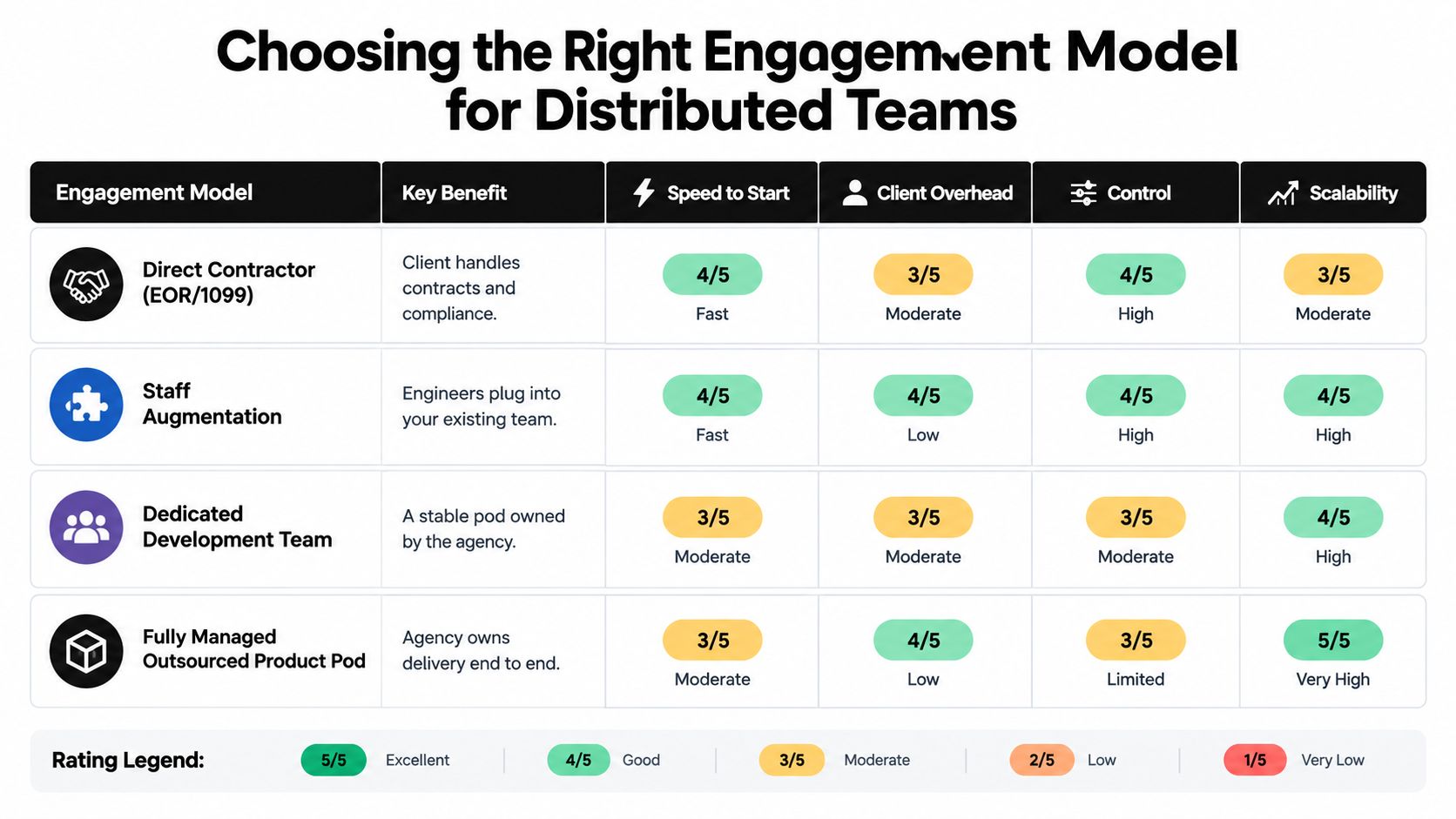
Distributed engineering hiring fails when the engagement model doesn't match the work. A role that needs daily product ownership, security access, and close architecture review should not be handled the same way as a loosely scoped project pod. Decide on control, compliance, and speed first, then choose the model.
Four models, four different trade-offs
A direct contractor arrangement gives you control, but it puts more compliance burden on your side. Staff augmentation plugs engineers into your team while keeping them on the agency side of the relationship. A dedicated development team works better when you want a stable pod. A fully managed outsourced product pod makes sense when you care more about outcome than day-to-day control.
The AI-era validation gap makes this more important, not less. A candidate who looks good in a take-home task may still fall apart in live collaboration, especially if they lean too heavily on AI tools without being able to explain trade-offs. Live pairing, reference triangulation, and explicit rules about permitted AI assistance need to be part of the SOW, not an afterthought.
Choose based on the risk in the work
If the role is customer-facing, security-sensitive, or highly integrated with your core product, keep more control in-house. If the work is well-scoped and the delivery expectations are clear, a managed pod can be efficient. If you need speed and flexibility, staff augmentation is usually the least disruptive path.
A lot of teams choose the wrong model because they're really solving for staffing pain, not delivery design. That's a mistake. The best model is the one that matches your product risk, your internal engineering bench, and your ability to manage external talent without confusion.
Onboarding Engineers and Tracking Agency Performance
A hire isn't done when the offer is signed. It's done when the engineer can work without friction, the manager trusts the output, and the agency has proven it can support the transition. That's why onboarding and vendor measurement belong in the same conversation.
Treat the first 90 days as the real test
Day 0 should be about access. If the engineer doesn't have the tools, permissions, and context they need early, you've already wasted the first week. Day 1 to Day 30 should center on a shared 30-60-90 scorecard, not vague optimism.
By Day 31 to Day 60, you want weekly feedback moving fast enough to correct course. By Day 61 to Day 90, you should know whether the person is ramping, whether the role description was accurate, and whether the staffing partner delivered the right profile. The agency's job doesn't end at placement; it ends when the new hire becomes productive.
Measure the agency like an internal funnel
Track source quality, interview-to-offer ratio, time-to-fill, and retention. Track hiring-manager satisfaction too, because a recruiter can hit activity metrics and still produce bad fits. If your 90-day retention starts slipping, that's not a minor blip, it's a signal to review the agency's screening and your own intake.
Useful standard: if early retention gets weak, don't argue about impressions. Pull the scorecards, look at the role brief, and inspect where the calibration broke.
You should also turn vendor performance into contract pull. If feedback is consistently late or candidate quality keeps missing the mark, the agency should feel that in the service terms, not just in a frustrated quarterly call. A staffing partner that can't sustain process quality isn't a partner, it's a short-term workaround.
Build the retention plan before the start date
Good onboarding includes a written retention plan. That means compensation awareness, meaningful growth work, and clear triggers for counter-offer risk. If the engineer lands in a role with no trajectory, the agency's replacement guarantee may become your only defense.
The insight is simple. Treat the agency relationship as a repeatable operating system, not a one-time transaction. Once you do that, measurement becomes practical instead of emotional.
When to Stay, When to Switch, and Alternatives to Consider
Every agency relationship should have a quarterly review cadence. If you don't schedule one, renewal day becomes the first time anyone admits the search quality has drifted. That's too late.
Watch for the signals before the numbers break
If offer acceptance starts falling, if retention weakens, or if time-to-fill keeps creeping beyond the agreed SLA, the relationship deserves a hard look. So do softer signs, like recruiters who stop remembering your stack or account managers who only reappear when the contract is up. Those are usually the early symptoms of a stale partnership.
The alternatives are real, and they should be judged using the same lens. Internal talent acquisition gives you control, but it takes time to build. Embedded recruiting partners can be useful when you need temporary capacity without a full agency relationship. Contractor platforms are fast for short-term needs. Employer-of-record providers help when international hiring brings legal and payroll complexity. University pipelines are slow, but they can build long-term supply.
Use the right channel for the right job
| Channel | Time to First Hire | Avg. Cost per Hire | Control Over Process | Best Use Case |
|---|---|---|---|---|
| Agency | Moderate | Medium to high | Shared | Specialized searches |
| Internal talent acquisition | Slow to start | Lower after build-out | High | Ongoing hiring volume |
| Embedded recruiting partner | Moderate | Medium | Moderate | Team extension |
| Contractor platform | Fast | Variable | Moderate | Short-term capacity |
| Employer of record | Moderate | Higher due to compliance layer | Moderate | Cross-border hiring |
| University pipeline | Slow | Lower over time | High | Early-career talent |
If you're not sure whether to renew, use a 30-60-90 switch protocol. Keep the current pipeline alive for 30 days, cross-train the next channel for 60, and fully transition sourcing, scorecards, and candidate notes by 90. That protects continuity and avoids starting from zero.
For teams that prefer a simpler productized route, HeyDevJob is worth comparing against agency-led sourcing if your hiring motion is still early and you want a lower-lift discovery path. The point isn't loyalty to any one channel. It's matching the channel to the work without pretending all hiring problems are the same.
The best staffing setup is the one that fits your operating reality, not the one with the smoothest sales pitch. If your agency can't keep pace with your stack, your feedback discipline, and your retention expectations, switch. If it can, keep it and make the relationship tighter.
If you're sorting out a hiring push right now, don't start by asking for more résumés. Start by fixing your intake, your feedback SLA, and your scorecard. Then compare agencies against the workflow you actually want, not the one they wish you had. If you're also publishing hiring content or launch pages, ScrollLaunch can help you get that material indexed and discovered while you keep your recruiting system under control.